
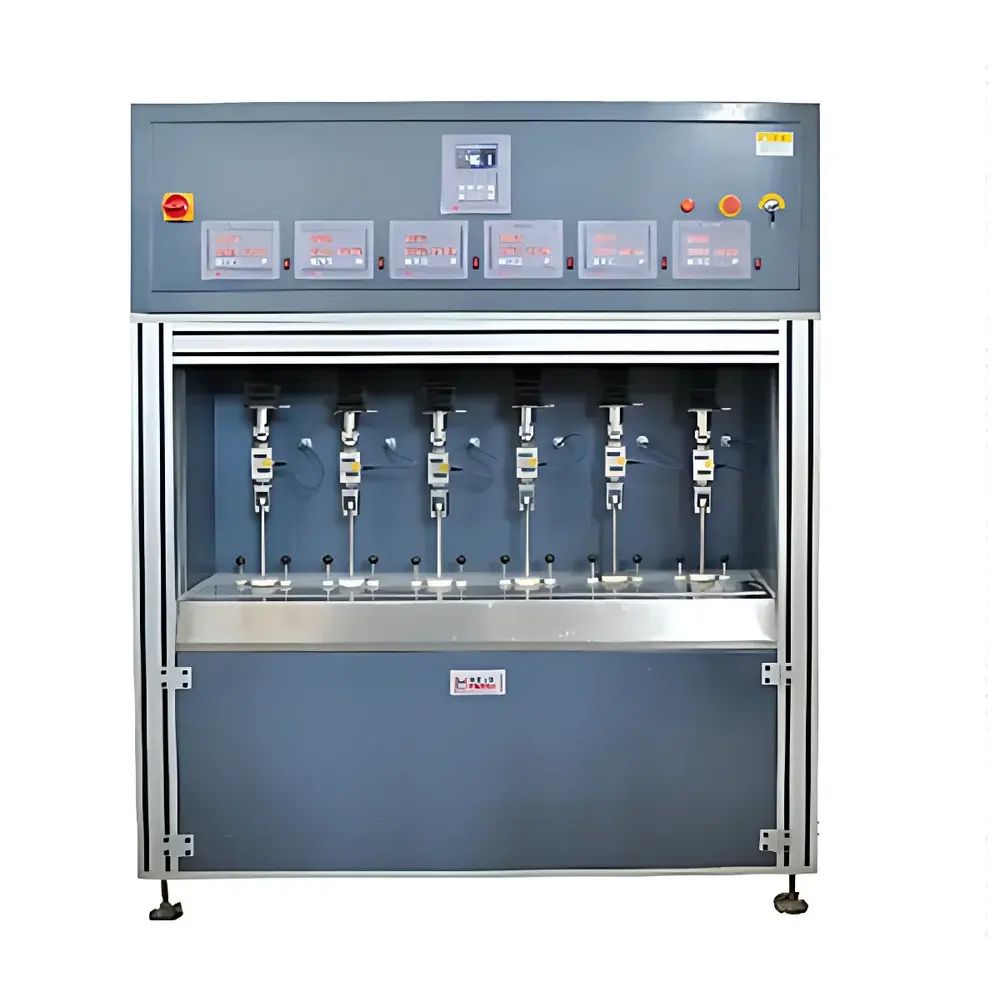
Hengyi HY(FNCT)0220 Full-Notch Creep Tensile Tester
| Brand | Hengyi |
|---|---|
| Origin | Shanghai, China |
| Manufacturer Type | Direct Manufacturer |
| Region of Origin | Domestic (China) |
| Model | HY(FNCT)0220YUB |
| Pricing | Upon Request |
| Test Stations | 6 or 12 independent stations |
| Control Method | PC-based closed-loop control |
| Effective Load Range | 20 N – 5000 N |
| Load Accuracy | ±0.5% FS |
| Creep Displacement Range | 0–200 mm |
| Temperature Control Accuracy | ±0.5 °C |
| Power Supply | 380 V AC |
Overview
The Hengyi HY(FNCT)0220 Full-Notch Creep Tensile Tester is an engineered solution for evaluating environmental stress cracking (ESC) resistance in thermoplastic polymers—particularly polyethylene (PE)—under sustained tensile loading in controlled thermal or chemical environments. Based on the principle of constant-load uniaxial creep deformation, the instrument applies a precisely regulated static force to pre-notched specimens immersed in a thermostatically stabilized bath (typically water or surfactant solutions), enabling measurement of time-to-failure under defined stress conditions. This methodology directly implements standardized test protocols including GB/T 32682–2016, ISO 16770, and ASTM D5397 (adapted), making it essential for PE pipe compound qualification, material development, and regulatory compliance in piping systems manufacturing.
Key Features
- Six or twelve fully independent test stations—each equipped with electromechanical load application, real-time displacement feedback, and isolated thermal coupling—eliminate cross-station interference and support parallel multi-condition testing.
- High-fidelity load control architecture delivers ±0.5% full-scale accuracy across the 20–5000 N range, ensuring traceable stress application per ISO 16770 Annex A requirements.
- Integrated thermostatic water bath system maintains temperature stability within ±0.5 °C over extended durations (up to 10,000 hours), critical for reproducible ESC kinetics assessment.
- Modular elastic support structure decouples mechanical vibration from adjacent stations, preserving measurement integrity during long-term creep observation.
- Comprehensive self-diagnostic routines monitor load cell drift, thermal gradient deviation, and actuator positioning—triggering automatic fault logging and safe shutdown if thresholds are exceeded.
Sample Compatibility & Compliance
The HY(FNCT)0220 accommodates standard FNCT specimens per GB/T 32682–2016 (10 mm × 4 mm × 4 mm with 1.5 mm full-depth notch) and ISO 16770 (Type A geometry). It supports both solid-sheet and extruded pipe specimens (cut into flat strips), enabling evaluation of extrusion-grade PE resins, HDPE pressure pipe compounds, and recycled polymer blends. The system complies with multiple international standards: GB/T 15820 (creep rupture of plastics), GB/T 11546 (creep behavior determination), ISO 3501 (tensile testing of rigid plastics), and ISO 16770 (FNCT method for PE). All test execution, data capture, and report generation adhere to GLP-aligned practices—including audit-trail-enabled software logging, user-access controls, and timestamped raw-data archiving—supporting FDA 21 CFR Part 11 readiness when configured with validated software modules.
Software & Data Management
The proprietary PC-based control suite operates in English and Chinese interfaces and provides full lifecycle test management: parameter configuration, real-time monitoring (load vs. time, displacement vs. time, stress vs. failure time), automated pass/fail classification per user-defined criteria, and export-ready reporting (CSV, PDF, XLSX). Raw datasets include synchronized timestamps, calibrated load/displacement values, bath temperature logs, and event markers (e.g., specimen fracture detection). Data files are stored with SHA-256 checksums and support hierarchical folder-based archiving compliant with ISO/IEC 17025 documentation requirements. Optional IQ/OQ documentation packages and electronic signature workflows are available for GMP-regulated laboratories.
Applications
- Environmental stress cracking resistance validation of PE 100 and PE 100-RC materials for gas/water distribution pipelines.
- Accelerated aging studies comparing antioxidant package efficacy under elevated temperature and surfactant exposure.
- Quality control screening of incoming resin batches against internal ESC performance specifications.
- Research into crack initiation mechanisms in semi-crystalline polymers using time–temperature superposition (TTS) analysis.
- Supporting ISO 4427 and EN 12201 certification testing for PE pipe manufacturers seeking CE marking.
FAQ
What standards does the HY(FNCT)0220 explicitly support?
It natively implements GB/T 32682–2016, ISO 16770, GB/T 15820, GB/T 11546, and ISO 3501. Custom protocol scripting allows adaptation to ASTM D5397 and ISO 22317 upon request.
Can the system operate without a water bath?
No—the FNCT method requires immersion in a temperature-controlled liquid medium; optional bath configurations include deionized water, Igepal CO-630 solutions, or custom solvent blends.
Is remote monitoring supported?
Yes—via secure TCP/IP interface, authorized users can view live station status, receive email/SMS alerts on test completion or anomalies, and access archived datasets through role-based web portals.
What maintenance intervals are recommended?
Load cell recalibration every 12 months, bath fluid replacement every 6 months (or per usage log), and annual verification of thermal uniformity across all stations using NIST-traceable PT100 probes.
Does the system meet electromagnetic compatibility (EMC) requirements for EU deployment?
Yes—certified to EN 61326-1:2013 (industrial environment) and CE-marked with Declaration of Conformity supplied.



