
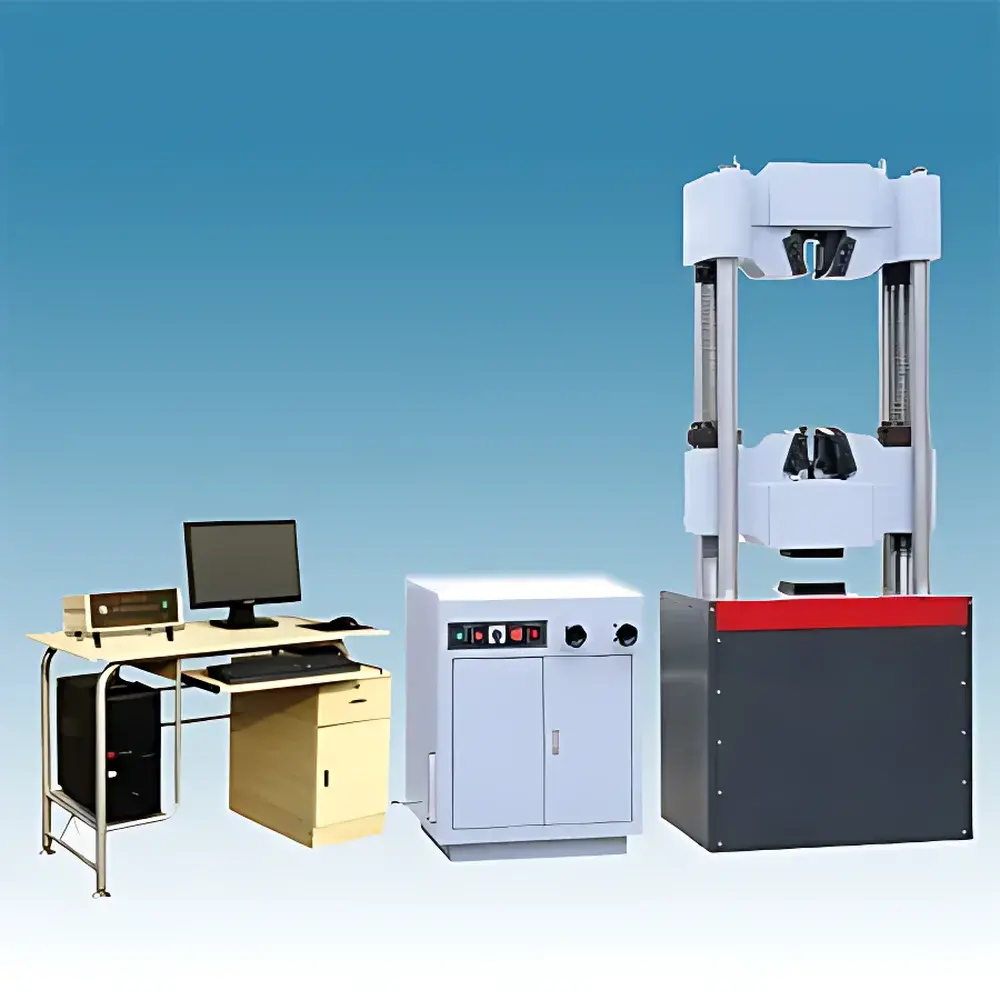
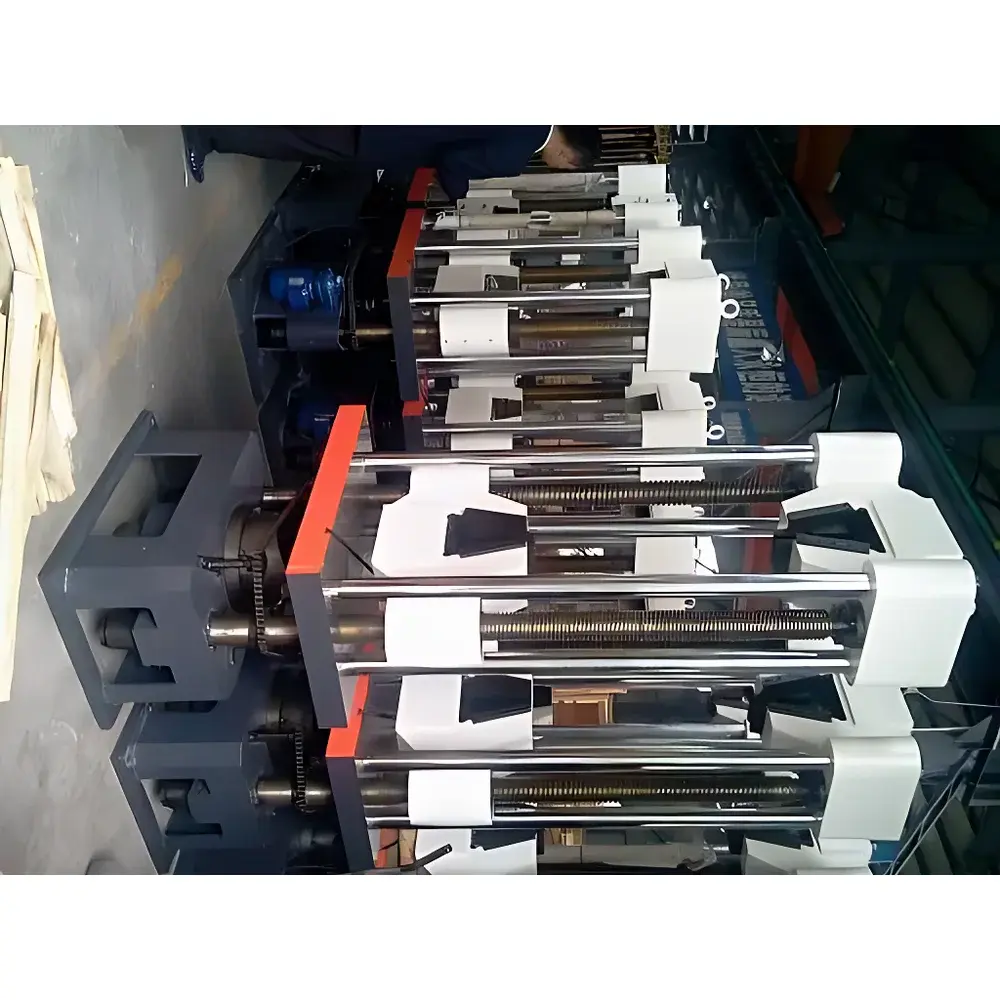
Hengyi HY(WE)100060 Electro-Hydraulic Servo Universal Testing Machine
| Brand | Hengyi |
|---|---|
| Origin | Shanghai, China |
| Manufacturer Type | Direct Manufacturer |
| Country of Origin | China |
| Model | HY(WE)100060TYHHTY |
| Instrument Type | Electro-Hydraulic Servo Universal Testing Machine |
| Maximum Load Capacity | 1000 kN |
| Load Measurement Accuracy | ±0.5% FS |
| Displacement Resolution | ≤0.5% FS |
| Compression Test Space | 600 mm |
| Tensile Test Space | 600 mm |
| Round Specimen Grip Range | Φ20–Φ60 mm |
| Flat Specimen Thickness Capacity | 0–40 mm |
| Piston Stroke | 150 mm |
| Bending Support Span Adjustment | 100–600 mm |
| Shear Specimen Diameter | Φ10 mm |
| Strain Measurement Accuracy | ±0.5% of reading |
| Stress Rate Control Range | 1–60 N/mm²/s |
| Strain Rate Control Range | 0.00025–0.0025 s⁻¹ |
| Closed-Loop Control Accuracy (Force/Displacement/Strain) | ±1% of setpoint |
| Overall Dimensions (W×D×H) | 880 × 580 × 2860 mm |
| Motor Power | 1.5 kW, 3-phase |
| Weight | 3500 kg |
Overview
The Hengyi HY(WE)100060 Electro-Hydraulic Servo Universal Testing Machine is a high-capacity, dual-actuation testing system engineered for precision mechanical characterization of structural and engineering materials under quasi-static loading conditions. Based on the Couette-type hydraulic actuation principle with electro-hydraulic servo control, the machine delivers stable, programmable force application across tension, compression, bending, and shear configurations. Its oil-cylinder-down architecture ensures optimal rigidity and thermal stability during extended test cycles—critical for ASTM E4, ISO 7500-1, and GB/T 228.1 compliant metal tensile testing. Designed for laboratories requiring full traceability and regulatory readiness, the system supports GLP-compliant audit trails, automatic calibration logging, and dual-channel synchronized data acquisition (load + displacement or strain).
Key Features
- 1000 kN maximum load capacity with ±0.5% full-scale accuracy per ISO 7500-1 Class 1 certification requirements
- Electro-hydraulic proportional servo control enabling precise stress-rate (1–60 N/mm²/s) and strain-rate (0.00025–0.0025 s⁻¹) regulation
- Dual closed-loop control modes: force-controlled, displacement-controlled, and strain-controlled—with ±1% setpoint accuracy in all modes
- Integrated high-precision load cell and optical encoder-based displacement measurement, both auto-calibrated and range-switching
- Adjustable test space: 600 mm tensile clearance and 600 mm compression height, optimized for standard and custom specimen geometries
- Grip versatility: self-aligning wedge-action clamps for round specimens (Φ20–Φ60 mm) and flat specimens (0–40 mm thickness)
- Bending fixture support span continuously adjustable from 100 mm to 600 mm, compatible with ASTM E290 and ISO 7438 standards
- Shear testing capability via dedicated Φ10 mm punch-and-die assembly, aligned to ISO 3785 methodology
- Robust cast-iron frame with four-column vertical guidance system and reinforced crosshead structure for minimal deflection under peak load
- 1.5 kW three-phase motor driving a high-efficiency axial-piston pump, ensuring low-noise, low-heat operation over sustained duty cycles
Sample Compatibility & Compliance
The HY(WE)100060 accommodates metallic alloys (steel, aluminum, titanium), cementitious composites (concrete, mortar), thermoplastics (PP, ABS, PC), and fiber-reinforced polymers within standardized specimen dimensions. Its mechanical architecture satisfies ISO 7500-1 Class 1 verification criteria for static load measurement systems and complies with the structural integrity requirements of ASTM E1012 for alignment validation. All software-generated reports include embedded metadata required for FDA 21 CFR Part 11 compliance—including electronic signatures, time-stamped audit logs, and immutable result archives. The system supports user-defined test protocols conforming to ISO 6892-1 (tensile), ISO 14577 (instrumented indentation), ASTM C39 (concrete compression), and GB/T 228.1 (Chinese national standard for metallic materials).
Software & Data Management
Control and analysis are performed via Hengyi’s native Windows-based software suite, fully localized in English and compliant with IEC 62304 Class B software safety standards. The interface provides real-time dual-axis plotting (force vs. displacement, stress vs. strain), multi-curve overlay, region-of-interest zoom, and derivative-based yield point detection (ReH, ReL, Rp0.2). Automated parameter extraction includes ultimate tensile strength (Rm), yield strength (ReH/ReL/Rp0.2), Young’s modulus (E), elongation at break (A), and reduction of area (Z). Raw data exports to CSV, Excel, and XML formats; PDF reports embed digital signatures, calibration certificates, and environmental condition tags (temperature/humidity timestamps). All data transactions are logged with timestamped user IDs and action types—enabling full forensic reconstruction for GMP/GLP audits.
Applications
- Mechanical property validation of structural steel grades per EN 10025 and ASTM A615
- Compression testing of precast concrete elements under ISO 4108 and ASTM C39
- High-force tensile evaluation of wind turbine blade root joints and composite spar caps
- Quasi-static shear characterization of adhesive bonds in aerospace assemblies (ASTM D1002)
- Creep and relaxation testing under constant load or displacement hold conditions
- Calibration reference for secondary force standards in metrology labs (traceable to NIM, China)
- Teaching and research applications in university materials science departments requiring ISO/IEC 17025-aligned instrumentation
FAQ
Is the system compatible with third-party extensometers or strain gauges?
Yes—the system features analog and digital input channels supporting industry-standard LVDTs, clip-on extensometers (e.g., Zwick Roell 1000 series), and 10 V/V full-bridge strain gauge signal conditioning modules.
Does the software support automated batch testing with pass/fail logic?
Yes—test sequences can be scripted with conditional branching, tolerance-based acceptance criteria, and auto-generated non-conformance flags linked to LIMS integration via OPC UA.
What maintenance intervals are recommended for hydraulic fluid and filter replacement?
Hydraulic oil must be replaced every 2,000 operating hours or biannually, whichever occurs first; high-efficiency return-line filters require replacement every 1,000 hours, with pressure-drop monitoring integrated into the control dashboard.
Can the machine be upgraded to meet ASTM E23 for impact testing?
No—this is a quasi-static electro-hydraulic servo platform. Impact testing requires separate pendulum or drop-weight systems compliant with ASTM E23 or ISO 148; however, the HY(WE)100060 may serve as a preload station in hybrid dynamic-static test setups.
Is remote diagnostics and firmware update supported?
Yes—via secure TLS 1.2 encrypted Ethernet connection, with role-based access control and firmware version rollback capability for validation continuity.



