
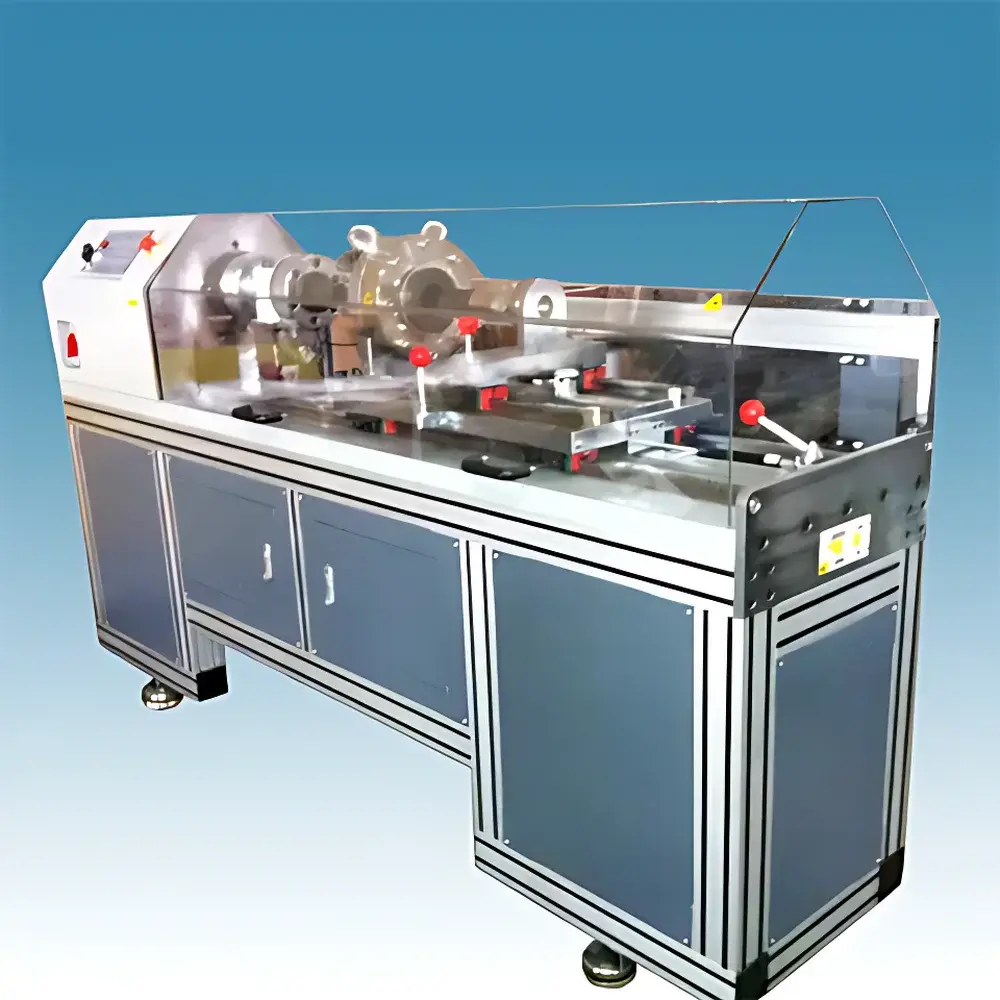
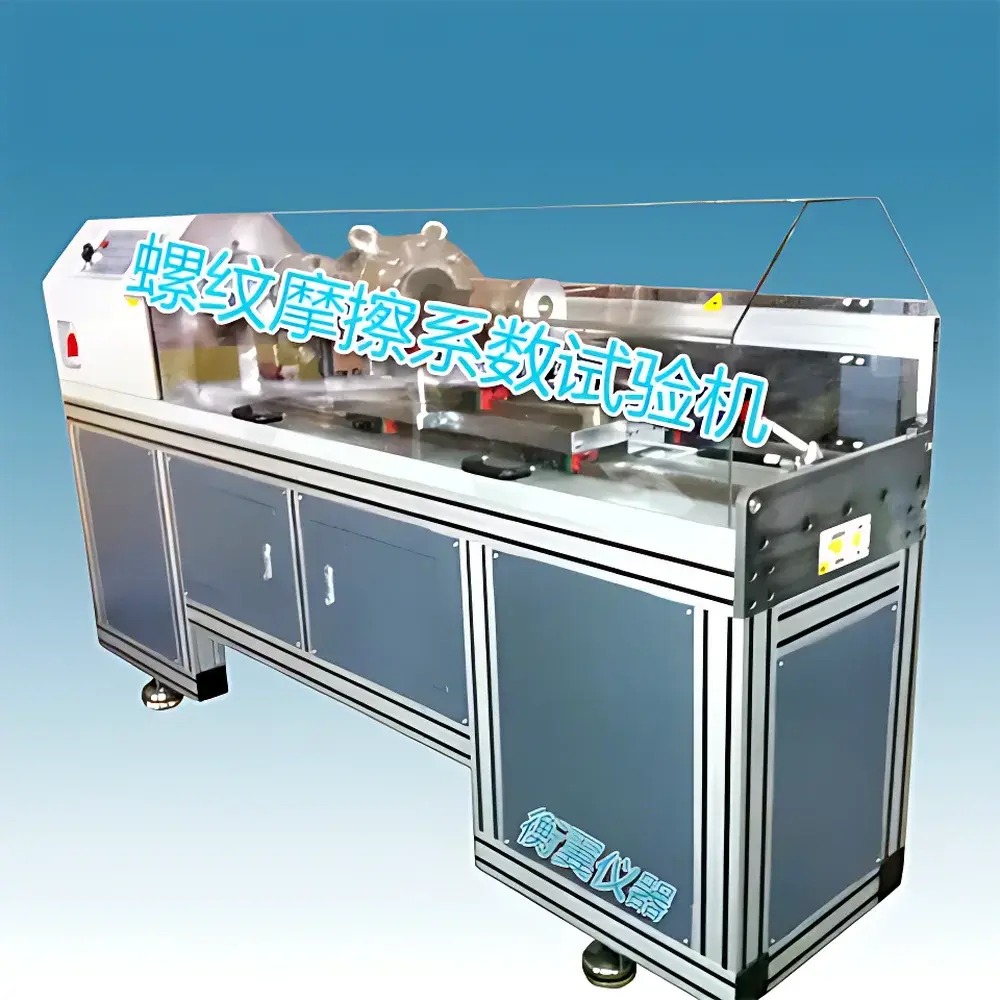
Hengyi HY-2000N·M Threaded Fastener Torque Coefficient Testing System
| Brand | Hengyi / Hengyitest |
|---|---|
| Origin | Shanghai, China |
| Manufacturer Type | Direct Manufacturer |
| Regional Category | Domestic (China) |
| Model | HY-2000N·M TY |
| Quotation | Upon Request |
| Maximum Total Torque | 2000 N·m |
| Maximum Thread Torque | 1000 N·m |
| Axial Force Range | 5–500 kN |
| Torque Measurement Accuracy | ±0.5% FS |
| Angular Displacement Range | 0–100,000° (or continuous) |
| Angular Measurement Accuracy | ±0.5% FS |
| Rotational Speed Range | 5–40 rpm (up to 200 rpm) |
| Max Spacing Between Grips | 1000 mm |
| Specimen Diameter Range | M10–M30 (customizable) |
| Power Supply | Single-phase 5 kW |
| Dimensions (L×W×H) | ≈2200×540×1250 mm |
| Weight | 1800 kg |
Overview
The Hengyi HY-2000N·M Threaded Fastener Torque Coefficient Testing System is a high-precision, dual-axis torsional testing platform engineered for the quantitative characterization of mechanical fastening behavior in bolt-nut assemblies and threaded joints. It operates on the principle of controlled torque application combined with simultaneous axial force and angular displacement measurement, enabling full traceability of tightening dynamics under quasi-static and dynamic rotational conditions. Designed specifically for structural and critical fasteners—such as high-strength bolts used in wind turbine towers, steel construction, rail infrastructure, and power generation systems—the system complies with fundamental test methodologies outlined in ISO 16047, ASTM F2281, DIN 267-27, and GB/T 16823.3. Its architecture supports both preload-dependent friction analysis and yield-based tightening evaluation, delivering metrologically sound data required for joint integrity validation, process qualification, and design verification.
Key Features
- Dual-sensor torque measurement: Independent transducers for total torque (0–2000 N·m) and thread-specific torque (0–1000 N·m), enabling precise separation of bearing surface and thread friction contributions.
- High-fidelity axial load measurement: Integrated load cell with 5–500 kN range and ±0.5% full-scale accuracy, synchronized with torque and angle acquisition at up to 1 kHz sampling rate.
- Programmable rotational control: Motor-driven actuation with speed regulation from 5 to 40 rpm (extendable to 200 rpm), supporting ramp, step, and dwell profiles per ISO 898-1 Annex B and VDI 2230 guidelines.
- Modular gripping system: Adjustable jaw configuration accommodating threaded fasteners from M10 to M30; custom tooling available for non-standard geometries including anchor bolts, shear studs, and double-end rods.
- Rigid C-frame structure: Heavy-duty cast-iron base and reinforced crosshead (1800 kg total mass) ensure minimal deflection during high-torque testing, maintaining geometric stability across extended test cycles.
- Real-time parameter calculation: On-the-fly derivation of torque coefficient (K), total friction coefficient (μtot), thread friction coefficient (μth), bearing surface friction coefficient (μb), yield clamping force, ultimate tensile load, and rotation-to-yield angle.
Sample Compatibility & Compliance
The HY-2000N·M system accommodates a broad spectrum of metallic threaded fasteners, including but not limited to: alloy steel (Cr-Mo, Ni-Cr-Mo), stainless steels (A2/A4, duplex), galvanized and coated structural bolts (e.g., ASTM A325, A490, EN 14399), shear connectors (weld studs), anchor bolts, and wind turbine tower foundation bolts. All test routines adhere to internationally recognized standards for fastener testing—including ISO 16047 (torque coefficient determination), ISO 898-1 (mechanical properties), ASTM F2281 (rotational capacity), and EN 15048 (non-preloaded joints). The system’s measurement uncertainty budget satisfies GLP-compliant environments and supports audit-ready documentation for ISO/IEC 17025-accredited laboratories.
Software & Data Management
Controlled by the Hengyi HYtest modular software suite, the system provides a deterministic, deterministic real-time operating environment compliant with FDA 21 CFR Part 11 requirements for electronic records and signatures. The software features role-based user access control, full audit trail logging (including parameter changes, calibration events, and test aborts), and automatic report generation in PDF/XLS formats conforming to ASTM E2917 templates. Raw data export includes time-stamped ASCII files containing synchronized torque, axial force, angle, and calculated coefficients—enabling post-test statistical analysis in third-party platforms such as MATLAB or JMP. Calibration certificates are digitally embedded and traceable to CNAS-accredited national standards.
Applications
- Verification of torque-tension relationships for production-line fastener qualification.
- Frictional behavior mapping of lubricated, dry, or coated threads under varying surface finishes and environmental conditions.
- Yield-point detection and rotational capacity assessment per ASTM F2281 for high-strength bolting applications.
- Development and validation of tightening protocols for automated assembly systems (e.g., robotic torque guns).
- Root-cause analysis of joint loosening, galling, or premature failure in field-deployed structures.
- Research-grade investigation into tribological interactions between mating threads and bearing surfaces under controlled humidity and temperature.
FAQ
What standards does this system support for torque coefficient testing?
ISO 16047, ASTM F2281, DIN 267-27, GB/T 16823.3, and EN 15048.
Can the system measure both torque and axial force simultaneously?
Yes—dual-channel acquisition captures total torque, thread torque, axial force, and angular displacement synchronously at ≥1 kHz sampling rate.
Is calibration traceable to national standards?
All transducers are calibrated against CNAS-accredited reference standards, with digital calibration certificates embedded in the software.
Does the software meet regulatory requirements for quality-critical industries?
Yes—HYtest software supports 21 CFR Part 11 compliance, including electronic signatures, audit trails, and secure user authentication.
What is the maximum specimen length the system can accommodate?
The adjustable grip spacing supports specimens up to 1000 mm between jaws, with optional extension kits available for longer assemblies.



