
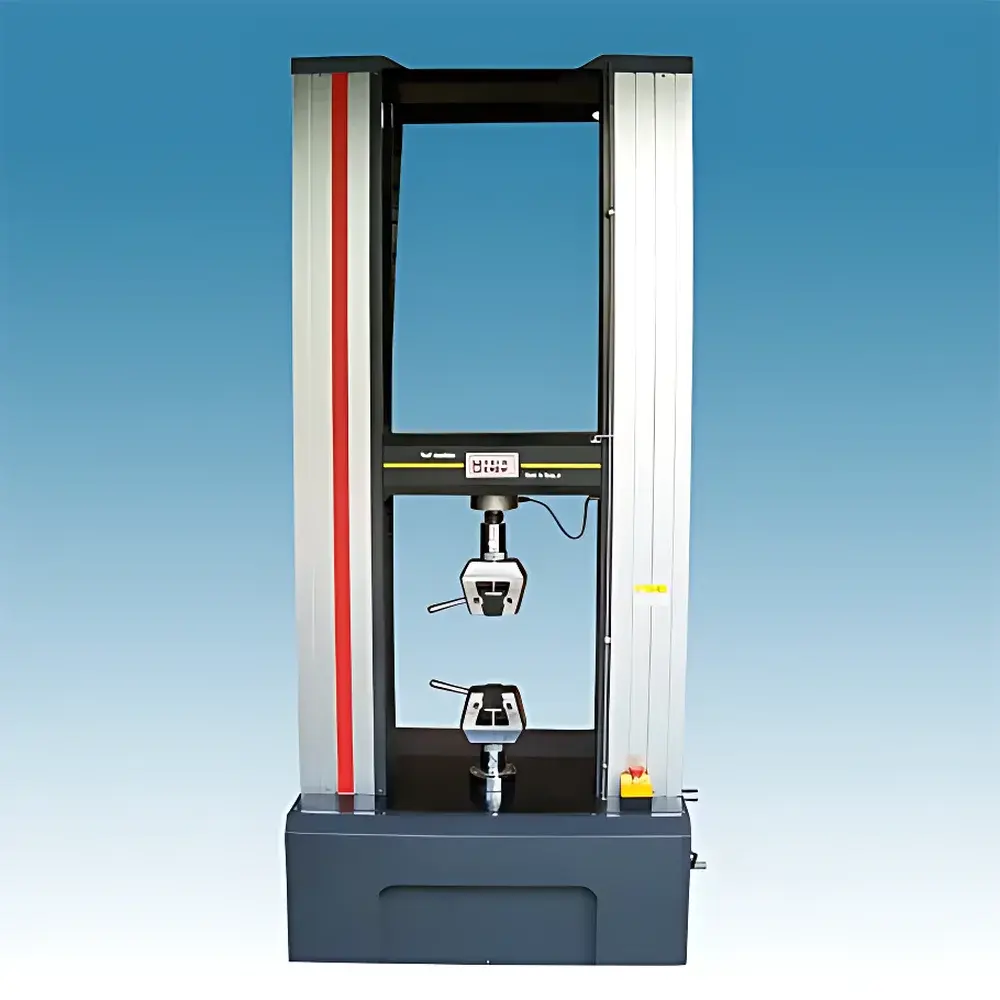
Hengyi HY-20080 200 kN Electromechanical Universal Testing Machine
| Brand | Hengyi |
|---|---|
| Origin | Shanghai, China |
| Manufacturer Type | Direct Manufacturer |
| Model | HY-20080 (200 kN) |
| Instrument Type | Electromechanical Universal Testing Machine |
| Max Load Capacity | 200 kN |
| Load Resolution | ±1/250000 (full-scale, constant) |
| Effective Test Width | 500 mm |
| Effective Tensile Travel | 600 mm or 800 mm |
| Test Speed Range | 0.001–1000 mm/min (adjustable) |
| Force Accuracy | < ±1% or < ±0.5% |
| Displacement Accuracy | ±0.5% of reading |
| Strain/Deformation Accuracy | ±0.5% of reading |
| Crosshead Movement | Dual-speed (fast/slow), jog-controllable |
| Safety Protection | Electronic limit switches, overload protection at 110% of full scale |
| Power Requirement | 2.5 kW |
| Dimensions (W×D×H) | 1000 × 680 × 2450 mm |
| Weight | 1250 kg |
Overview
The Hengyi HY-20080 is a high-capacity electromechanical universal testing machine engineered for precision mechanical characterization of metallic and non-metallic materials under static and quasi-static loading conditions. Operating on the principle of servo-controlled axial force application and displacement measurement, it delivers traceable, repeatable mechanical property data—including tensile strength, yield point, modulus of elasticity, elongation at break, compressive strength, flexural modulus, peel resistance, tear strength, and low-cycle fatigue behavior—within a calibrated load range up to 200 kN. Designed for compliance with international standard test methods—including ASTM E8/E21 (metals), ISO 6892-1 (tensile testing), ISO 178 (flexure), ISO 1421 (tear), and JIS Z 2241—the HY-20080 integrates seamlessly into quality control laboratories, R&D facilities, and third-party testing centers requiring GLP-compliant, auditable mechanical testing workflows.
Key Features
- High-resolution force measurement system with ±1/250000 full-scale resolution maintained across the entire 200 kN range, ensuring consistent sensitivity from sub-newton to maximum load
- Dual-speed crosshead actuation with precise jog control and programmable acceleration/deceleration profiles for optimized test sequencing
- Robust dual-column steel frame architecture (1250 kg mass) minimizing deflection and enhancing rigidity during high-load compression and bending tests
- Electronically monitored safety interlocks including real-time overload cutoff (110% FS), hardware-based travel limits, and emergency stop integration
- Thermally stable load cell and encoder subsystems calibrated per ISO 7500-1 Class 1 requirements, supporting traceability to national metrology institutes
- Modular fixture interface compatible with standardized wedge-grip, hydraulic clamp, bend support, and pneumatic peel fixtures per ASTM and ISO mounting specifications
Sample Compatibility & Compliance
The HY-20080 accommodates specimens ranging from thin foils (<0.1 mm) to structural metal sections (up to 50 mm thickness), provided within its 500 mm effective test width and 600/800 mm vertical travel envelope. Specimen alignment is facilitated by precision-machined T-slot base plates and adjustable grip centering mechanisms. All test procedures adhere to regulatory frameworks governing material certification: data acquisition complies with FDA 21 CFR Part 11 requirements for electronic records and signatures when configured with audit-trail-enabled software; test reports include metadata required for ISO/IEC 17025 accreditation (e.g., calibration dates, uncertainty budgets, environmental monitoring logs). The system supports direct export of raw force-displacement datasets in CSV and XML formats for external statistical analysis per ASTM E29 or ISO 5725.
Software & Data Management
Control and analysis are executed via Windows-based proprietary software featuring real-time dual-axis plotting (force vs. displacement, stress vs. strain), synchronized video capture (optional), and multi-curve overlay functionality. Users may perform post-test operations including curve segmentation, baseline correction, tangent modulus calculation, and automatic yield point detection per ASTM E111 and ISO 6892-1 Annex A. All actions—including parameter edits, curve annotations, and report generation—are logged with timestamped operator ID and system event codes. Data integrity is preserved through encrypted local storage, optional network backup to NAS or LIMS, and configurable auto-save intervals. Software validation documentation—including IQ/OQ protocols and version-controlled release notes—is supplied to support GMP and aerospace qualification programs.
Applications
- Tensile and compression testing of aluminum alloys, stainless steels, titanium grades, and high-strength fasteners per ASTM B557 and ISO 6892-2
- Flexural evaluation of welded joints and cast components using three- or four-point bending configurations
- Peel and tear resistance assessment of coated metals, laminated sheets, and adhesive-bonded assemblies per ASTM D903 and ISO 8510-2
- Low-cycle fatigue pre-screening of prototype components under controlled displacement or load control modes
- Quality conformance verification for automotive stampings, aerospace sheet stock, and medical device substrates
- Calibration transfer and reference material verification against certified NIST-traceable standards
FAQ
What international standards does the HY-20080 support out-of-the-box?
The system includes preloaded test method templates for ASTM E8, ISO 6892-1, JIS Z 2241, DIN 53455, and GB/T 228.1, with customizable parameters for strain rate, hold time, and acceptance criteria.
Is the load cell factory-calibrated and traceable?
Yes—each unit ships with a UKAS-accredited calibration certificate (ISO/IEC 17025) covering the full 200 kN range, valid for 12 months under normal operating conditions.
Can the HY-20080 be integrated into an existing LIMS or MES environment?
It supports OPC UA and TCP/IP communication protocols; API documentation and HL7-compatible data export modules are available upon request for enterprise-level interoperability.
What maintenance is required to maintain accuracy over time?
Annual recalibration of the load cell and position encoder is recommended; routine checks include lubrication of lead screws, verification of grip alignment, and validation of safety limit switch response times per ISO 7500-1 Clause 8.3.
Does the system meet electromagnetic compatibility (EMC) requirements for laboratory use?
Yes—it conforms to IEC 61326-1:2013 for industrial environments, with CE marking and FCC Part 15 Class A compliance verified by independent testing laboratories.



