
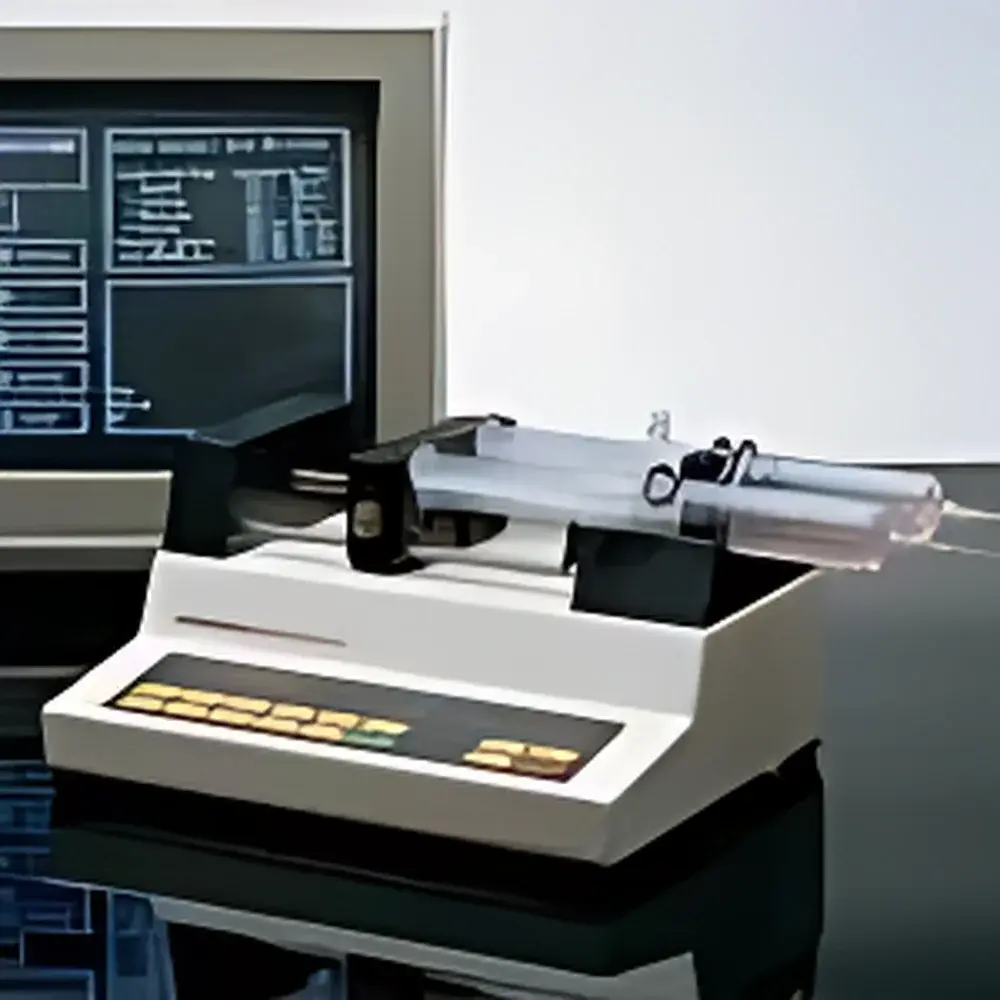
Harvard Apparatus Pump 33 Dual Syringe Pump
| Brand | Harvard Apparatus |
|---|---|
| Origin | USA |
| Model | Pump 33 |
| Accuracy | ±0.35% |
| Repeatability | ±0.1% |
| Syringe Volume Range | 0.5 µL – 140 mL |
| Flow Rate Range | 0.0004 µL/hr – 106.6 mL/min |
| Drive Mechanism | Dual independent microstepping stepper motors (0.9° step angle) |
| Microstep Resolution | 1/2 or 1/4 step |
| Steps per Revolution | 1600 (1/2-step) or 3200 (1/4-step) |
| Linear Actuation Speed | 0.7267 µm/min – 95.25 mm/min |
| Max Push Force | 57 lbf |
| Power Input | 95–130 VAC, 60 Hz or 220–260 VAC, 50 Hz |
| Power Consumption | 45 W |
| Dimensions (H×W×D) | 15.2 × 31.1 × 28.6 cm |
| Weight | 6.8 kg |
| Interface | RS-232 (RJ11-4), TTL (9-pin D-sub), non-volatile memory for parameter storage |
Overview
The Harvard Apparatus Pump 33 Dual Syringe Pump is an engineered solution for high-precision, long-duration fluid delivery and withdrawal in research and industrial laboratory environments. Based on a dual-channel, microprocessor-controlled syringe actuation architecture, it operates via precision lead-screw-driven linear motion of two independently controlled plunger mechanisms. Each channel utilizes a dedicated 0.9° hybrid stepper motor with selectable 1/2- or 1/4-step microstepping—enabling sub-microliter positional resolution and stable low-flow performance down to 0.0004 µL/hr. Unlike peristaltic or piston-based systems, the Pump 33 eliminates pulsation, ensures volumetric fidelity across wide viscosity ranges, and maintains mechanical stability under sustained load. Its design supports continuous 24/7 operation with thermal management optimized for unattended runs exceeding 72 hours—making it suitable for chronic infusion studies, reactor feed control, and multi-phase reagent dosing where temporal consistency and volumetric reproducibility are critical.
Key Features
- Dual independent syringe channels with synchronized or decoupled control—enabling co-infusion, counter-infusion, or differential dosing protocols
- High-accuracy volumetric delivery with ±0.35% stability and ±0.1% repeatability over full syringe volume range (0.5 µL to 140 mL)
- Programmable operational modes: Reciprocal/Parallel (same/opposite direction), Proportional (flow ratio control between channels), AutoStop (limit-switch triggered halt), and Continuous Run (direction reversal at limit activation)
- Integrated non-volatile memory retains all user-defined parameters—including flow rates, syringe dimensions, acceleration profiles, and mode selection—across power cycles
- Robust mechanical architecture delivering up to 57 lbf linear thrust per channel, compatible with glass, plastic, and stainless-steel syringes including high-pressure models
- Standard RS-232 (RJ11-4) and TTL (9-pin D-sub) interfaces support bidirectional communication, remote triggering, and daisy-chaining of up to 100 units for scalable multi-pump arrays
- Universal AC input (95–130 VAC / 220–260 VAC, 50/60 Hz) with internal fuse protection and low-noise power regulation for stable motor performance
Sample Compatibility & Compliance
The Pump 33 accommodates standard Luer-lock and slip-tip syringes from major manufacturers—including BD, Hamilton, and SGE—with compatibility verified for volumes spanning microliter-scale analytical injections to 140 mL preparative deliveries. It supports aqueous, organic, and moderately viscous fluids (up to ~10,000 cP with appropriate syringe selection and reduced flow rate). The device complies with IEC 61010-1:2010 for electrical safety in laboratory equipment and meets EMC requirements per FCC Part 15 Class B and EN 61326-1. While not certified for clinical use, its deterministic flow control, audit-ready parameter logging, and deterministic start/stop behavior align with GLP and preclinical GMP documentation standards. When integrated into automated systems with validated software layers, it supports traceability frameworks consistent with FDA 21 CFR Part 11 requirements for electronic records.
Software & Data Management
The Pump 33 operates natively via front-panel keypad and rotary encoder, but achieves full protocol flexibility through serial command interface. Harvard Apparatus provides ASCII-based SCPI-compatible command sets for integration with LabVIEW, MATLAB, Python (pySerial), and custom C/C++ applications. All commands—including flow rate assignment, mode switching, real-time position query, and error status polling—are timestamped and buffered. The RS-232 port enables hardware handshaking (RTS/CTS) for reliable high-frequency control in time-critical experiments. For enterprise deployment, third-party middleware solutions (e.g., TIBCO Spotfire, LabArchives ELN) can ingest Pump 33 telemetry via OPC UA or REST API wrappers. No proprietary runtime or license is required—firmware updates are delivered as signed HEX files with checksum verification.
Applications
- Long-term toxicology and pharmacokinetic studies requiring uninterrupted sub-nanoliter/hour infusions in rodent or primate models
- Controlled reagent addition in continuous-flow chemical reactors and microfluidic synthesis platforms
- Dual-channel calibration of mass spectrometry or chromatography sample introduction systems
- Simultaneous sampling from paired biological compartments (e.g., cerebral spinal fluid + plasma) with matched temporal resolution
- Precision metering of dyes, catalysts, or flavor compounds in pilot-scale food, fragrance, and polymer manufacturing
- Automated dilution series generation with programmable concentration gradients across two independent streams
FAQ
Can the Pump 33 operate with syringes smaller than 0.5 µL?
No—the minimum calibrated syringe volume is 0.5 µL; using smaller syringes compromises accuracy due to mechanical backlash and encoder resolution limits.
Is firmware upgrade supported in the field?
Yes—firmware updates are distributed as signed binary files and applied via RS-232 using Harvard’s documented bootloader sequence.
Does the pump support analog voltage input for external flow rate modulation?
No—analog input is not implemented; all control is digital via RS-232 or TTL trigger lines.
What is the maximum backpressure rating?
The system is rated for continuous operation up to 100 psi (6.9 bar); peak transient pressure must remain below 150 psi to avoid mechanical overload.
Can both channels run at different flow rates while maintaining synchronization?
Yes—Proportional Mode allows independent flow rate definition per channel while preserving temporal alignment of start/stop events and ramp profiles.



