
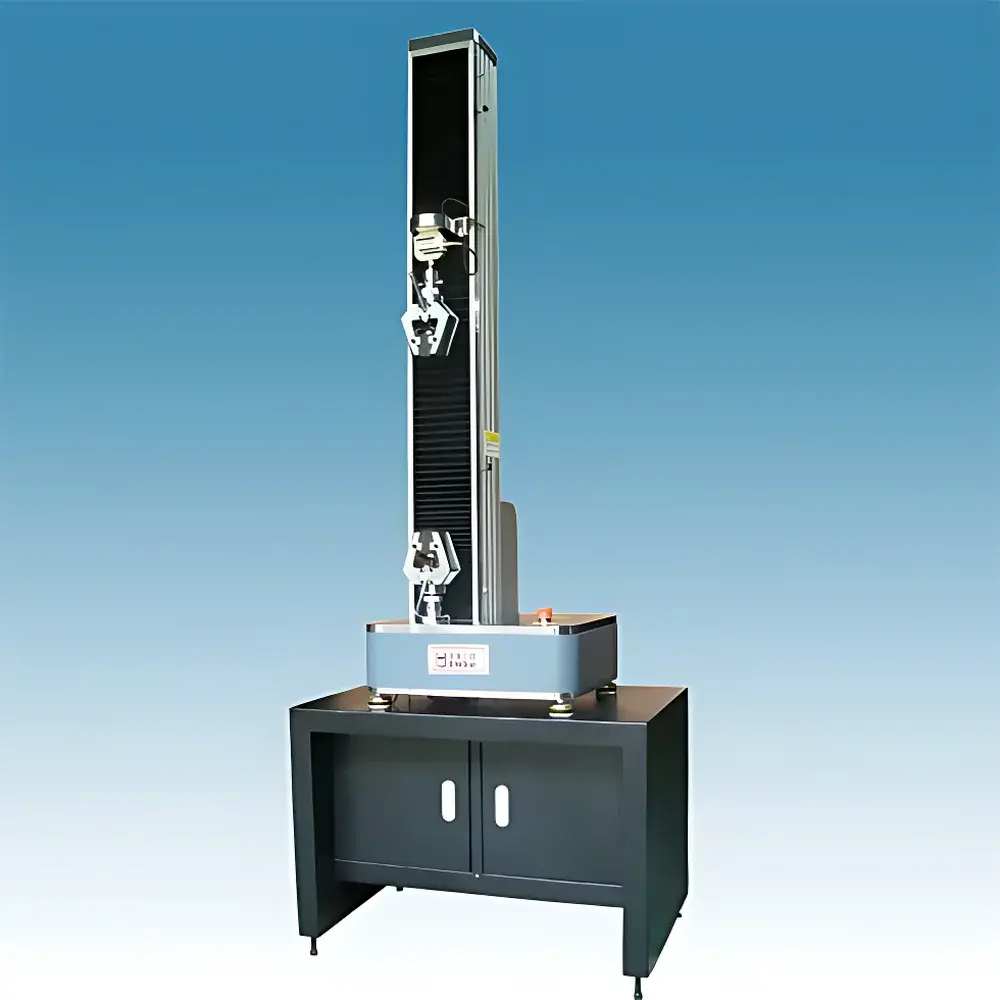
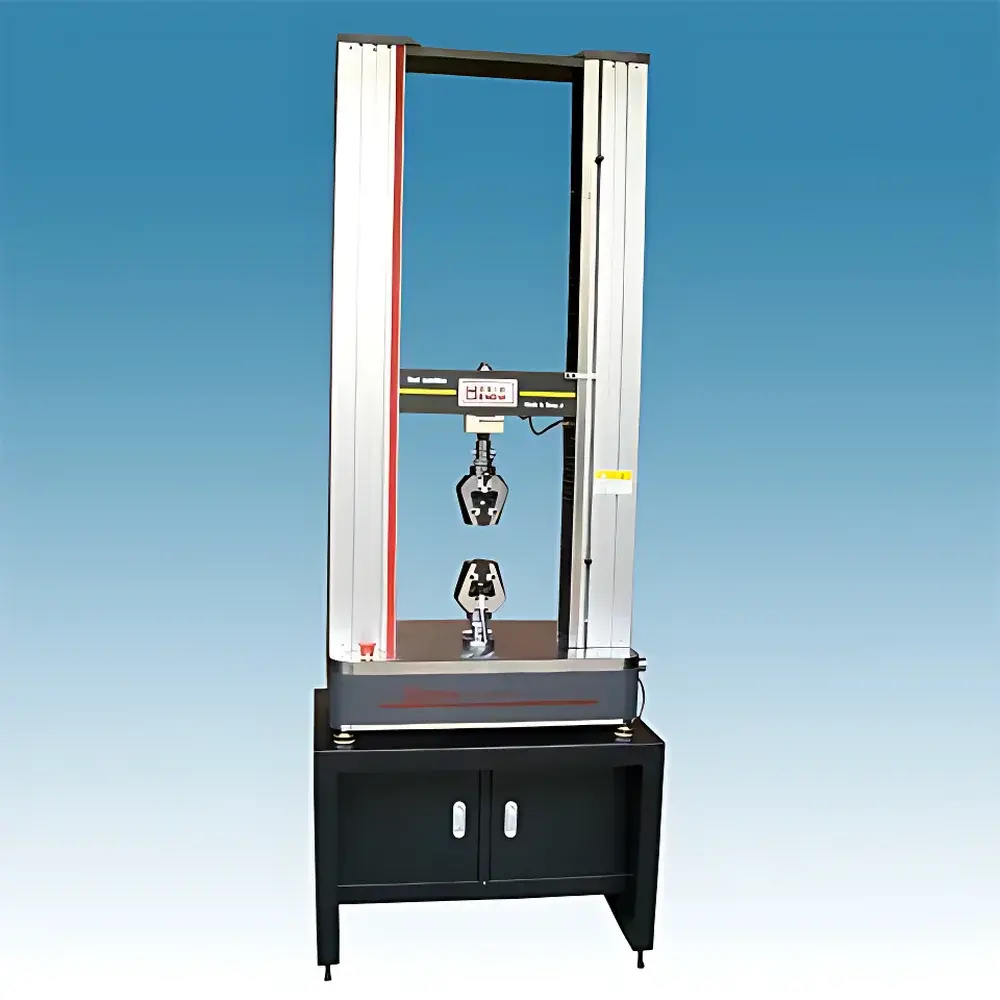
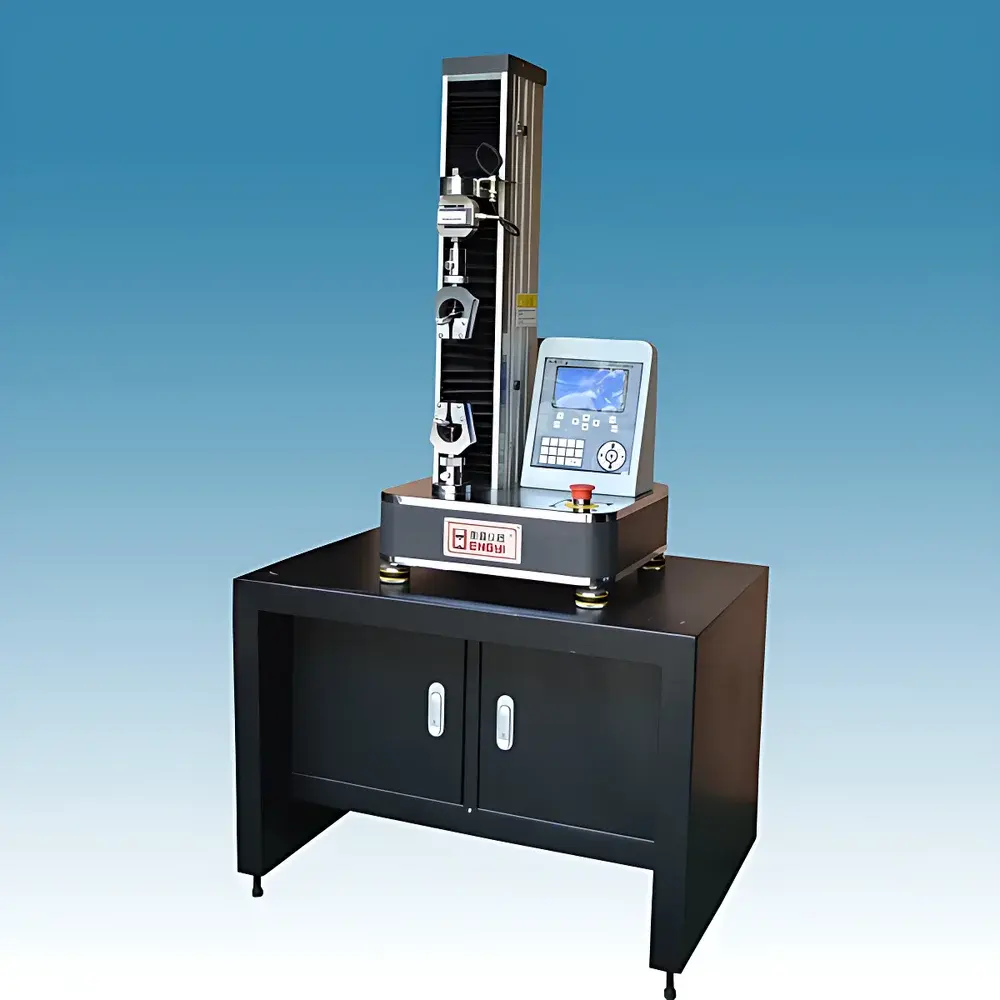
Hengyi HY-0580 Single-Column Universal Testing Machine
| Brand | Hengyi |
|---|---|
| Origin | Shanghai, China |
| Manufacturer Type | Direct Manufacturer |
| Product Category | Domestic |
| Model | HY-0580 |
| Instrument Type | Electromechanical Universal Testing Machine |
| Load Capacity Options | 1 N to 5000 N (interchangeable load cells) |
| Force Accuracy | ≤ ±0.5% of reading |
| Effective Test Width | 120 mm |
| Effective Vertical Travel | 800 mm |
| Speed Range | 0.001–500 mm/min (adjustable) |
| Speed Accuracy | ±0.5% of set value |
| Displacement Accuracy | ±0.5% of reading |
| Strain Measurement Accuracy | ±0.5% of reading |
| Force Resolution | ±500,000 counts (full-scale, no range switching) |
| Power Supply | 220 V AC, 750 W |
| Dimensions (W×D×H) | 470 × 400 × 1510 mm |
| Weight | 120 kg |
Overview
The Hengyi HY-0580 is a single-column electromechanical universal testing machine engineered for high-precision mechanical property evaluation of low-to-medium force-range materials—including silicone rubber, elastomers, thin films, textiles, biomedical polymers, adhesives, and small-section composites. It operates on the principle of controlled axial displacement via a precision ball-screw-driven crosshead, coupled with closed-loop servo control of load, displacement, and strain. The system complies with static uniaxial testing fundamentals defined in ISO 7500-1, ASTM E4, and GB/T 16491–2008, supporting both tensile and compressive modes across standardized specimen geometries. Its modular architecture enables rapid reconfiguration for peel, tear, bend, shear, and puncture tests through interchangeable fixtures and extensometers—making it suitable for R&D labs, QC departments, and academic institutions requiring traceable, repeatable mechanical data under GLP-aligned workflows.
Key Features
- Single-column rigid frame with aluminum alloy upright and reinforced base for minimal deflection (<0.02 mm under full load)
- High-resolution force measurement system with ±500,000-count A/D conversion and auto-zeroing compensation
- True dual-closed-loop control: simultaneous regulation of load, displacement, and strain rates per ISO 527-1 and ASTM D638
- Adjustable test speed from 0.001 to 500 mm/min, with real-time feedback and ±0.5% speed fidelity across the entire range
- Digital electronic limit protection with dual-stage overtravel cutoff (hardware + software)
- Programmable stop conditions: load-limited, displacement-limited, strain-limited, or time-triggered termination
- Integrated overload protection: automatic shutdown at >110% of selected load cell capacity
- Self-diagnostic firmware that monitors drive current, encoder signal integrity, and load cell bridge voltage at 10 Hz intervals
- Quick-return mechanism with selectable high-speed (200 mm/min) manual return or automated post-test reset
Sample Compatibility & Compliance
The HY-0580 accommodates specimens up to 120 mm wide and 800 mm tall, supporting standardized test geometries per GB/T 3923 (woven fabrics), GB/T 1040 (plastics), GB/T 528 (vulcanized rubber), ISO 37 (rubber tensile properties), and ASTM D412 (vulcanized rubber). With optional wedge-action grips, pneumatic clamps, or custom fixtures, it handles brittle films, soft gels, coated substrates, and anisotropic composites without slippage or premature failure. All calibration procedures align with JJG 475–2018 (Chinese national metrology verification regulation) and support traceability to NIM (National Institute of Metrology, China). System validation includes force linearity checks, displacement repeatability assessment, and crosshead alignment verification—documented per ISO/IEC 17025 requirements for accredited testing laboratories.
Software & Data Management
Bundled Hengyi TestMaster v3.2 software provides ISO/IEC 17025-compliant test sequence definition, real-time curve overlay, multi-channel synchronized acquisition (load, displacement, extensometer, temperature), and automated report generation in PDF/XLS formats. The software supports user-defined test methods compliant with ASTM E23, ISO 527, and GB/T 228.1, with editable pass/fail criteria and statistical analysis (mean, SD, CV%, confidence intervals). Audit trail functionality records all operator actions, parameter changes, and calibration events with timestamps and user IDs—meeting FDA 21 CFR Part 11 requirements when deployed with Windows domain authentication and digital signature modules. Raw data export is available in ASCII (.txt) and universal .csv formats for third-party analysis in MATLAB, Python, or Minitab.
Applications
- Tensile strength, elongation at break, and modulus determination of silicone rubber compounds per ISO 34-1 and ASTM D412
- Peel adhesion testing of pressure-sensitive adhesives on flexible substrates (ASTM D903, GB/T 7122)
- Compression set evaluation of elastomeric seals and gaskets (ISO 815, ASTM D395)
- Flexural rigidity of thin polymer sheets and medical device components (ASTM D790, GB/T 9341)
- Shear strength of laminated composites and bonded joints (ASTM D1002, ISO 4587)
- Dynamic fatigue profiling under cyclic loading (optional add-on module)
- Educational use in materials science curricula for stress-strain relationship visualization
FAQ
What load cell capacities are supported by the HY-0580?
The system accepts interchangeable load cells ranging from 1 N to 5000 N, allowing users to optimize resolution and accuracy for specific material classes without hardware modification.
Does the HY-0580 meet international calibration standards?
Yes—it conforms to ISO 7500-1 (class 0.5), ASTM E4, and GB/T 16491–2008. Factory calibration certificates include uncertainty budgets and are traceable to national standards.
Can the software generate GLP-compliant test reports?
Yes. TestMaster v3.2 supports electronic signatures, audit trails, version-controlled method templates, and metadata embedding required for GLP audits.
Is extensometer integration supported?
Yes—both clip-on and non-contact video extensometers (with sub-pixel resolution) can be connected via USB or analog input channels for strain measurement independent of crosshead motion.
What safety protections are built into the mechanical system?
Hardware-based electronic limit switches, software-defined travel boundaries, automatic overload cutoff, and emergency stop circuitry meeting IEC 60204-1 requirements.



