
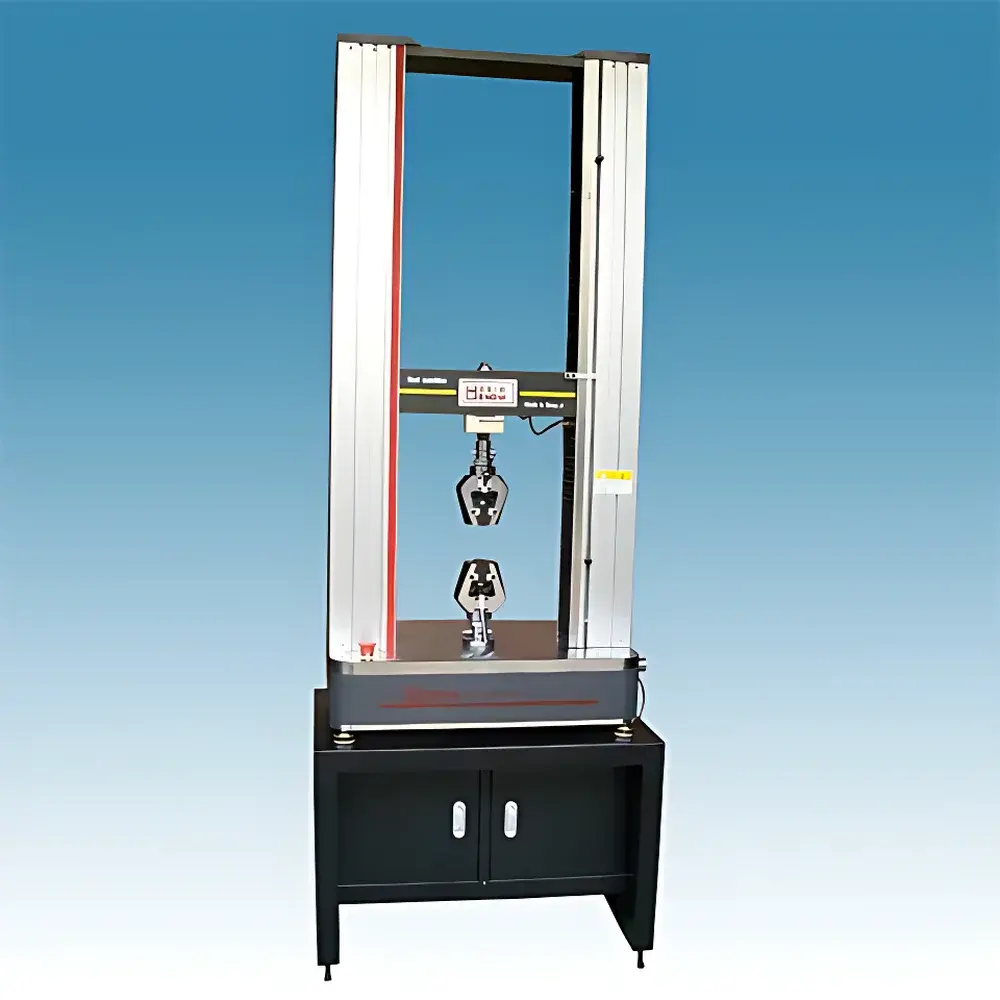
Hengyi HY-1080ERT Universal Tensile Testing Machine
| Brand | Hengyi |
|---|---|
| Origin | Shanghai, China |
| Manufacturer Type | Direct Manufacturer |
| Product Category | Domestic |
| Model | HY-1080ERT |
| Maximum Test Load | 10 kN |
| Force Measurement Range | 0.001–100% FS |
| Force Accuracy | ±0.5% of reading |
| Crosshead Travel | 800 mm |
| Displacement Resolution | 0.001 mm |
| Test Speed Range | 0.001–800 mm/min |
| Speed Accuracy | ±0.5% of set value |
| Displacement Accuracy | ±0.5% of reading |
| Strain Control Rate Range | 0.002–6% FS/s |
| Stress Control Rate Range | 0.005–6% FS/s |
| Load Cell Options | 1 N to 10 kN (interchangeable) |
| Effective Test Width | 420 mm (expandable) |
| Power Supply | 220 V AC, 750 W |
| Machine Weight | 210 kg |
| Dimensions (W×D×H) | 400 × 420 × 1600 mm |
Overview
The Hengyi HY-1080ERT is a high-precision, dual-column universal tensile testing machine engineered for static mechanical characterization of metallic, polymeric, composite, and elastomeric materials under controlled uniaxial loading conditions. It operates on the principle of servo-controlled electromechanical actuation, where a precision ball-screw-driven crosshead applies calibrated axial force to specimens while synchronized high-resolution encoders and load cells capture real-time force, displacement, and strain data. Designed in compliance with ISO 7500-1 (Class 0.5), ASTM E4, ASTM E8/E8M, ASTM D638, ISO 527, ISO 6892-1, and GB/T 228.1, the system delivers traceable, repeatable results suitable for R&D laboratories, quality control departments, and third-party certification bodies operating under GLP or ISO/IEC 17025 frameworks.
Key Features
- Modular load cell architecture supporting interchangeable transducers from 1 N to 10 kN — enabling seamless transition between micro-scale polymer film testing and macro-scale structural composite evaluation.
- Full-range force resolution of ±500,000 counts without internal range switching — ensuring consistent sensitivity across the entire measurement span (0.001–100% FS).
- Precision-ground ball-screw transmission with integrated brushless servo motor — delivering smooth, low-noise motion control and long-term mechanical stability.
- Dual-mode control architecture: closed-loop stress rate, strain rate, and displacement rate control — compliant with ISO 6892-1 Annex C for quasi-static tensile testing of metals and plastics.
- Integrated electronic limit protection and overload cutoff at 110% of full scale — preventing hardware damage during specimen failure or operator error.
- Automated return-to-start function post-test, programmable hold conditions (constant load, constant displacement, constant strain), and real-time diagnostic self-checks for drive system, load cell, and encoder integrity.
Sample Compatibility & Compliance
The HY-1080ERT accommodates standard test geometries per ASTM D3039 (composites), ASTM D638 (plastics), ISO 527-2 (thermoplastics), and ISO 6892-1 (metals), including dog-bone, straight-bar, and custom-fixture configurations. With an effective test width of 420 mm (expandable) and vertical travel of 800 mm (extendable), it supports specimens up to 160 mm wide and 750 mm long. All control algorithms and calibration routines adhere to ISO/IEC 17025 requirements for measurement uncertainty estimation. The system supports audit-ready operation via optional 21 CFR Part 11-compliant software modules, including electronic signatures, change logs, and immutable raw-data archiving.
Software & Data Management
Equipped with Hengyi’s proprietary TestMaster Pro v4.x software, the HY-1080ERT provides ISO-standardized test method templates (e.g., tensile modulus, yield point, elongation at break, Poisson’s ratio), real-time curve overlay, multi-channel synchronized acquisition (force, displacement, extensometer), and automated report generation in PDF/XLS formats. Raw data export includes ASCII-delimited time-stamped records with metadata (operator ID, calibration certificate number, environmental conditions). Software architecture supports networked deployment, role-based access control (RBAC), and integration with LIMS via ODBC or REST API. Calibration certificates are digitally signed and include uncertainty budgets traceable to NIM (China National Institute of Metrology).
Applications
This system is routinely deployed in aerospace composites QA (carbon fiber/epoxy laminate tensile strength verification), automotive thermoplastic validation (PP, PA66, PBT ductility assessment), biomedical device testing (suture tensile strength, hydrogel compression modulus), construction material certification (reinforced concrete reinforcement bars per GB/T 1499.2), and packaging R&D (peel strength of laminated films per ASTM F904). Its broad speed range (0.001–800 mm/min) enables both quasi-static characterization and creep/relaxation protocols under ISO 899-1/2.
FAQ
Does the HY-1080ERT support extensometer integration?
Yes — it features analog and digital inputs compatible with clip-on, video, and non-contact extensometers meeting ISO 9513 Class 1 accuracy requirements.
Is calibration documentation provided with shipment?
Each unit ships with a factory calibration certificate traceable to NIM, including as-found/as-left data, uncertainty budgets, and compliance statements against ISO 7500-1.
Can the system be upgraded for dynamic testing?
No — the HY-1080ERT is strictly a static testing platform. For fatigue or cyclic loading, consider Hengyi’s HY-2000FD series equipped with hydraulic or electrodynamic actuators.
What environmental conditions are required for optimal operation?
Ambient temperature: 10–35 °C; relative humidity: ≤80% RH (non-condensing); vibration-isolated floor mounting recommended for sub-0.1% FS repeatability.
Is remote technical support available outside China?
Yes — Hengyi offers English-language remote diagnostics, firmware updates, and application engineering support via secure TeamViewer sessions and encrypted file transfer.



