
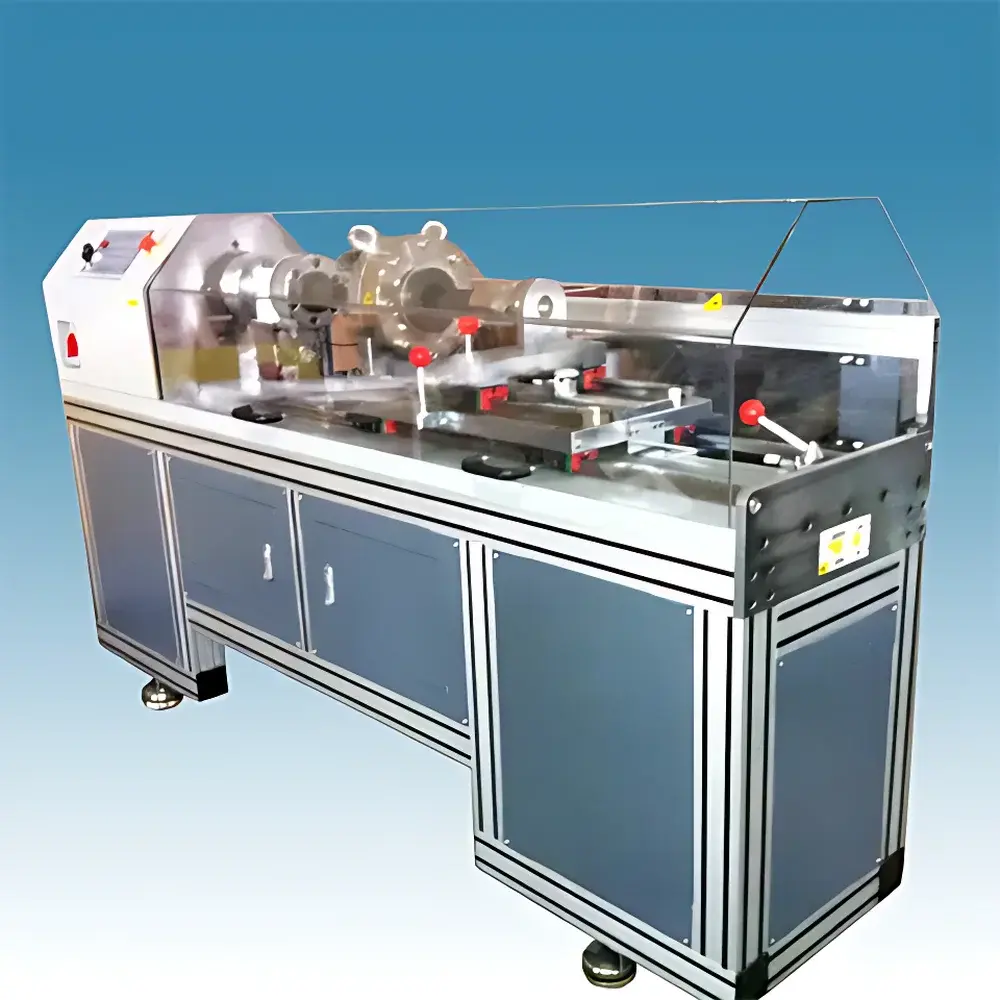
HY-5000NM Electronic Torsion Testing Machine
| Origin | Shanghai, China |
|---|---|
| Manufacturer Type | Authorized Distributor |
| Origin Classification | Domestic (China) |
| Model | HY-5000NM |
| Price Range | USD 14,000 – 28,000 |
| Torque Measurement Range | 50–5000 N·m |
| Angular Displacement Accuracy | ±0.5% |
| Angular Measurement Range | 0–10,000° |
| Torsion Speed | 0.01–1000 °/min |
| Specimen Grip Diameter Range | Φ6–Φ32 mm |
| Dimensions (L×W×H) | 2800×470×1250 mm |
| Motor Power | 4 kW |
| Machine Weight | 1500 kg |
Overview
The HY-5000NM Electronic Torsion Testing Machine is a high-precision, servo-controlled mechanical testing system engineered for static and quasi-static torsional characterization of metallic and non-metallic materials, structural components, and engineering parts. Based on the principle of controlled angular displacement under applied torque, the system measures fundamental torsional properties—including torsional yield strength, ultimate torsional strength, modulus of rigidity (G), non-proportional torque, and torsional stiffness—according to standardized mechanical test protocols. Designed for laboratory-grade reproducibility and long-term operational stability, the machine integrates a high-resolution torque transducer, optical encoder-based angular measurement, and closed-loop digital motion control. Its architecture supports both manual operation and fully automated test sequences, making it suitable for routine quality assurance, R&D validation, and compliance-driven material certification.
Key Features
- High-capacity torque measurement range of 50–5000 N·m with ±0.5% full-scale accuracy, calibrated traceable to national metrological standards.
- Precision angular displacement sensing over 0–10,000° with resolution better than 0.01°, enabling accurate determination of shear modulus (G) and torsional elastic limit.
- Programmable torsion speed from 0.01 to 1000 °/min, adjustable in real time via software interface; higher speeds managed through PC-based closed-loop control.
- Modular chuck system accommodating cylindrical specimens from Φ6 mm to Φ32 mm; optional custom fixtures available for non-standard geometries including shafts, fasteners, and hollow tubes.
- Robust cast-iron frame with reinforced base and precision-machined guideways, minimizing torsional deflection and ensuring mechanical integrity during high-load testing.
- Integrated 4 kW AC servo motor with regenerative braking, delivering smooth acceleration/deceleration profiles and consistent torque output across the entire speed range.
Sample Compatibility & Compliance
The HY-5000NM accommodates solid rods, wire, springs, drive shafts, couplings, and machined prototypes—provided they fall within the specified grip diameter and aspect ratio constraints. It supports standardized specimen preparation per ISO 7800, ASTM E143, and GB/T 239.1–2012 for torsional testing of metallic materials. The system complies with Chinese national verification regulation JJG 269–1981 and performance standard GB/T 9370–1999 for torsion testing machines. All hardware and firmware configurations are designed to support GLP-compliant workflows, including audit-ready calibration logs, user-access-level controls, and timestamped test records.
Software & Data Management
The HY-5000NM operates with proprietary virtual instrumentation software built on a real-time Windows-based platform. The application provides synchronized acquisition of torque, angle, and time data at up to 1 kHz sampling rate. Users can define multi-step test profiles—including ramp-hold, cyclic torsion, and stepwise loading—with automatic detection of yield points and failure events. Data analysis modules compute G-values using linear regression of the initial elastic region, generate stress–strain analogues (τ–γ), and export results in CSV, PDF, or XML formats. The software supports 21 CFR Part 11–compatible electronic signatures, audit trails, and secure user authentication (admin/operator/guest roles), fulfilling regulatory documentation requirements for ISO/IEC 17025-accredited laboratories.
Applications
- Quality control of cold-formed fasteners, automotive drive axles, and aerospace turbine shafts.
- Determination of shear modulus and torsional fatigue thresholds in polymer composites and aluminum alloys.
- Validation of weld integrity and heat-affected zone (HAZ) behavior under torsional loading.
- Research into viscoelastic torsional response of elastomeric bushings and rubber-metal bonded joints.
- Calibration and verification of torque sensors and rotary encoders used in industrial automation systems.
- Teaching laboratories for undergraduate and graduate courses in solid mechanics and materials science.
FAQ
What standards does the HY-5000NM comply with for calibration and verification?
It conforms to JJG 269–1981 (verification regulation), GB/T 9370–1999 (performance specification), and GB/T 239.1–2012 (test method for metallic materials).
Can the system perform cyclic torsion testing?
Yes—software-defined waveforms (sinusoidal, triangular, trapezoidal) enable controlled low-cycle and high-cycle torsional fatigue experiments.
Is third-party calibration documentation provided with delivery?
Each unit ships with a factory calibration certificate referencing CNAS-accredited reference standards, valid for 12 months under normal use conditions.
Does the machine support integration with LIMS or enterprise MES platforms?
Via TCP/IP and OPC UA interfaces, raw data streams and summary reports can be exported to external laboratory information management systems.
What maintenance intervals are recommended for long-term accuracy?
Torque sensor recalibration every 12 months; angular encoder alignment check every 6 months; lubrication of lead screws and bearings every 2000 operational hours.



