
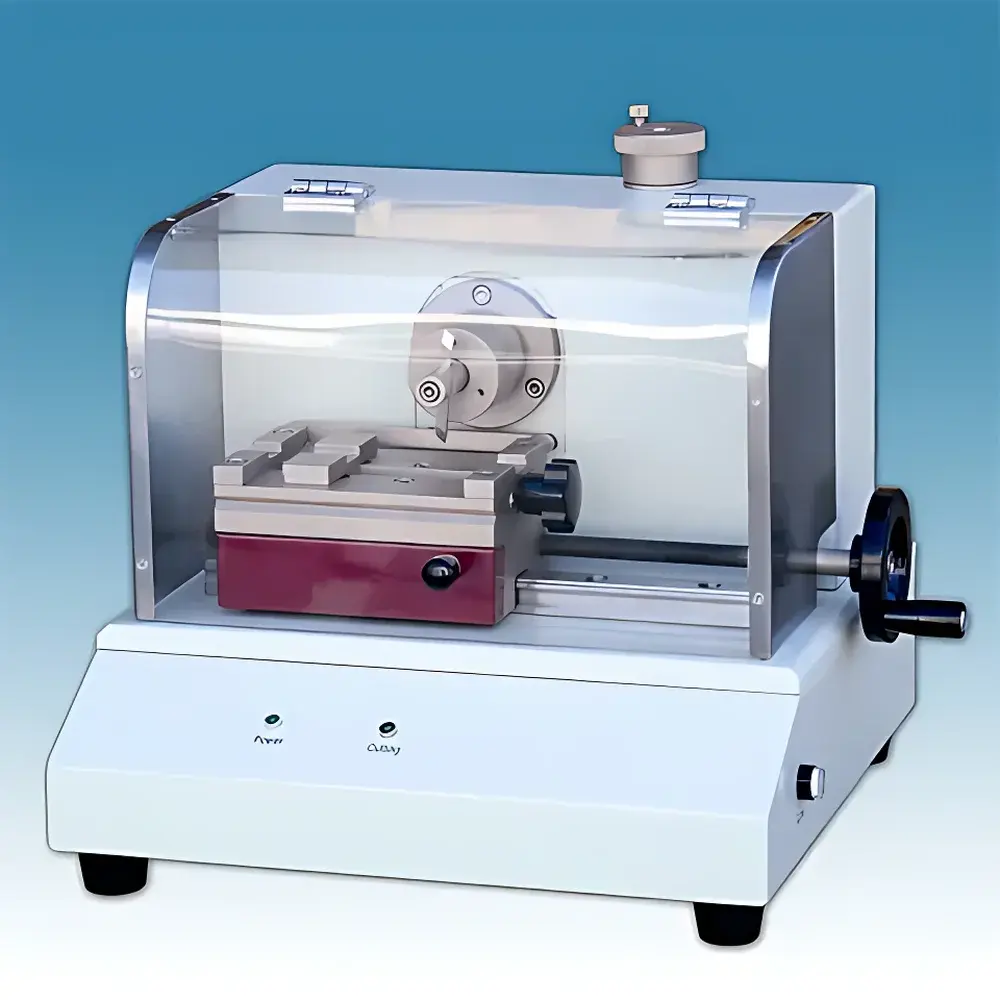
Hengyi HY-QKTYU Cantilever Beam Impact Notching Machine
| Brand | Hengyi |
|---|---|
| Origin | Shanghai, China |
| Manufacturer Type | Direct Manufacturer |
| Country of Origin | China |
| Model | HY-QKTYU |
| Quotation | Upon Request |
| Worktable Travel | >90 mm |
| Feed Rate | 30 mm/min |
| Sample Dimensions Supported | 80 mm × 10 mm × 4 mm (customizable) |
| Notch Types | Type A (45°±0.2°, r = 0.25±0.05 mm), Type B (45°±0.2°, r = 1.0±0.05 mm), Type C (45°±0.2°, r = 0.1±0.02 mm) |
| Feed Adjustment Range | 0–2.5 mm |
| Feed Stroke | 10 mm |
| Overall Dimensions (L×W×H) | 400 mm × 270 mm × 300 mm |
| Power Supply | 220 VAC ±10%/−15%, 50 Hz, Single-Phase Three-Wire |
| Tool Material | Imported European High-Alloy Steel, Hardness > HRC60, Surface Roughness Ra < 0.4 µm |
| Tool Lifespan | Re-sharpenable, Extended Service Life |
| Standard Compliance | ISO 179:2000, ISO 180:2001, GB/T 1043–2008, GB/T 1843–2008 |
Overview
The Hengyi HY-QKTYU Cantilever Beam Impact Notching Machine is a precision-engineered benchtop instrument designed to produce standardized notches in rigid plastic and non-metallic specimens prior to Charpy or Izod impact testing. It operates on a controlled linear feed principle using hardened alloy steel cutting tools mounted on a rigid cantilever-guided carriage system. The machine ensures geometric fidelity of the notch profile—critical for achieving high reproducibility in impact energy measurements per ASTM D6110, ISO 179, and ISO 180 methodologies. Unlike manual filing or generic milling setups, the HY-QKTYU integrates synchronized depth control, angular stability, and repeatable tool engagement, eliminating operator-induced variability in notch root radius and flank angle—two parameters directly influencing fracture initiation behavior during pendulum impact.
Key Features
- High-throughput batch processing: Simultaneous clamping of up to 20 specimens; average output exceeds 60 notched samples per 10 minutes under standard operating conditions.
- Triple-notch-type compatibility: Interchangeable Type A (r = 0.25 mm), Type B (r = 1.0 mm), and Type C (r = 0.1 mm) tooling kits—all calibrated to ±0.02 mm radius tolerance and ±0.2° angular accuracy.
- Tooling system with traceable metrology: European-sourced high-alloy steel cutters (HRC > 60, Ra < 0.4 µm) featuring regrind capability and documented wear-life performance exceeding 2,000 notches per sharpening cycle.
- Adjustable feed control: Stepless feed depth selection from 0 to 2.5 mm with 10 mm total stroke, enabling precise notch depth modulation without recalibration.
- Rigid mechanical architecture: Cast-iron base with linear guide rails and backlash-free lead screw drive ensures dimensional stability over extended operation cycles and ambient temperature fluctuations.
- Integrated calibration verification suite: Includes three certified gauge blocks (L = 63.5 mm, 80 mm, and 120 mm) for routine verification of worktable positioning accuracy and feed repeatability.
Sample Compatibility & Compliance
The HY-QKTYU accommodates standard ISO/GB-compliant test bars measuring 80 mm × 10 mm × 4 mm, with optional custom fixturing available for alternative cross-sections up to 12 mm thickness. All notch geometries conform strictly to the dimensional tolerances defined in ISO 179–1:2000 (Cantilever Beam Impact), ISO 180–1:2001 (Izod Impact), GB/T 1043.1–2008, and GB/T 1843–2008. The machine supports full audit readiness for GLP and GMP environments: its mechanical design precludes software-mediated control, thereby eliminating requirements for electronic record validation under FDA 21 CFR Part 11—while still enabling full traceability via physical calibration logs and tool maintenance records.
Software & Data Management
As a fully mechanical, manually actuated notching system, the HY-QKTYU does not incorporate embedded firmware, touchscreen interfaces, or data logging capabilities. This architecture ensures zero risk of firmware obsolescence, cybersecurity exposure, or software validation burden—making it suitable for regulated laboratories where hardware-only instrumentation is preferred for critical sample preparation steps. All operational parameters—including feed depth, tool type, and specimen batch ID—are recorded externally in laboratory notebooks or LIMS-integrated worksheets. Tool change history and calibration verification dates are maintained per ISO/IEC 17025 clause 6.4.10 requirements.
Applications
This instrument serves as a primary sample preparation tool in polymer R&D labs, quality control departments of thermoplastic compounders, and third-party testing facilities accredited to ISO/IEC 17025. Typical use cases include: notch preparation for ABS, PC, PBT, and PP composites prior to low-temperature impact assessment; validation of notch sensitivity in flame-retardant formulations; comparative evaluation of aging effects on fracture toughness; and inter-laboratory round-robin studies requiring absolute geometric consistency across test sites. Its deterministic mechanical behavior also makes it ideal for reference material certification programs where measurement uncertainty budgets must exclude software-related contributions.
FAQ
What standards does the HY-QKTYU comply with?
It meets all geometric and procedural requirements specified in ISO 179–1:2000, ISO 180–1:2001, GB/T 1043.1–2008, and GB/T 1843–2008 for notch production in impact testing.
Can the machine process specimens thicker than 4 mm?
Yes—customized clamping fixtures and extended-stroke tool holders are available upon request to support specimens up to 12 mm in thickness.
How often must the cutting tools be replaced or resharpened?
Under normal usage (60–80 notches/day), each tool maintains dimensional integrity for ≥2,000 notches; resharpening restores full specification compliance without replacement cost.
Is electrical safety certification provided?
The unit carries CE marking per EN 61000-6-2 (immunity) and EN 61000-6-4 (emissions), along with local CCC certification for China market deployment.
Does the system require compressed air or coolant?
No—it operates as a dry-cutting system; no auxiliary utilities beyond standard single-phase AC power are required.



