
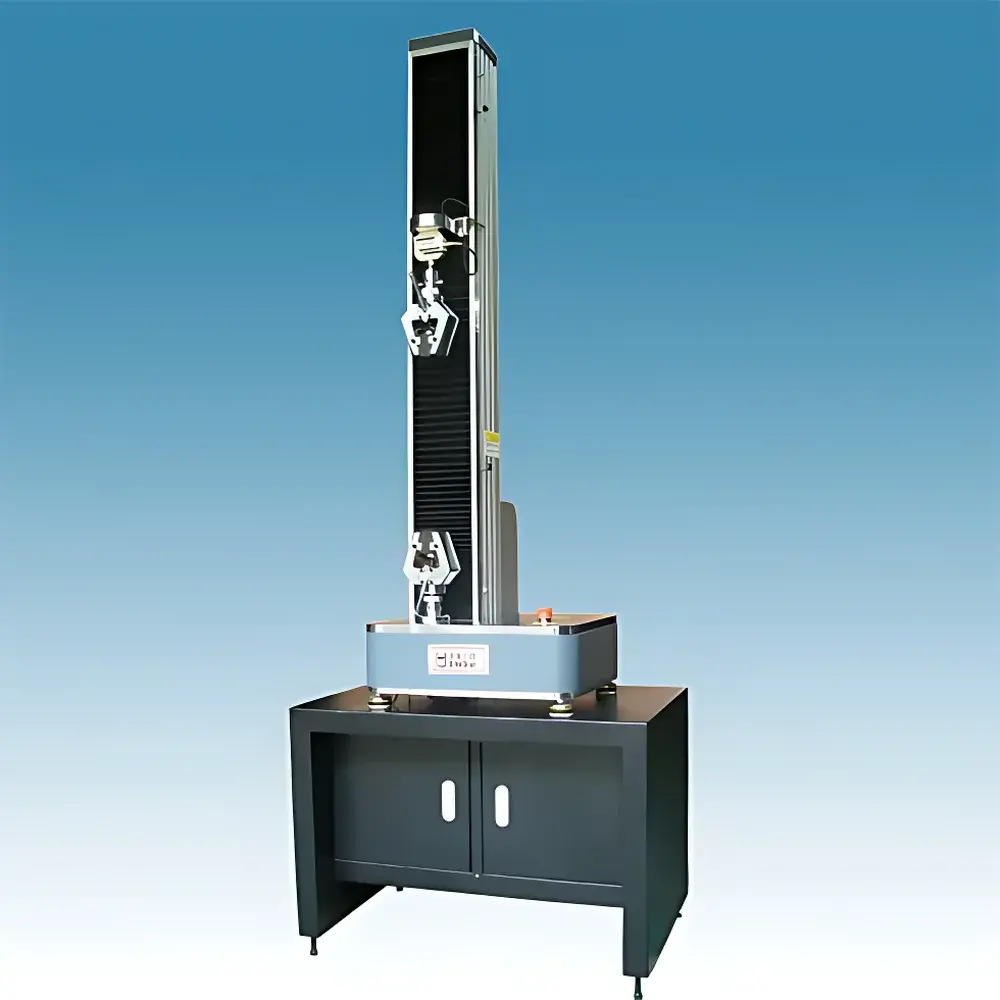
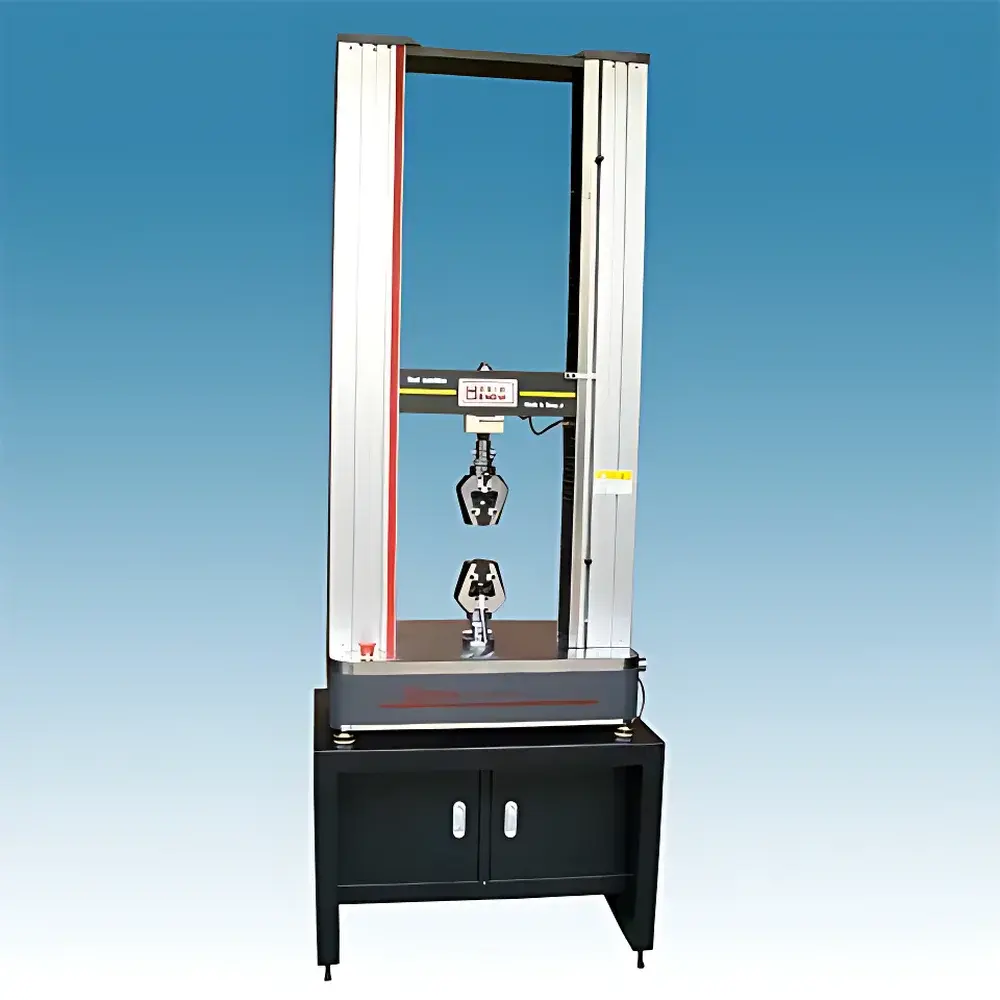
Hengyi HY-0580 Single-Column Universal Testing Machine for Automotive Glass Seal Strip Pull-Out Force Testing
| Brand | Hengyi |
|---|---|
| Origin | Shanghai, China |
| Manufacturer Type | Direct Manufacturer |
| Instrument Type | Electronic Universal Testing Machine |
| Model | HY-0580 (Single-Arm) |
| Load Capacity Options | 1 N to 5000 N (interchangeable load cells) |
| Force Accuracy | ≤ ±0.5% of reading |
| Effective Test Width | 120 mm |
| Effective Vertical Travel | 800 mm |
| Speed Range | 0.001–500 mm/min |
| Speed Accuracy | ±0.5% of set value |
| Displacement Accuracy | ±0.5% of reading |
| Force Resolution | ±500,000 counts (full-scale, no range switching) |
| Stress/Strain Control Range | 0.002–6% FS/s |
| Constant-Load/Displacement/Strain Control Accuracy | ±0.1% FS (≥10% FS), ±1% FS (<10% FS) |
| Safety Features | Electronic limit protection, overload cutoff at 110% FS, auto-diagnostic system |
| Power Supply | 220 V AC, 750 W |
| Dimensions (W×D×H) | 470 × 400 × 1510 mm |
| Weight | 120 kg |
Overview
The Hengyi HY-0580 is a precision-engineered single-column universal testing machine specifically configured for quantitative pull-out force evaluation of automotive glass seal strips. It operates on the fundamental principle of uniaxial tensile force measurement under controlled displacement rate—applying a defined linear traction along the horizontal axis of the seal strip specimen (standardized at 100 mm length) at a constant speed of 100 mm/min under ambient conditions. The system captures real-time force-displacement data to determine the peak detachment force—the critical mechanical threshold at which the elastomeric seal loses adhesion from the glass substrate. This metric directly informs design validation, process consistency, and regulatory conformance in Tier-1 automotive component manufacturing. Built with a rigid aluminum-alloy frame and high-fidelity load cell architecture, the HY-0580 delivers traceable, repeatable results across low-force regimes (1 N minimum) while maintaining full compliance with static mechanical testing metrology standards.
Key Features
- Modular load cell configuration supporting 12 selectable capacities—from 1 N to 5000 N—enabling seamless transition between micro-force seal integrity checks and macro-scale material characterization.
- True single-column compact design (470 × 400 × 1510 mm) optimized for benchtop integration in QC labs and R&D environments without compromising structural rigidity or thermal stability.
- High-resolution force measurement system with ±500,000 internal counts and no range switching—ensuring consistent resolution across the entire force spectrum and eliminating step-change errors during dynamic loading.
- Precise electromechanical actuation with closed-loop speed control (0.001–500 mm/min), calibrated to ±0.5% accuracy per ISO 7500-1 and ASTM E4.
- Integrated safety architecture including electronic travel limits, automatic overload shutdown at 110% of selected capacity, and real-time self-diagnostic monitoring of drive electronics, sensor integrity, and power regulation.
- Motorized crosshead with dual-speed (fast/slow) positioning and programmable return-to-start functionality—reducing operator intervention and enhancing throughput in high-volume test sequences.
Sample Compatibility & Compliance
The HY-0580 accommodates standardized 100 mm seal strip specimens as well as broader material classes—including thermoplastic elastomers (TPE), EPDM, silicone rubbers, polyurethane foams, and coated textile composites—via customizable jaw geometries and pneumatic/clamp fixtures. Its mechanical and software architecture conforms to essential international testing standards: GB/T 2611–2007 (General Requirements for Testing Machines), GB/T 16491–2008 (Electronic Universal Testing Machines), GB/T 16852.1–2008 (Calibration of Static Uniaxial Testing Machines), ASTM D412/D638 (Rubber/Plastic Tensile Properties), ISO 37 (Vulcanized Rubber – Tensile Stress-Strain), and JIS K6251. All calibration protocols are traceable to national metrological institutes, and system verification reports satisfy GLP audit requirements for automotive Tier-1 suppliers.
Software & Data Management
The embedded control software supports fully automated test execution—including pre-defined seal strip pull-out routines with configurable hold times, break detection thresholds, and pass/fail logic based on user-specified force limits. Real-time plotting displays force vs. displacement, stress vs. strain, and modulus derivation curves. Raw data exports to CSV and XML formats; graphical reports include annotated peaks, yield points, and statistical summaries (mean, SD, CV%) across batch runs. Audit trail functionality logs all parameter changes, operator IDs, calibration events, and system diagnostics—meeting FDA 21 CFR Part 11 requirements for electronic records and signatures when deployed in regulated quality systems.
Applications
- Quantitative validation of adhesion strength between automotive glazing substrates and extruded rubber or TPE sealing profiles.
- Comparative analysis of bonding performance across adhesive primers, surface treatments (e.g., plasma activation), and curing protocols.
- Material qualification of new elastomer compounds against OEM specification thresholds (e.g., Ford WSS-M99P1111-A, GMW14872).
- Process capability studies for extrusion line stability, die wear impact, and post-cure dimensional relaxation effects.
- Failure mode identification—including cohesive failure within the seal body versus interfacial delamination at the glass interface—using synchronized video capture (optional add-on).
- Multi-specimen batch testing for PPAP submissions, with automated report generation compliant with AIAG APQP documentation templates.
FAQ
What is the minimum resolvable force for seal strip testing?
The system achieves sub-millinewton resolution down to 0.001 N when equipped with the 1 N load cell, enabling precise quantification of early-stage debonding initiation.
Can the HY-0580 be integrated into an automated production line?
Yes—via RS-232, Ethernet TCP/IP, or optional PLC-compatible digital I/O, the machine supports external trigger inputs, status feedback, and recipe-based test sequencing.
Is third-party calibration certification available?
Hengyi provides NIST-traceable factory calibration certificates; optional on-site verification by accredited metrology providers is supported per ISO/IEC 17025.
Does the software support multi-language UI and report output?
The interface is English-native; report templates can be localized via editable XML schema—supporting Chinese, German, French, Japanese, and Korean language fields.
How is specimen alignment ensured during horizontal pull-out tests?
Custom-designed parallel-grip fixtures with micrometer-adjustable lateral centering and zero-backlash clamping ensure axial load alignment within ±0.2°, minimizing bending moment artifacts.



