
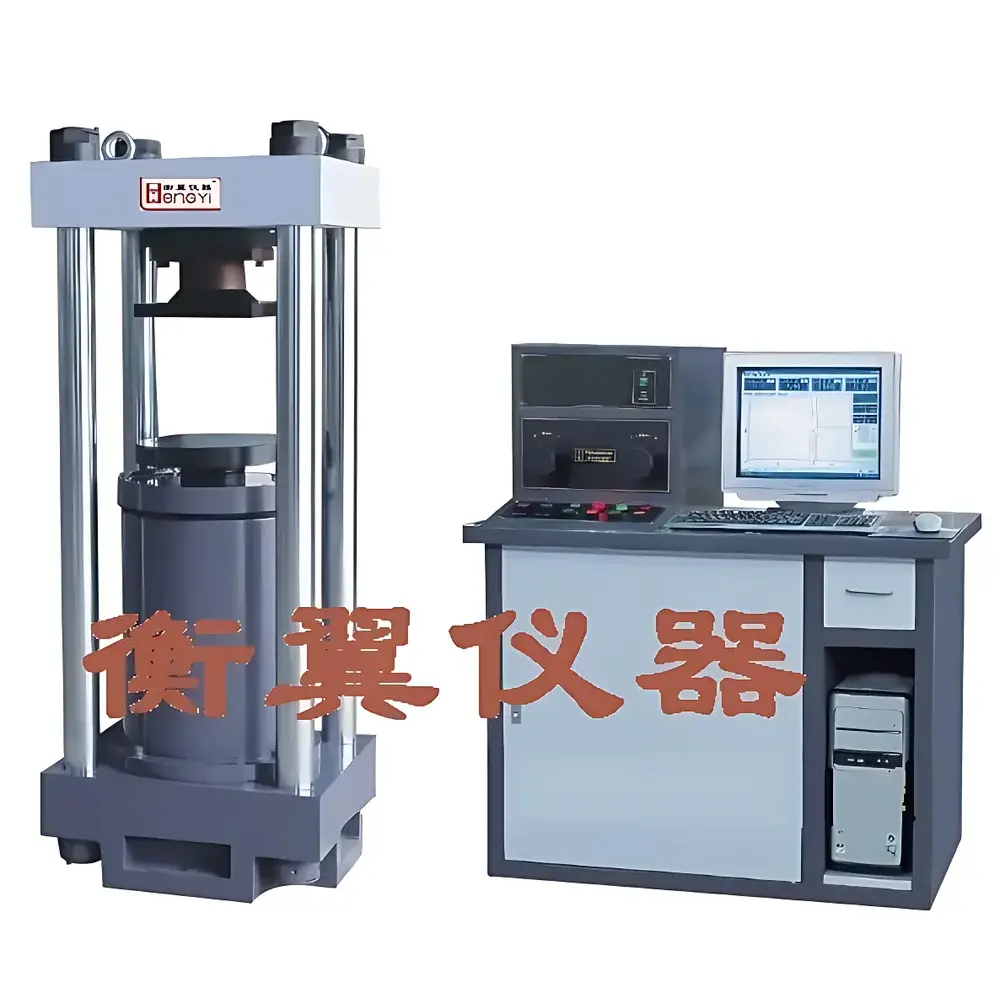
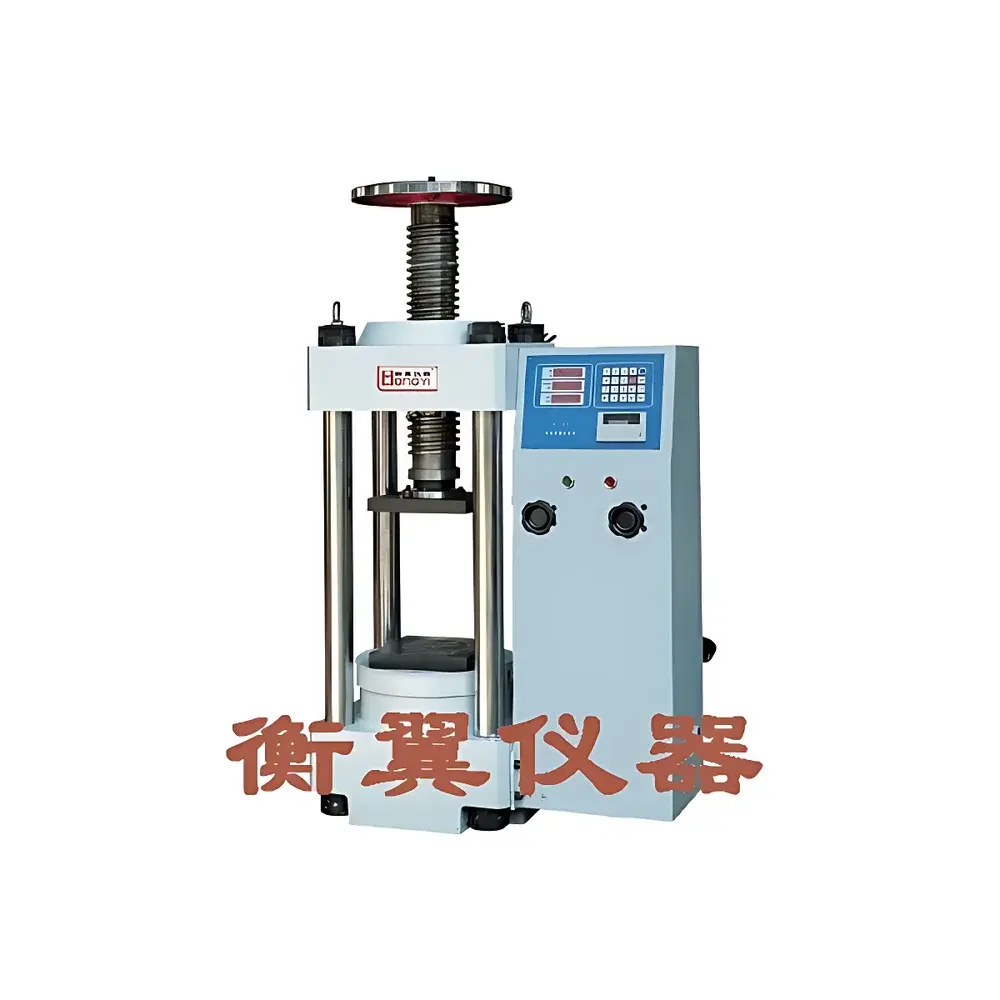
Hengyi HY(WE)-200008 Microcomputer-Controlled Electro-Hydraulic Compression Testing Machine
| Brand | Hengyi |
|---|---|
| Origin | Shanghai, China |
| Manufacturer Type | Direct Manufacturer |
| Model | HY(WE)-200008W |
| Max Load Capacity | 2000 kN |
| Accuracy Class | Class 1 (per GB/T 3159 & ISO 7500-1) |
| Force Measurement Range | 200–2000 kN |
| Relative Indicated Error | ±1% |
| Internal Clear Distance | 450 mm |
| Upper & Lower Platen Dimensions | 240 × 240 mm |
| Piston Stroke | 80 mm |
| Motor Power | 0.75 kW |
| Net Weight | ~800 kg |
| Overall Dimensions (W×D×H) | 850 × 500 × 1480 mm |
| Deformation Measurement Accuracy | ±0.5% of reading |
| Displacement Measurement Error | ±0.5% of reading |
| Stress Rate Control Range | 1–60 N/mm²/s |
| Strain Rate Control Range | 0.00025–0.0025 s⁻¹ |
| Closed-Loop Control Accuracy (Force/Displacement/Deformation) | ±1% of setpoint |
| Hydraulic Control | High-Precision Electro-Hydraulic Proportional Valve |
| Sensors | High-Accuracy Load Cell & Linear Displacement Transducer |
| Control System | Dedicated Microcomputer-Based Electro-Hydraulic Proportional Closed-Loop Controller |
| Software | Full-featured Test Management Suite with A4 Color Report Generation, Data Archiving, and Audit-Trail-Ready Export |
Overview
The Hengyi HY(WE)-200008 is a microcomputer-controlled electro-hydraulic compression testing machine engineered for high-reliability mechanical characterization of construction materials under uniaxial compressive loading. It operates on the principle of servo-controlled hydraulic actuation, where a high-precision electro-hydraulic proportional valve regulates oil flow to maintain precise force or displacement trajectories in real time. Designed in strict compliance with national and international standards—including GB/T 3159 (Chinese standard for universal testing machines), ISO 7500-1 (metallic materials — calibration of static uniaxial testing machines), and ASTM C39/C109 for concrete and mortar compression testing—the system delivers traceable, repeatable, and auditable test results suitable for QA/QC laboratories, third-party certification bodies, and R&D departments in civil engineering and building materials manufacturing.
Key Features
- Class 1 force accuracy per ISO 7500-1 and GB/T 3159, verified across 10–100% of full scale (200–2000 kN range)
- Dual closed-loop control architecture supporting simultaneous or independent regulation of load, displacement, and strain rate
- Electro-hydraulic proportional valve enabling smooth, low-noise, and hysteresis-minimized actuation with dynamic response optimized for ramp-hold and cyclic protocols
- Integrated high-stiffness frame with precision-ground vertical columns, rigid upper/lower crossheads, and self-aligning platens (240 × 240 mm) to minimize eccentric loading effects
- Motor-driven screw lift system for rapid, repeatable specimen height adjustment (80 mm piston stroke, 450 mm internal clear distance)
- Real-time acquisition of load, displacement, and deformation via calibrated load cell and LVDT-based displacement transducer, both traceable to national metrological standards
- Embedded microcomputer controller with industrial-grade embedded OS, eliminating external PC dependency for basic operation and emergency stop functionality
Sample Compatibility & Compliance
The HY(WE)-200008 accommodates standard cylindrical and cubic specimens used in structural material evaluation—including 150 mm × 150 mm × 150 mm concrete cubes, Ø150 mm × 300 mm concrete cylinders, fired clay bricks (240 × 115 × 53 mm), and natural stone blocks up to 240 mm square cross-section. Its platen geometry and alignment mechanism comply with requirements specified in ISO 4012, EN 12390-3, and GB/T 50081 for compressive strength determination. All firmware and software modules support GLP-compliant data integrity: user authentication, electronic signatures, immutable audit trails, and exportable raw data files (.csv, .txt) compatible with LIMS integration. The system meets electromagnetic compatibility (EMC) requirements per GB/T 18268 and safety standards per GB 5226.1.
Software & Data Management
The proprietary closed-loop test management software provides full lifecycle control—from test method configuration (e.g., ASTM C39 ramp-to-failure, ISO 10113 constant strain rate) to post-test analysis. Users define multi-step control profiles including preload, ramp, hold, and unloading phases with programmable dwell times and rate limits. Real-time graphs display load–displacement, stress–strain, and time-series curves with auto-scaling and cursor-based measurement tools. All test parameters, environmental metadata (operator ID, date/time, lab temperature), and raw sensor timestamps are embedded in each record. Reports conform to ISO/IEC 17025 documentation requirements and generate A4-format color PDFs with customizable headers, logos, and compliance statements. Data export supports CSV, XML, and Excel formats; database backup is automated and encrypted.
Applications
This system serves as a primary verification tool in accredited construction materials laboratories performing routine and type-approval testing per regulatory frameworks including China’s JC/T 724 (cement mortar), GB/T 2542 (masonry units), and JTGE30 (highway engineering). It supports standardized compression tests on Portland cement concrete, autoclaved aerated concrete (AAC), refractory bricks, gypsum boards, and stabilized soil-cement composites. In R&D settings, its programmable strain-rate capability enables investigation of rate-dependent behavior in fiber-reinforced concretes and early-age strength development kinetics. The machine also functions as a platform for calibrating field rebound hammers (Schmidt hammers) and validating non-destructive evaluation (NDE) correlations.
FAQ
What standards does this machine comply with for calibration and verification?
It conforms to ISO 7500-1 (static calibration), GB/T 3159 (performance verification), and includes factory calibration certificates traceable to CNAS-accredited reference standards.
Can the system be integrated into an existing LIMS or ERP environment?
Yes—via configurable ODBC/JDBC drivers and structured data export (CSV/XML) with timestamped audit logs meeting 21 CFR Part 11 data integrity expectations.
Is remote diagnostics or firmware update supported?
Firmware updates are performed via secure USB interface; remote diagnostic access requires optional Ethernet module and authenticated VPN tunnel per IT security policy.
What maintenance intervals are recommended for hydraulic and sensor subsystems?
Hydraulic oil replacement every 2,000 operating hours; annual recalibration of load cell and displacement transducer by authorized service center with certificate of conformity.
Does the software support multi-user role-based access control?
Yes—administrator, operator, and reviewer roles with granular permissions for test creation, execution, report approval, and archive deletion.



