
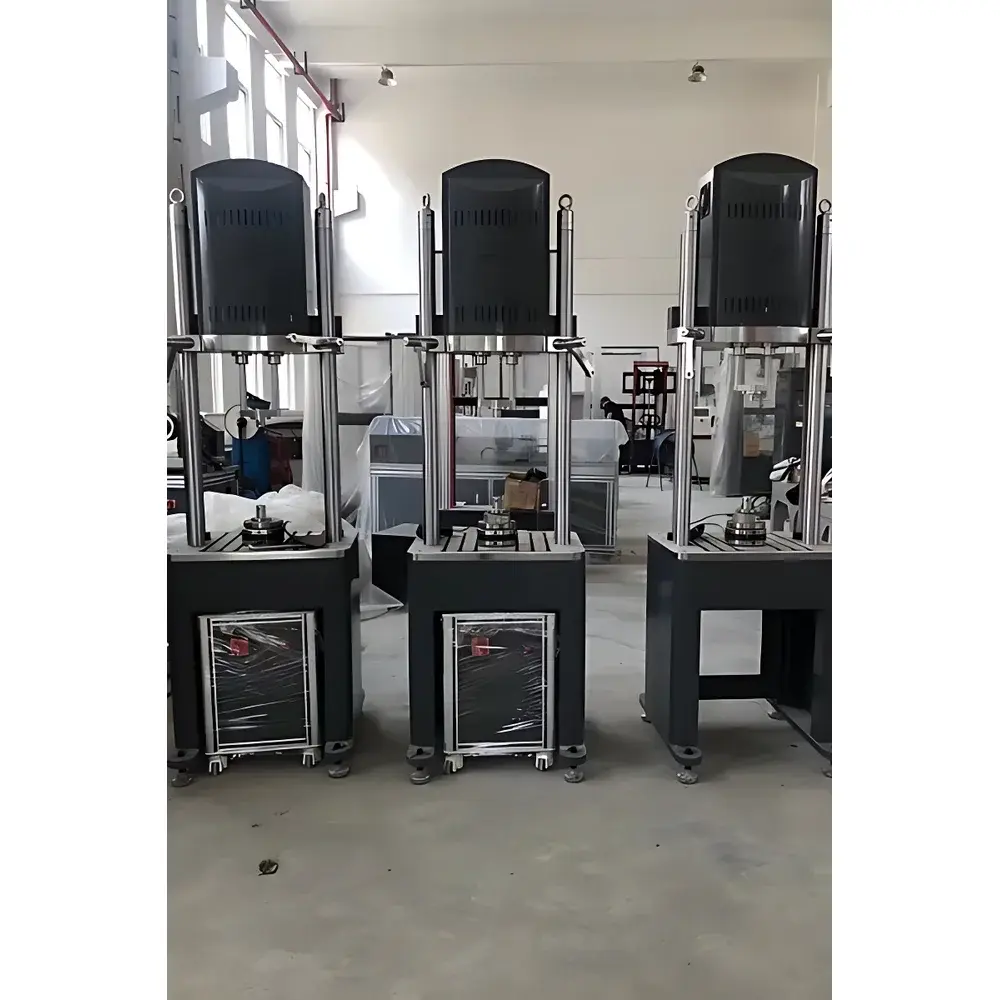
Hengyi HY(DP)5020FRT Dynamic Tension-Compression Fatigue Testing Machine for Human Knee Joint Biomechanics
| Brand | Hengyi |
|---|---|
| Origin | Shanghai, China |
| Manufacturer Type | Direct Manufacturer |
| Product Category | Domestic |
| Model | HY(DP)5020FRT |
| Price Range | USD 14,000 – 43,000 |
| Instrument Type | High-Frequency Electromechanical Fatigue Tester |
| Maximum Test Load | ±5000 N |
| Frequency Range | 0–10 Hz |
| Machine Weight | 600 kg |
Overview
The Hengyi HY(DP)5020FRT is a microprocessor-controlled electromechanical dynamic tension-compression fatigue testing system specifically engineered for biomechanical evaluation of human knee joint prostheses, ligament grafts, meniscal implants, and orthopedic fixation devices. It operates on a closed-loop servo-controlled actuation principle, applying precisely regulated cyclic loads under programmable waveforms—including sinusoidal, cosine, square, triangular, and sawtooth profiles—to simulate physiological loading conditions during gait, stair climbing, or squatting. Designed to meet the mechanical validation requirements of ISO 14243-1/2/3 (for knee joint replacements), ASTM F2723 (for soft tissue anchors), and ISO 14879-1 (for meniscal repair devices), this system delivers high reproducibility in low-frequency, high-precision fatigue regimes typical of musculoskeletal implant durability assessment.
Key Features
- Electromechanical actuator with ±5000 N force capacity and ±100 mm stroke (0–200 mm total displacement range), resolution of 0.01 N and 0.01 mm respectively
- Force measurement accuracy conforming to ISO 7500-1 Class 1 (±1% full-scale error; e.g., ±1 N at 100 N reading)
- Displacement measurement accuracy per ISO 23718 Class 1 (±0.1 mm at 10 mm reading)
- Programmable frequency range from DC to 10 Hz—optimized for physiologically relevant loading rates in knee kinematics
- Modular test space: 450 mm lateral clearance, 500 mm vertical compression height, and configurable 300 mm tensile gap (customizable per specimen fixture requirements)
- Robust structural frame weighing 600 kg, minimizing resonance interference and ensuring long-term stability during extended fatigue cycles
- Integrated multi-level safety protocols including force-limiting, amplitude-limiting, frequency-limiting, and real-time overload cutoff
Sample Compatibility & Compliance
The HY(DP)5020FRT accommodates standard and custom-designed fixtures for whole-joint specimens, bone-implant constructs, suture anchors, tibial trays, femoral components, and collagen-based scaffolds. Its mechanical architecture supports ISO 14243-3 compliant axial compression-torsion coupling when paired with optional rotational modules (not included). All control logic and data acquisition comply with GLP documentation standards, supporting audit-ready traceability for regulatory submissions. The system satisfies mechanical verification requirements referenced in FDA guidance documents for orthopedic device 510(k) and PMA pathways, particularly regarding fatigue life prediction under cyclic loading per ISO 14242-1.
Software & Data Management
The Windows-based control software communicates via RS-232 serial interface and provides full instrument automation. Real-time data acquisition enables synchronized plotting of force–time, displacement–time, and force–displacement hysteresis loops. Curve rendering supports zoom, pan, grid customization, axis scaling, and overlay comparison across multiple test runs. Data storage options include time-triggered, cycle-triggered, and user-defined interval logging. End-of-test criteria are programmable: cycle count termination, force decay thresholds (e.g., 10% loss from initial peak), or percentage deviation from baseline waveform fidelity. Export formats include native binary (.hdf), CSV, Excel (.xlsx), and Word (.docx) reports—with fully customizable templates covering specimen ID, environmental conditions (temperature/humidity logged externally), operator name, calibration status, and statistical summaries of stiffness degradation, energy dissipation, and hysteresis area.
Applications
- Fatigue life evaluation of total knee arthroplasty (TKA) components under ISO 14243-1 simulated walking cycles
- Cyclic mechanical testing of ACL/PCL graft fixation systems per ASTM F2723 and ISO 15197
- Dynamic compressive resilience assessment of osteochondral scaffolds and hydrogel-based meniscus substitutes
- Validation of cementless implant micromotion under sub-yield loading conditions
- Biomechanical benchmarking of novel biomaterials (e.g., UHMWPE variants, PEEK composites, bioresorbable polymers) in joint-relevant stress states
- Preclinical screening of additive-manufactured porous tibial baseplates under variable amplitude loading
FAQ
What standards does the HY(DP)5020FRT support for orthopedic device testing?
It is configured to execute test protocols aligned with ISO 14243-1/2/3, ASTM F2723, ISO 14879-1, and ISO 14242-1—covering static, dynamic, and fatigue performance of knee implants and soft-tissue fixation devices.
Can the system perform combined loading (e.g., compression + torsion)?
The base configuration supports uniaxial tension-compression only; optional rotational actuation modules enable coupled loading modes upon request and integration validation.
Is the software compliant with 21 CFR Part 11 requirements?
While the core software provides electronic signatures, audit trails, and data integrity safeguards, full 21 CFR Part 11 compliance requires site-specific validation documentation and role-based access configuration managed by the end user.
What is the recommended maintenance schedule?
Biannual calibration of load cell and displacement transducer is advised; annual inspection of actuator bearings, drive belt tension, and thermal management systems ensures optimal long-term repeatability.
Does the system support third-party fixture integration?
Yes—standard M6 and 1/4″-20 threaded mounting interfaces are provided; custom fixture designs must conform to maximum moment arm and center-of-gravity constraints specified in the mechanical installation manual.



