
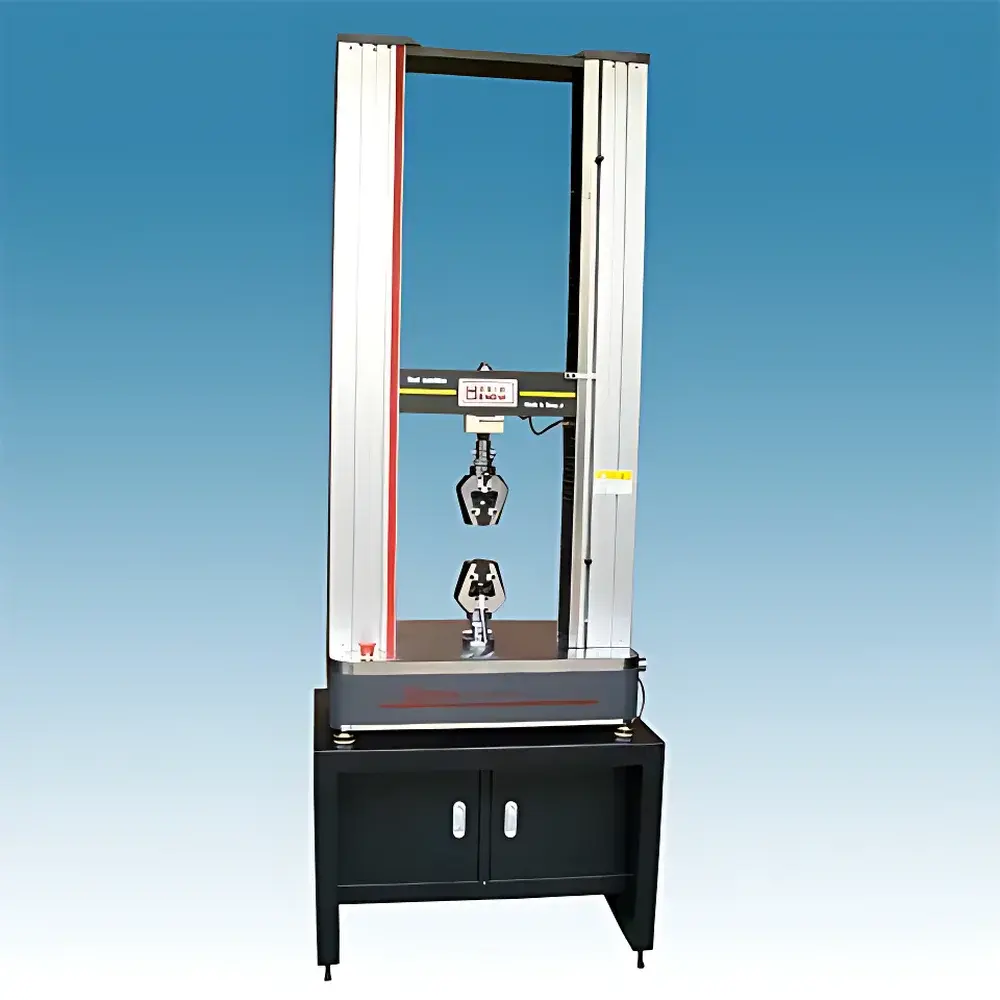
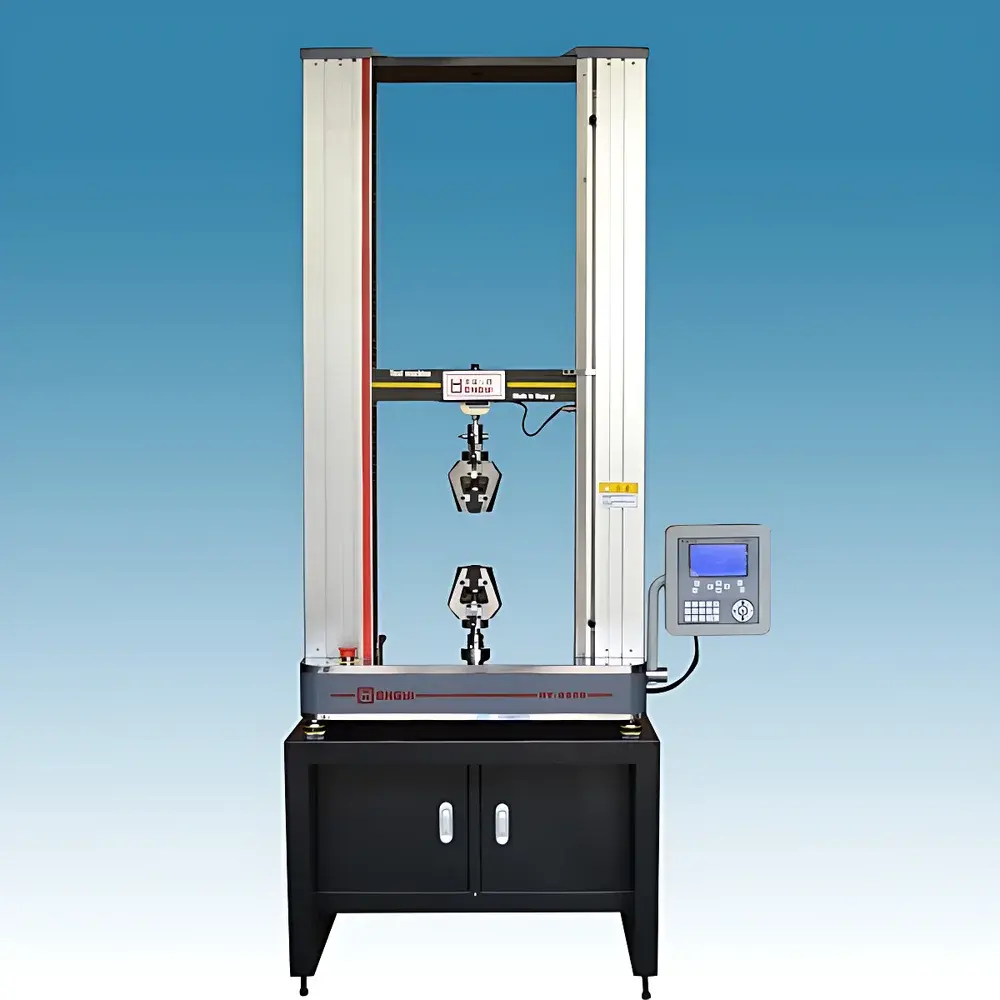
Hengyi HY-3080UIMM 30 kN Dual-Column Universal Testing Machine
| Brand | Hengyi |
|---|---|
| Origin | Shanghai, China |
| Manufacturer Type | Direct Manufacturer |
| Instrument Type | Electromechanical Universal Testing Machine |
| Load Capacity | 30 kN |
| Accuracy Class | ≤0.5% |
| Effective Test Width | 380 mm |
| Effective Stroke | 800 mm |
| Speed Range | 0.001–1000 mm/min |
| Force Resolution | ±500,000 counts (full-scale, no range switching) |
| Displacement Accuracy | ±0.5% of reading |
| Strain Control Range | 0.002–6% FS/s |
| Stress Control Range | 0.005–6% FS/s |
| Power Supply | 220 V AC, 0.75 kW |
| Weight | 210 kg |
| Dimensions (W×D×H) | 700 × 420 × 1600 mm |
Overview
The Hengyi HY-3080UIMM is a precision-engineered dual-column universal testing machine designed for static mechanical characterization of materials across research, quality control, and production environments. Based on electromechanical actuation with servo-controlled motion and high-fidelity load measurement, it implements standardized uniaxial tensile, compression, flexure, peel, shear, and cyclic loading protocols per ASTM E4, ASTM E8/E8M, ISO 6892-1, ISO 7500-1, and GB/T 228.1. Its rigid C-frame architecture—featuring preloaded ball screws, dual precision guide columns, and integrated overload protection—ensures long-term dimensional stability and repeatable force transmission under dynamic load conditions. The system delivers traceable force measurement down to 0.1% of full scale (FS), with real-time synchronization of load, displacement, and extensometer-derived strain data at up to 1 kHz sampling rate.
Key Features
- High-rigidity dual-column frame with optimized thermal mass and vibration-damped base plate for minimal deflection during high-load testing
- Brushless AC servo motor coupled with dual preloaded ground ball screws (pitch: 5 mm) enabling smooth, backlash-free motion across the full speed range
- Calibrated bi-directional load cell (±30 kN capacity, class 0.5 accuracy per ISO 376) with integrated temperature compensation and digital filtering
- Modular controller supporting open-loop speed control and closed-loop modes: force control, displacement control, strain control, and multi-step ramp-hold profiles
- Intuitive handheld pendant with tactile buttons and LCD status display for rapid jog, start/stop, and safety-initiated emergency halt
- Comprehensive hardware safety suite: electronic stroke limits, software-defined overload cutoff (110% FS), mechanical end-stop buffers, and automatic fault diagnostics for drive, sensor, and power subsystems
Sample Compatibility & Compliance
The HY-3080UIMM accommodates specimens from sub-millimeter filaments to structural composites, including polymer films (PET, PE, PP), elastomeric strips, metallic foils (Al, Cu), photovoltaic interconnect ribbons, biomedical tubing (PVC, silicone), suture materials, orthopedic fixation wires, packaging straps, paperboard laminates, and ceramic matrix composites. Grip options include pneumatic wedge clamps, hydraulic vise jaws, and custom fixtures compliant with ASTM D882, ISO 527-2, ISO 179, and ISO 1133. All force and displacement measurements are traceable to national standards via factory calibration certificates (NIST-traceable reference loads). The system meets electromagnetic compatibility requirements per EN 61326-1 and functional safety criteria per EN ISO 13857 for guarded access zones.
Software & Data Management
The embedded test software supports multilingual UI (English, Chinese, Spanish, German) and configurable unit systems (N/kN/lbf, mm/in, MPa/psi). It records raw channel data (load, position, extensometer output) in binary format with time-stamped metadata, exportable to CSV or HDF5 for third-party analysis. Audit trails log user actions, method changes, calibration events, and system errors in accordance with GLP and FDA 21 CFR Part 11 requirements when paired with optional electronic signature modules. Custom test methods can be defined using parameterized templates—e.g., “Tensile Test – ASTM D638 Type I” or “Peel Adhesion – ASTM D903”—with pass/fail thresholds, auto-stop triggers (load drop >15%, displacement limit, time duration), and post-test report generation (PDF/Excel) including stress–strain curves, modulus calculation (secant, tangent), yield point identification (0.2% offset), and statistical summaries across replicate tests.
Applications
This system serves as a core platform for mechanical property validation in regulated and non-regulated sectors: tensile strength and elongation-at-break of medical device components (catheters, sutures, stent crimping validation); peel adhesion of pressure-sensitive tapes and pouch seals; compressive yield behavior of foam insulation and lightweight honeycomb cores; flexural modulus of fiber-reinforced thermoplastics per ISO 178; creep and relaxation profiling under constant load; and high-cycle fatigue pre-screening (via optional servo-hydraulic upgrade path). It is routinely deployed in university materials science labs, ISO/IEC 17025-accredited calibration centers, automotive Tier-1 supplier QC labs, and pharmaceutical packaging validation units.
FAQ
What is the maximum test speed and its accuracy specification?
The crosshead speed is adjustable from 0.001 to 1000 mm/min, with speed accuracy maintained within ±0.5% of setpoint across the entire range.
Can the system perform strain-controlled testing with an extensometer?
Yes—it supports both clip-on and video-based extensometers (optional accessories), enabling closed-loop strain control with rates from 0.002% to 6% FS/s and accuracy per ISO 9513.
Is the force measurement traceable to international standards?
Each load cell is factory-calibrated against NIST-traceable deadweight standards, with certificate documentation provided; annual recalibration is recommended per ISO/IEC 17025 guidelines.
Does the controller support automated test sequencing?
Yes—the software allows batch execution of multiple specimen tests with unique parameters, auto-reset between runs, and conditional branching based on real-time pass/fail evaluation.
What safety certifications does the machine hold?
It complies with CE marking requirements under Machinery Directive 2006/42/EC, EMC Directive 2014/30/EU, and Low Voltage Directive 2014/35/EU, with documented risk assessment per ISO 12100.



