
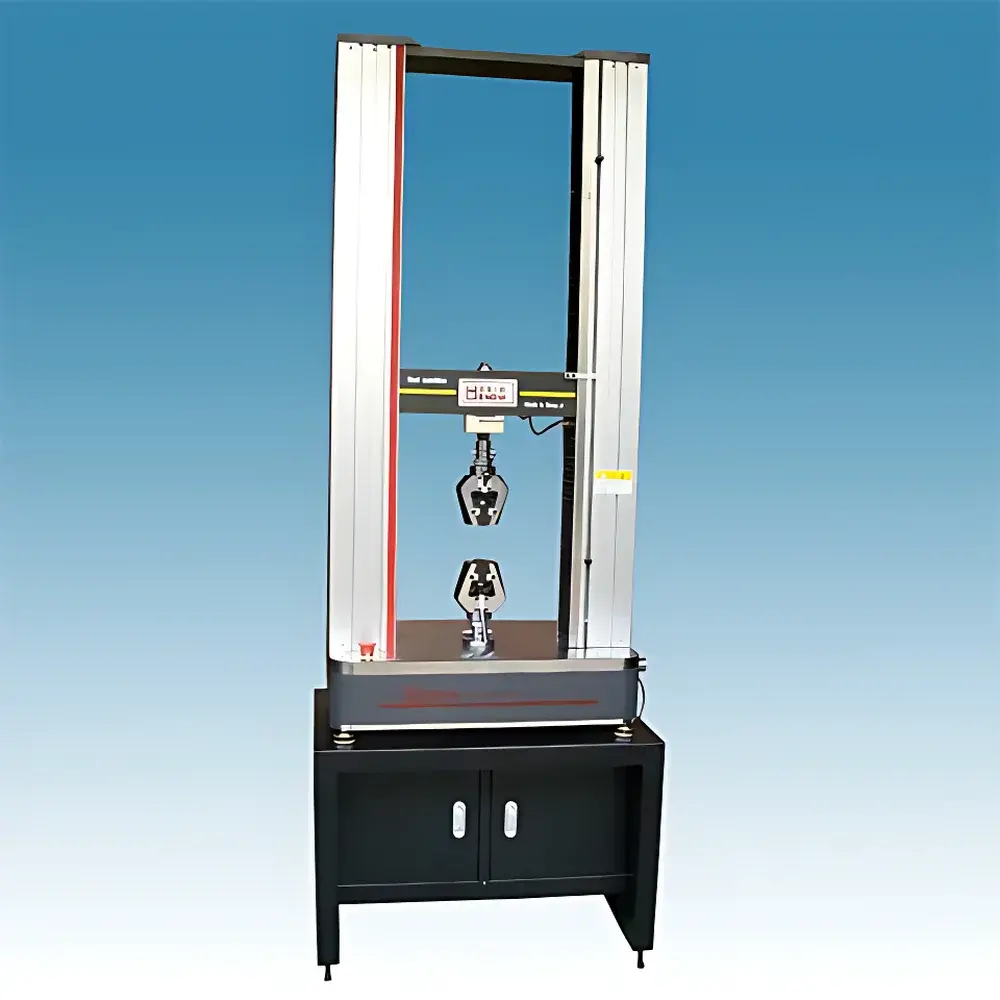
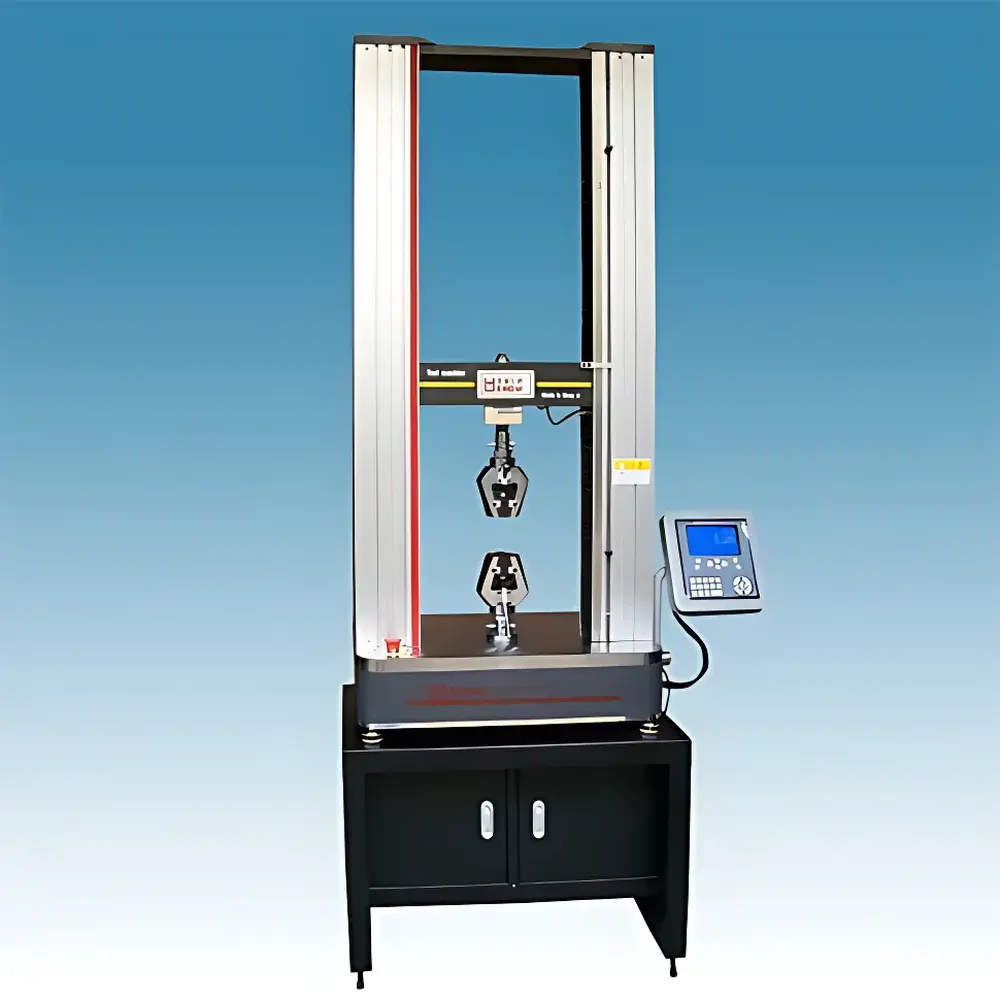
Hengyi HY-1080YUNN Universal Testing Machine for Spring Steel Wire Tensile Testing
| Brand | Hengyi |
|---|---|
| Origin | Shanghai, China |
| Manufacturer | Yes |
| Type | Electronic Universal Testing Machine |
| Load Capacity | 10 kN (configurable below 10 kN) |
| Load Cell Accuracy | 0.01% FS |
| Measurement Accuracy | < ±0.5% |
| Control Mode | Full PC-based Windows control system |
| Effective Test Width | ~380 mm |
| Effective Stroke | ~800 mm |
| Test Speed Range | 0.001–500 mm/min |
| Speed Accuracy | ±0.5% |
| Displacement Accuracy | ±0.5% |
| Strain/Deformation Accuracy | ±0.5% |
| Safety Features | Electronic limit switches, emergency stop button |
| Unit Weight | ~210 kg |
| Power Supply | 220 V AC |
| Dimensions (W×D×H) | 700 × 420 × 1600 mm |
Overview
The Hengyi HY-1080YUNN Universal Testing Machine is an electromechanical static testing system engineered for high-precision tensile, compression, and flexural characterization of metallic wire materials—particularly spring steel wire, high-carbon steel wire, tire cord steel, and other high-strength linear metallic specimens. It operates on the principle of controlled uniaxial force application with real-time synchronized measurement of load, displacement, and axial deformation. Designed in compliance with ISO 6892-1 (metallic materials — tensile testing), ASTM E8/E8M, and GB/T 11181-2016 (steel cord for radial tires), the system delivers traceable mechanical property data including ultimate tensile strength (UTS), yield strength (Rp0.2), elongation at break (%A), modulus of elasticity (E), and reduction of area. Its rigid dual-column frame, precision ball-screw actuation, and high-resolution digital load cell ensure structural stability and repeatability under dynamic loading conditions typical of quality control laboratories and R&D facilities.
Key Features
- Modular 10 kN load capacity (scalable to lower ranges), supported by a 0.01% full-scale accuracy load cell for reliable low-load sensitivity and high-end linearity.
- Wide-speed electromechanical drive system enabling test velocities from 0.001 mm/min (creep-sensitive tests) to 500 mm/min (high-rate rupture analysis), with speed fidelity maintained within ±0.5%.
- Integrated displacement transduction via high-resolution encoder and optional extensometer inputs, delivering stroke and strain measurement accuracy of ±0.5% across the full 800 mm effective travel range.
- Dual-mode operation: fully automated Windows-based software control with programmable test profiles, or manual jog mode for specimen alignment and pre-load verification.
- Comprehensive safety architecture including hardware-based electronic limit switches, redundant emergency stop circuitry, and software-enforced stroke safeguards—fully compliant with IEC 61508 functional safety principles for industrial test equipment.
- Robust mechanical construction: cast-iron base, hardened steel crosshead guides, and preloaded ball screws ensure minimal deflection (<0.02 mm under max load) and long-term dimensional stability.
Sample Compatibility & Compliance
The HY-1080YUNN accommodates a broad spectrum of one-dimensional and planar specimens. Standard configurations support steel wire (diameters 0.15–5.0 mm), steel cords (single- and multi-filament), metal foils, thin plates, and polymer monofilaments. With optional fixtures—including wedge-action grips, pneumatic clamps, compression platens, and three-point bend assemblies—the system extends to rubber strips, textile yarns, geotextiles, and coated cables. All mechanical and software functions align with regulatory expectations for GLP and GMP environments: audit trail logging, user access levels (admin/operator/guest), electronic signature capability, and data immutability per FDA 21 CFR Part 11 requirements when configured with validated software modules. Test reports are exportable in PDF/A-1b and CSV formats for integration into LIMS or enterprise QA databases.
Software & Data Management
Built on a VB.NET + SQL Server backend, the proprietary Hengyi TestSuite v4.2 provides deterministic data acquisition at up to 1 kHz sampling rate. The interface supports real-time curve overlay (force vs. displacement, stress vs. strain), automatic detection of yield points (0.2% offset method), fracture identification via slope thresholding, and customizable pass/fail criteria based on UTS, elongation, or load drop. Users may define reusable test methods—including ramp-hold-relax sequences, cyclic loading protocols, and multi-step tensile-to-fracture routines—with parameter inheritance across batches. Raw datasets are stored in encrypted binary containers with embedded metadata (operator ID, timestamp, environmental conditions, calibration certificate IDs). Export options include ISO-standardized XML result files compatible with ASTM E1434 and ISO 10360-7 traceability frameworks.
Applications
- Tensile evaluation of spring steel wire per EN 10270-1 and JIS G 3561 for fatigue-critical applications in automotive valve springs and suspension systems.
- Quality conformance testing of steel tire cords per GB/T 11181-2016 and ISO 10422, including breaking force, elongation at maximum load, and residual elongation after unloading.
- Mechanical screening of high-carbon drawn wire used in orthodontic archwires, surgical sutures, and precision fasteners.
- Interlaboratory round-robin studies requiring inter-system comparability, supported by NIST-traceable calibration certificates (available upon request).
- Research-grade ductility mapping of alloy-modified stainless steel wires under varying heat treatment conditions.
FAQ
What standards does the HY-1080YUNN comply with for steel wire testing?
It meets the mechanical and procedural requirements of GB/T 11181-2016, ISO 6892-1:2019, ASTM E8/E8M-23, and EN ISO 15630-3 for metallic wire and cord testing.
Can the system perform compression or bending tests without hardware modification?
Yes—compression and three-point bending capabilities are enabled via optional accessory kits (flat platens, bending jigs) that mount directly to the standard crosshead and base; no frame retrofitting required.
Is the software validated for regulated pharmaceutical or medical device manufacturing?
The base software is configurable for 21 CFR Part 11 compliance; full validation documentation (IQ/OQ/PQ protocols, risk assessments) is available as a separate service package.
What maintenance intervals are recommended for long-term accuracy retention?
Annual load cell recalibration and biannual mechanical inspection (guide rail lubrication, screw preload verification, grip jaw wear assessment) are advised per ISO/IEC 17025 maintenance guidelines.
Does the system support third-party data acquisition integration (e.g., LabVIEW, MATLAB)?
Yes—TCP/IP and RS-232 APIs are provided for external control and streaming of live sensor data, with sample drivers included for LabVIEW 2020+ and MATLAB R2022a.



