
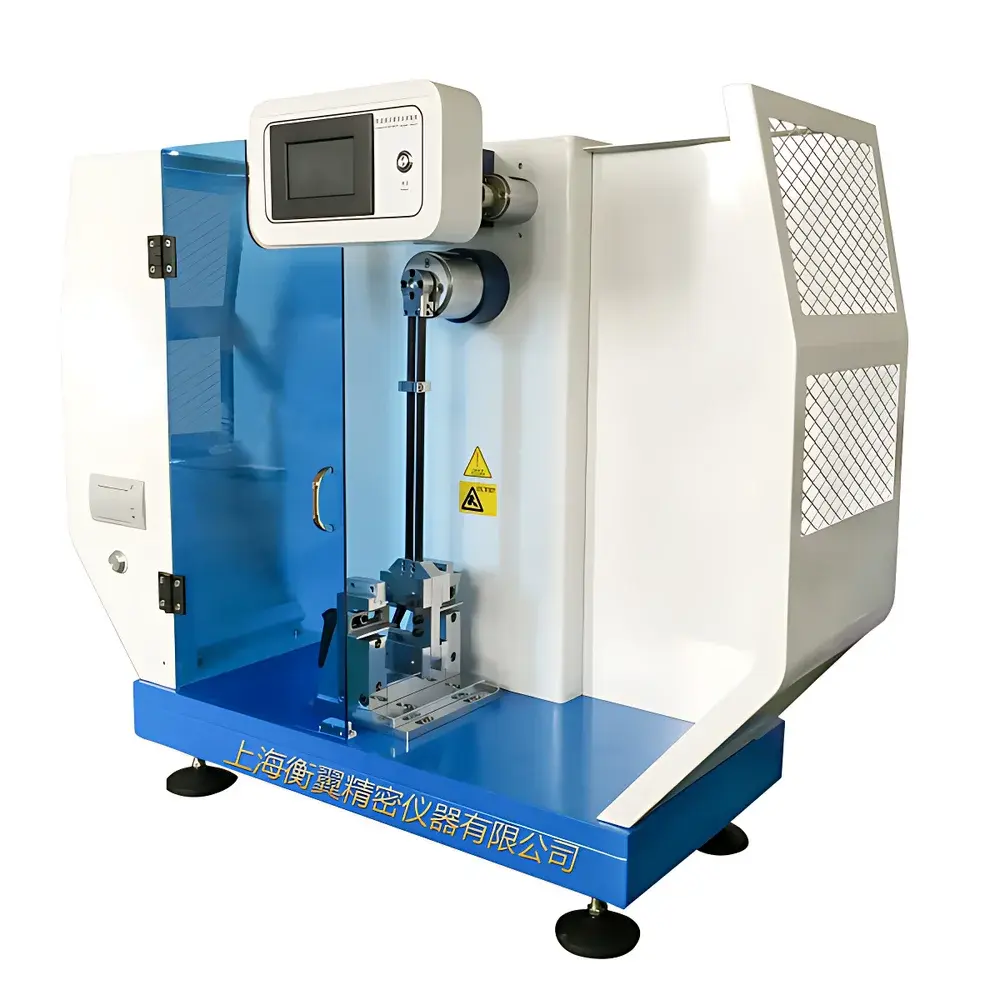
Hengyi HY(JZ)-50J Digital Charpy Impact Tester for Plastics
| Brand | Hengyi |
|---|---|
| Origin | Shanghai, China |
| Manufacturer Type | Direct Manufacturer |
| Product Category | Domestic |
| Model | HY(JZ)-50JTYY |
| Instrument Type | Pendulum Impact Tester |
| Impact Energy | 50 J |
| Impact Velocity | 2.9 m/s or 3.8 m/s (configurable) |
| Pendulum Torque (Impact Constant) | 0.001 N·m/° |
| Load Cell Range | 50 J |
| Maximum Lifting Height | 395 mm |
| Support Span Options | 40 mm / 60 mm / 70 mm / 95 mm |
| Anvil Radius | R = 1.0 mm |
| Striking Edge Angle | 30° |
| Striking Edge Radius | R = 2.0 ± 0.5 mm |
| Angular Resolution | 0.01° (Omron encoder) |
| Energy Resolution | 0.01 J |
| Display | Color TFT Touchscreen (English/Chinese UI) |
| Data Storage | Up to 12 test records with auto-averaging |
| Output | Built-in thermal printer & USB interface |
| Compliance | ISO 179-1:2010, GB/T 1043.1–2008, JB/T 8762–1998, GB/T 18743–2002 |
Overview
The Hengyi HY(JZ)-50J Digital Charpy Impact Tester is a precision-engineered pendulum impact testing system designed specifically for the quantitative determination of notched Izod impact strength in rigid and semi-crystalline thermoplastic and thermoset materials. Based on the classical Charpy (simply supported beam) principle, the instrument measures the energy absorbed by a standardized notched specimen during fracture under a defined impact load. The test method conforms to internationally recognized standards including ISO 179-1:2010 (Plastics — Determination of Charpy impact properties — Part 1: Non-instrumented impact testing), GB/T 1043.1–2008 (Chinese national standard equivalent), and GB/T 18743–2002 for thermoplastic piping systems. Unlike free-fall or drop-weight configurations, this system employs a calibrated gravity-driven pendulum with dynamically optimized mass distribution and minimal rotational inertia—ensuring high reproducibility and low measurement uncertainty across repeated tests.
Key Features
- High-stiffness carbon fiber pendulum arm engineered to minimize torsional deflection and suppress mechanical resonance during impact—enhancing repeatability and extending service life.
- Imported Omron high-resolution optical encoder (0.01° angular resolution) ensures traceable, stable angle measurement for precise kinetic energy calculation per ASTM E23 and ISO 148 calibration protocols.
- Dual configurable impact velocities (2.9 m/s and 3.8 m/s) accommodate material-specific test requirements and align with standard-defined test conditions for polymers and composites.
- Modular anvil and striker assembly with interchangeable support spans (40 mm, 60 mm, 70 mm, 95 mm) and standardized geometry (anvil radius R = 1.0 mm; striker radius R = 2.0 ± 0.5 mm; included angle 30°) guarantees strict compliance with specimen geometry tolerances.
- Integrated microthermal printer and USB data export enable immediate hardcopy reporting and offline analysis without external software dependency.
- Intelligent energy loss compensation algorithm corrects for air resistance and bearing friction in real time—improving accuracy for low-energy impacts and reducing operator-induced variability.
- Full-color touchscreen interface supports bilingual operation (English/Chinese), customizable unit output (J/m, kJ/m², kg·cm/cm, ft·lb/in), and automated statistical processing (mean, SD, CV%) across up to 12 stored test results.
Sample Compatibility & Compliance
The HY(JZ)-50J is validated for use with standardized rectangular bars (e.g., 80 × 10 × 4 mm) featuring ASTM D6110 or ISO 179-compliant notch geometries. It accommodates rigid plastics (PVC, ABS, PC, PMMA), reinforced polyamides (PA6-GF30), fiber-reinforced composites (GFRP), ceramics, cast stone, and electrically insulating materials. The system meets mechanical verification requirements outlined in ISO 179-2:2010 (instrumented impact testing) and satisfies routine performance qualification criteria for GLP-compliant laboratories. All critical mechanical dimensions—including pendulum center-of-mass offset, pivot-to-specimen distance (230 mm or 395 mm), and striking edge alignment—are factory verified and documented per ISO/IEC 17025 traceability guidelines.
Software & Data Management
No external PC or proprietary software is required for basic operation. The embedded control firmware implements deterministic real-time acquisition synchronized with pendulum angular position, enabling direct energy computation using the fundamental equation E = mgL(1 – cosθ), where m is effective pendulum mass, g gravitational acceleration, L distance from pivot to center of percussion, and θ measured deflection angle. Test records include timestamp, specimen ID, support span, notch depth, impact velocity mode, raw angular displacement curve (optional), and final absorbed energy value. Data export via USB adheres to CSV format for compatibility with LIMS platforms and statistical process control (SPC) tools. Audit trail functionality logs all parameter changes and test executions—supporting FDA 21 CFR Part 11 readiness when deployed in regulated quality assurance environments.
Applications
This tester serves as a core tool in polymer formulation development, incoming raw material inspection, batch release testing, and failure analysis workflows. Typical use cases include comparative evaluation of impact modifiers in polyolefin blends, validation of thermal aging effects on ductile-brittle transition behavior, assessment of weld-line integrity in injection-molded components, and qualification of pipe extrusion parameters per ISO 4427 or ASTM F714. Its robust architecture and low maintenance design make it suitable for high-throughput QC labs in chemical manufacturing, automotive Tier-1 suppliers, and academic polymer science departments conducting ISO/IEC 17025-accredited testing.
FAQ
What standards does the HY(JZ)-50J comply with?
It fully supports ISO 179-1:2010, GB/T 1043.1–2008, JB/T 8762–1998, and GB/T 18743–2002 for thermoplastic pipes.
Can the instrument measure unnotched specimens?
No—it is configured exclusively for notched Charpy (simply supported beam) testing per ISO 179 methodology.
Is calibration certification included with shipment?
Yes—a factory calibration report with traceability to national metrology institutes (NIM, China) is provided, covering pendulum geometry, angular sensor linearity, and energy scale verification.
How is energy loss correction implemented?
Through empirical friction compensation coefficients derived from no-load swing decay profiles, applied in real time during impact energy calculation.
Does the system support GLP or GMP audit requirements?
Yes—the embedded audit log, user access control, electronic signature capability (via optional password-protected admin mode), and CSV export format meet baseline data integrity expectations for regulated environments.



