
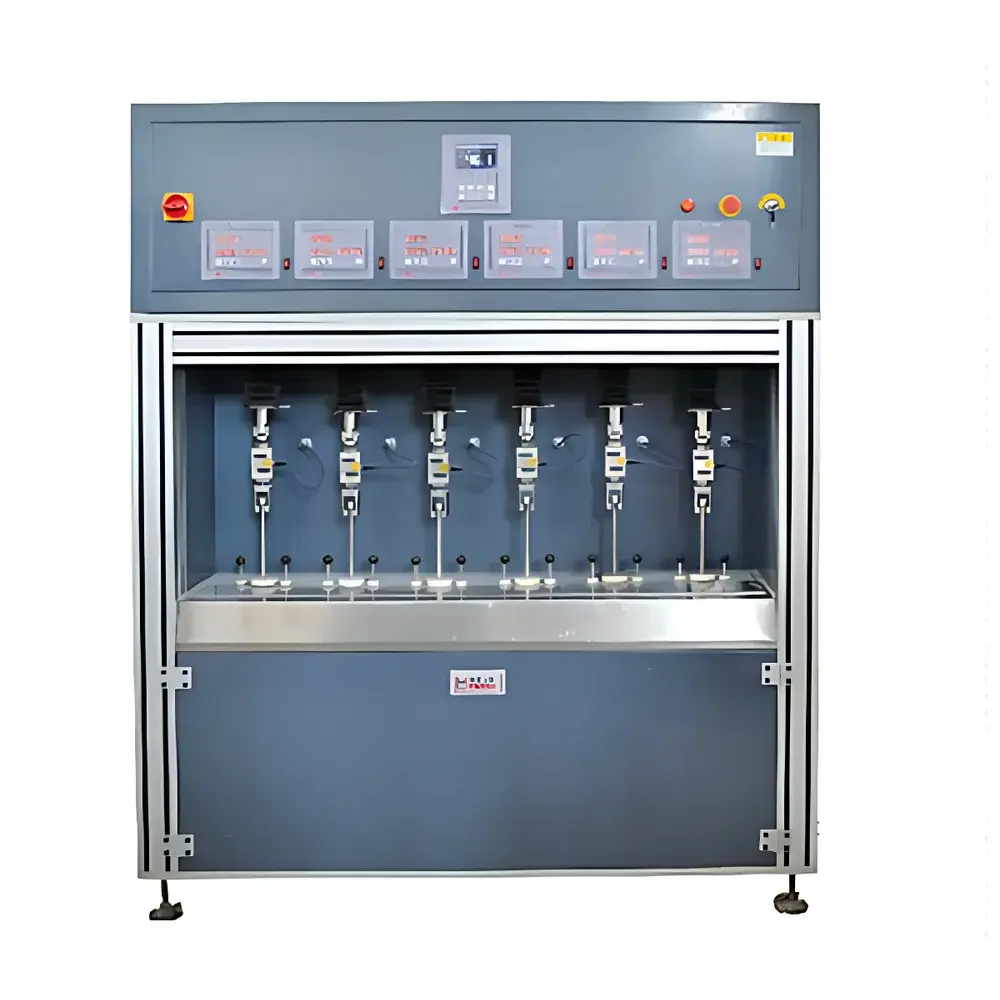
Hengyi HY-QKRBTYHNNB Full-Notch Creep Testing Machine for Polymer Composites
| Brand | Hengyi / Hengyitest |
|---|---|
| Origin | Shanghai, China |
| Manufacturer Type | Direct Manufacturer |
| Region | Domestic (China) |
| Model | HY-QKRBTYHNNB |
| Price | Upon Request |
| Load Capacity | 2000 N |
| Force Accuracy | Class 0.5 |
| Effective Force Range | 0.4–99.999% of full scale |
| Test Width | 120 mm |
| Test Height | 200 mm |
| Speed Range | 0.001–100 mm/min |
| Speed Accuracy | ±1% of indicated value |
| Displacement & Strain Accuracy | ±1% of indicated value |
| Test Stations | 12 independent stations |
| Temperature Control Range | Ambient to 95 °C |
| Temperature Stability | ±0.5 °C |
| Control System | PC-based software with automated loading and real-time data acquisition |
| Power Supply | 220 V, 10 kW |
| Dimensions (W×D×H) | 1620 × 850 × 1750 mm |
| Weight | 850 kg |
| Compliance | GB/T 15820, GB/T 11546, GB/T 32682–2016, ISO 899-1, ISO 16770, ISO 3501 |
Overview
The Hengyi HY-QKRBTYHNNB Full-Notch Creep Testing Machine is an engineered solution for evaluating time-dependent mechanical behavior—specifically creep rupture and environmental stress cracking (ESC)—in thermoplastic polymer composites, with primary application to polyethylene (PE) pipes, fittings, and structural components. It operates on the principle of sustained static loading under controlled thermal and chemical environments, enabling standardized full-notch creep testing (FNCT) per ISO 16770 and GB/T 32682–2016. Unlike conventional tensile testers, this system integrates 12 independently actuated test stations, each equipped with precision load cells, high-stability displacement transducers, and synchronized temperature-controlled water baths. The machine applies constant force or constant stress to pre-notched specimens immersed in defined media (e.g., surfactant solutions or distilled water), recording time-to-failure as a function of stress level, temperature, and environmental exposure. Its architecture supports long-term unattended operation—critical for tests spanning hundreds to thousands of hours—while maintaining metrological traceability to national and international standards.
Key Features
- Twelve fully independent test stations with isolated mechanical and thermal pathways—eliminating cross-talk between specimens during multi-condition evaluation.
- Modular load cell configuration: Standard 2000 N capacity with optional lower-range sensors (e.g., 500 N, 100 N) for enhanced resolution in low-stress ESC regimes.
- High-precision electromechanical actuation delivering force stability better than ±0.5% over 1000-hour tests, verified per ISO 7500-1 calibration protocols.
- Dual-mode control: Constant-force and constant-stress modes, both programmable via PC interface with real-time feedback compensation.
- Integrated thermostatic bath system with PID-controlled circulation, maintaining ±0.5 °C uniformity across all 12 chambers (ambient to 95 °C).
- Automated diagnostic routines including overload protection, thermal runaway detection, sensor drift monitoring, and emergency shutdown with event logging.
- Robust structural frame (850 kg mass) minimizes vibration-induced noise and ensures dimensional stability during extended creep measurements.
Sample Compatibility & Compliance
The HY-QKRBTYHNNB accommodates standard FNCT specimens per ISO 16770 (10 × 10 × 4 mm PE bars with 0.3 mm deep notch) as well as ASTM D1598-compliant pipe pull-out geometries. It supports testing in aqueous surfactant solutions (e.g., Igepal CO-630), glycerol-water mixtures, or inert media per ISO 899-1 Annex B. All hardware and firmware comply with regulatory requirements for quality-controlled laboratories: design documentation conforms to ISO/IEC 17025:2017 clause 5.5.2 (equipment verification); software validation includes audit trails, electronic signatures, and user-access tiering aligned with FDA 21 CFR Part 11 principles. Certified test reports generated by the system satisfy GLP/GMP submission criteria for polymer certification bodies and third-party accreditation (e.g., CNAS, UKAS).
Software & Data Management
Hengyi’s proprietary Windows-based control suite provides ISO 17025-compliant data governance. Each test session logs timestamped force, displacement, temperature, and elapsed time at configurable intervals (1 s to 60 min). Raw datasets are stored in encrypted .hdf5 format with embedded metadata (operator ID, calibration certificate IDs, environmental conditions). Automated post-processing calculates key outputs: time-to-failure (tf), creep compliance (J(t)), and master curves via shift-factor analysis (Williams–Landel–Ferry method). Export options include CSV, PDF test reports with digital signatures, and XML for LIMS integration. Audit trail functionality records all user actions—including parameter changes, manual overrides, and report generation—with immutable timestamps and operator attribution.
Applications
- Environmental stress cracking resistance (ESCR) assessment of PE100 and PE100-RC pipe materials per ISO 16770 and GB/T 32682–2016.
- Long-term hydrostatic strength (LTHS) prediction via multi-stress-level FNCT data fitted to power-law or Arrhenius models.
- Validation of pipe joint integrity under sustained axial pull-out loads (GB/T 15820–1995).
- Comparative evaluation of antioxidant package efficacy in polyolefin formulations under accelerated aging conditions.
- Research into crystallinity–creep coupling mechanisms using synchronized DSC or XRD correlation studies.
FAQ
What standards does this instrument directly support?
It natively implements test protocols from ISO 16770, ISO 899-1, GB/T 11546, GB/T 15820, GB/T 32682–2016, and ISO 3501.
Can individual stations operate at different temperatures or loads?
No—temperature is uniform across all 12 baths; however, each station accepts independent load setpoints and timing schedules.
Is the software compliant with FDA 21 CFR Part 11?
Yes: it includes role-based access control, electronic signatures, audit trails, and data immutability features validated per Part 11 Annex A guidance.
What maintenance intervals are recommended for long-term reliability?
Load cell recalibration every 12 months; bath fluid replacement every 6 months; mechanical guide lubrication quarterly; full system verification annually per ISO/IEC 17025.
Does the system support external data acquisition from auxiliary sensors (e.g., strain gauges, pH meters)?
Yes—via analog voltage inputs (±10 V, 16-bit resolution) and Modbus TCP interface for third-party instrumentation synchronization.



