
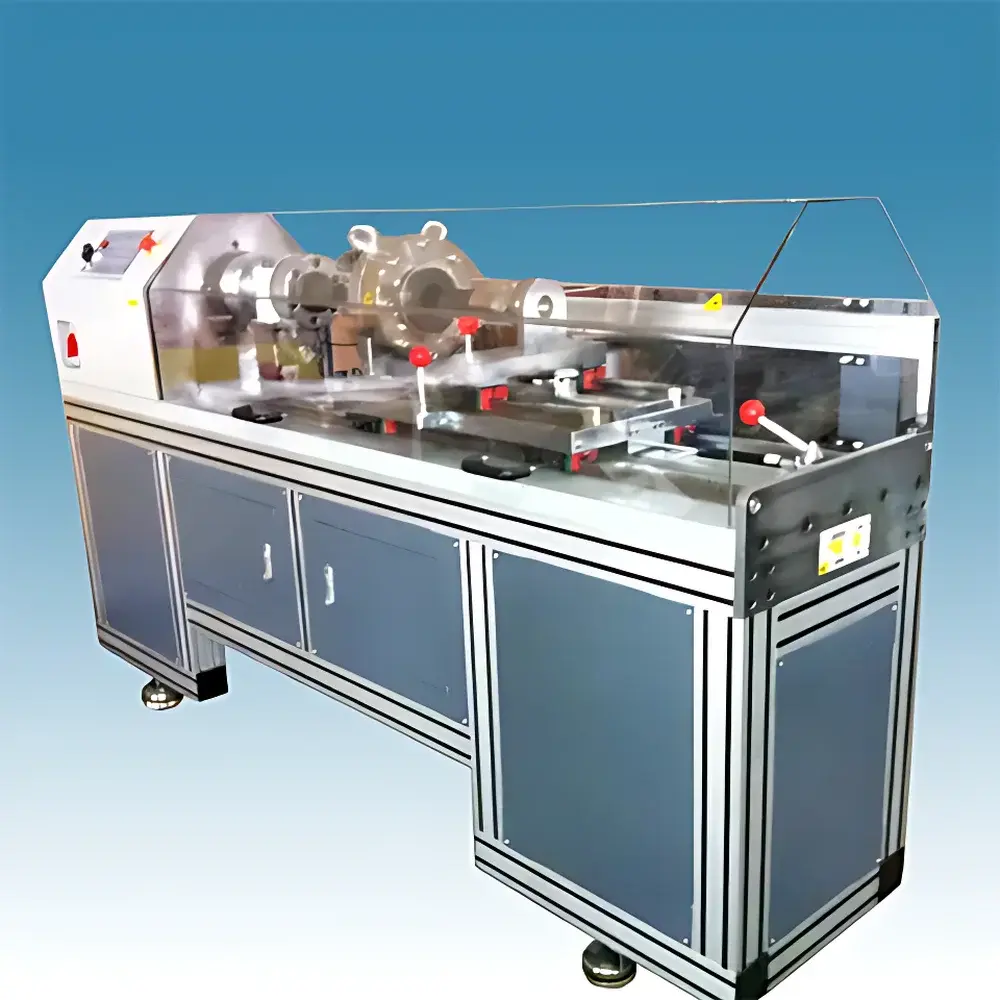
Hengyi HY-2000N·m Microcomputer-Controlled Thread Friction Coefficient Tester
| Brand | Hengyi |
|---|---|
| Origin | Shanghai, China |
| Manufacturer Type | Direct Manufacturer |
| Model | HY-2000NMX |
| Max Torque | 2000 N·m |
| Torque Measurement Range | 2–2000 N·m |
| Torque Resolution | 1/500,000 |
| Torsion Angle Measurement Range | 0–100,000° (or continuous) |
| Motor Power | 5 kW |
| Axial Force Range | 5–500 kN |
| Torque Accuracy | ±0.5% FS |
| Angular Accuracy | ±0.5% FS |
| Torsion Speed | 5–40 rpm |
| Gauge Length | 1000 mm |
| Specimen Clamping Range | M10–M30 |
| Weight | 1800 kg |
| Dimensions (L×W×H) | 2200×540×1250 mm |
Overview
The Hengyi HY-2000N·m Microcomputer-Controlled Thread Friction Coefficient Tester is a high-precision torsion testing system engineered for quantitative evaluation of mechanical and tribological behavior in threaded fasteners under combined axial load and rotational torque. Based on the principle of controlled torsional loading with simultaneous axial force application, the instrument measures real-time torque-angle response to determine critical fastener performance parameters—including thread friction coefficient (μth), bearing surface friction coefficient (μb), total coefficient of friction (μtot), torque coefficient (K), yield torque, ultimate torque, proof load, and effective torque. Its dual-sensor architecture enables independent acquisition of total torque and thread-specific torque, while synchronized axial force measurement ensures traceable separation of frictional contributions across interfaces. Designed for compliance-driven environments, the system supports static and quasi-static torsional protocols per ISO 16047, ASTM F2268, DIN 267-27, and GB/T 3098.1–2013.
Key Features
- High-fidelity dual-torque sensing: Integrated 2000 N·m main torque transducer and 1000 N·m dedicated thread torque transducer—both calibrated to ISO 376 Class 0.5 accuracy—enable decoupled measurement of gross and interface-specific torque components.
- Precision axial loading: 500 kN high-stiffness load cell (ISO 7500-1 Class 0.5) delivers stable, low-drift axial force control during rotation, essential for reproducible μth/μb partitioning.
- Advanced motion control: Panasonic AC servo motor (5 kW) coupled with planetary gearbox (2,000,000:1 speed ratio) and high-resolution optical encoder (10,000 pulses/rev) ensures torsion angle resolution better than 0.0036° and speed stability within ±0.5% of setpoint.
- Dedicated 32-bit ARM-based controller: Custom firmware running on ARM Cortex-M4 architecture provides closed-loop real-time control at 100 Hz sampling rate, supporting dynamic parameter tracking, segment-wise data zoom, and instantaneous peak capture (max torque, twist angle, axial force).
- Modular mechanical design: Horizontal two-column frame with 1000 mm adjustable test length accommodates M10–M30 threaded specimens; hardened steel chucks with interchangeable sleeves ensure repeatable clamping without slippage or thread damage.
Sample Compatibility & Compliance
The HY-2000NMX accommodates standard and custom fasteners including bolts, screws, studs, and threaded rods ranging from M10 to M30. Optional tooling extends compatibility to non-standard geometries. All measurement functions align with internationally recognized fastener testing standards: ISO 16047 (determination of torque–tension characteristics and friction coefficients), ASTM F2268 (standard test method for determining torque–tension relationships in threaded fasteners), DIN 267-27 (fastener testing—friction coefficients), and GB/T 3098.1 (mechanical properties of fasteners). Data output includes full audit trails compliant with GLP and GMP requirements, and optional configuration supports 21 CFR Part 11–compliant electronic signatures and user access control when paired with validated software modules.
Software & Data Management
The proprietary Hengyi TestMaster™ software—developed for Windows OS—provides intuitive workflow management from test setup to report generation. Users define multi-step test profiles (e.g., preload ramp → dwell → torque ramp → yield detection → failure), assign calibration certificates to each sensor, and apply real-time corrections for thermal drift and mechanical hysteresis. Raw data streams (torque, axial force, angle, time) are stored in IEEE-compliant .tdms format with embedded metadata (operator ID, sample ID, environmental conditions, calibration dates). Export options include CSV, Excel, PDF reports with customizable templates aligned to ISO/IEC 17025 reporting requirements. Software validation documentation (IQ/OQ/PQ protocols) is available upon request for regulated laboratories.
Applications
- Fastener development labs evaluating lubricant efficacy, coating performance, and surface treatment impact on μth and μb.
- Quality assurance departments conducting incoming inspection of high-strength bolts used in aerospace, wind turbine, rail, and automotive structural assemblies.
- Research institutions studying tribological mechanisms at thread/flank and bearing surface interfaces under varying preload, surface roughness, and environmental conditions.
- Standards laboratories performing inter-laboratory comparisons and reference material certification for torque–tension relationships.
- Manufacturing process engineers optimizing tightening strategies by correlating K-factor variation with thread geometry, pitch diameter tolerance, and assembly tool dynamics.
FAQ
What standards does the HY-2000NMX support for friction coefficient calculation?
It fully implements ISO 16047 Annex A (calculation of μth, μb, and μtot) and ASTM F2268 Annex B, with built-in formulae and uncertainty propagation per GUM (JCGM 100:2008).
Can the system measure both static and dynamic friction coefficients?
Yes—the instrument captures static friction onset during initial torque ramp and quantifies kinetic friction behavior throughout the torsional displacement curve, provided rotational speed remains ≤40 rpm.
Is calibration traceability provided for all sensors?
All torque and force transducers are supplied with UKAS-accredited calibration certificates (traceable to NPL or PTB), valid for 12 months; angular encoder calibration is performed in-house using laser interferometry.
Does the software support automated pass/fail evaluation against specification limits?
Yes—users can define acceptance criteria for K-value, yield torque, and friction coefficient ranges; the system flags deviations in real time and logs them in the test report.
What maintenance is required for long-term accuracy?
Annual recalibration of all load cells and encoder alignment verification are recommended; routine checks include chuck wear inspection, lubrication of gearbox, and verification of servo motor encoder coupling integrity.



