
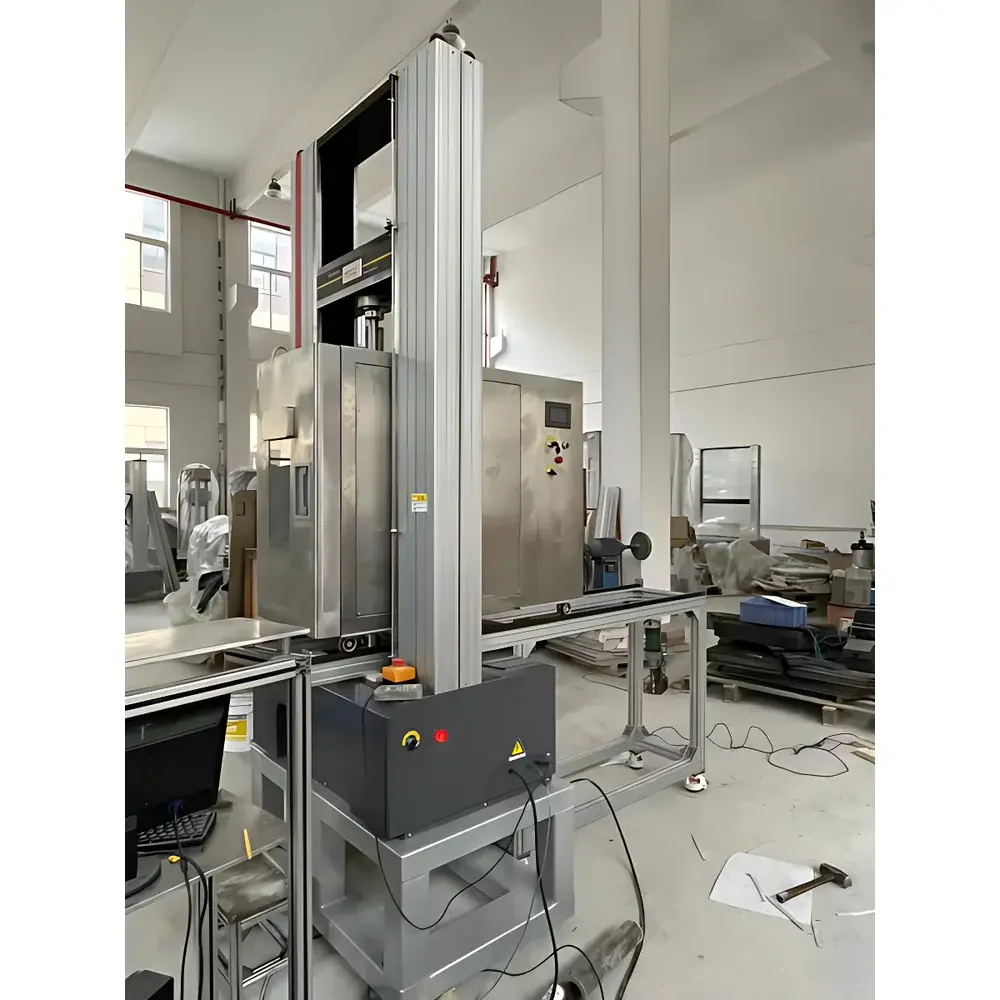
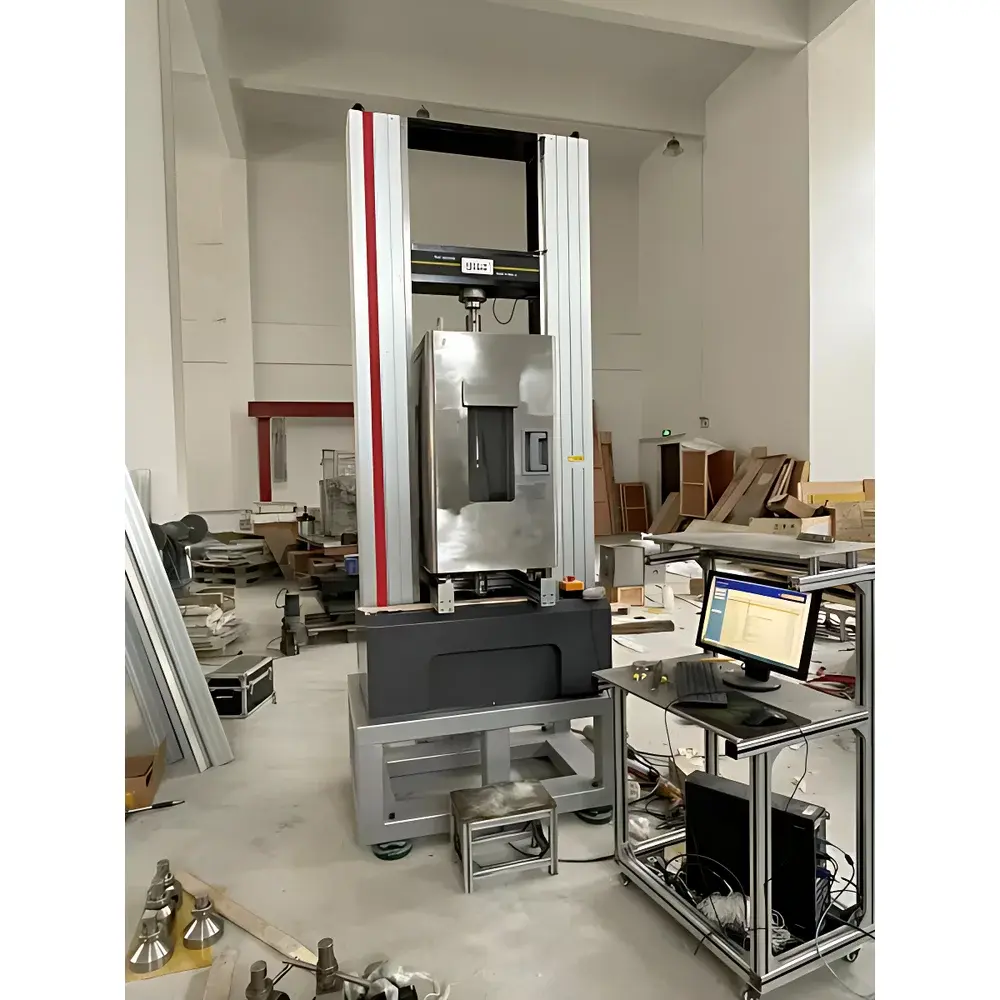
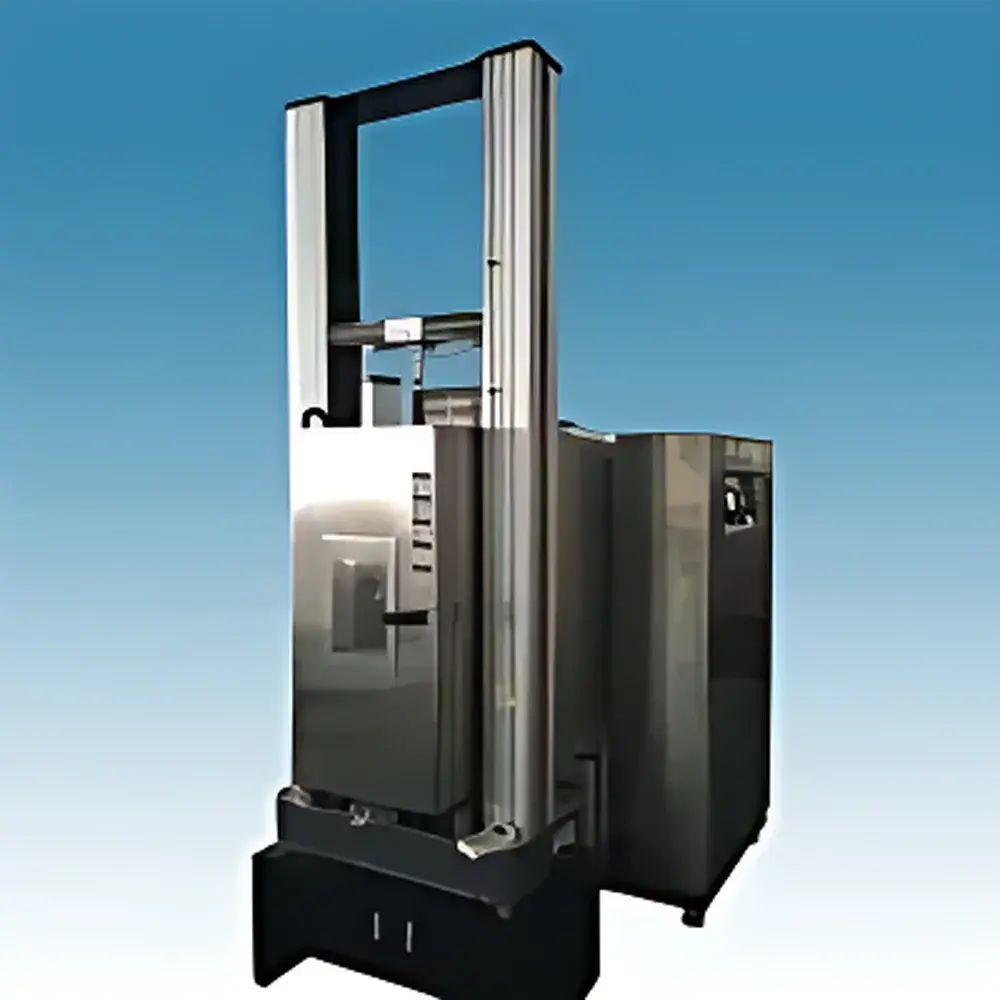
Hengyi HY-5080(GW) Aluminum Alloy High-Low Temperature Shear Testing System
| Brand | Hengyi / Hengyitest |
|---|---|
| Origin | Shanghai, China |
| Manufacturer Type | Direct Manufacturer |
| Region of Origin | Domestic (China) |
| Model | HY-5080(GW) |
| Pricing | Available Upon Request |
| Max Load | 50 kN |
| Accuracy Class | 0.5 |
| Effective Test Width | 600 mm |
| Effective Vertical Travel | 1150 mm |
| Speed Range | 0.001–500 mm/min |
| Speed Accuracy | ±0.5% of indicated value |
| Force Resolution | ±500,000 counts (full-scale, no range switching) |
| Force Measurement Range | 0.1–99.99% of full scale |
| Displacement & Strain Accuracy | ±0.5% of indicated value |
| Stress/Strain Control Rate Range | 0.002–6% FS/s |
| Temperature Range (Environmental Chamber) | −40 °C to +100 °C |
| Temp. Uniformity in Working Zone | ±1 °C (RT–100 °C), ±2 °C (−40 °C) |
| Chamber Internal Dimensions (W×H×L) | 300 × 600 × 300 mm |
| Power Supply | 220 V AC, 1.5 kW |
| Machine Weight | 950 kg |
| Overall Dimensions (W×D×H) | 1000 × 520 × 2160 mm |
Overview
The Hengyi HY-5080(GW) Aluminum Alloy High-Low Temperature Shear Testing System is a precision-engineered universal testing platform designed specifically for evaluating the mechanical integrity and thermal-dependent shear performance of aluminum alloy architectural profiles—particularly thermally broken curtain wall and window frame systems. It operates on the principle of controlled uniaxial force application under precisely regulated environmental conditions, enabling quantitative measurement of interfacial bond strength, thermal expansion mismatch effects, and shear resistance across standardized temperature gradients. The system integrates a high-rigidity dual-column load frame with a servo-controlled actuation system, high-fidelity multi-channel transduction (load, displacement, strain), and a fully programmable −40 °C to +100 °C environmental chamber—ensuring compliance with structural performance validation requirements for building materials subjected to real-world climatic cycling.
Key Features
- Robust dual-column load frame with precision-ground linear guide rods and anti-rotation coupling interfaces between crosshead, grips, and fixtures—ensuring axial alignment fidelity and minimizing parasitic bending moments during high-force shear testing.
- 0.5-class accuracy load cell (50 kN capacity) with ±500,000-count resolution, delivering stable, noise-immune force measurement across the full dynamic range without auto-ranging artifacts.
- Wide-speed servo drive (0.001–500 mm/min) with ±0.5% speed accuracy, supporting both quasi-static shear characterization and accelerated durability protocols per ISO 12944 or EN 14024.
- Dedicated high-temperature shear fixture set—including longitudinal shear, transverse tensile, and elevated-temperature tensile configurations—engineered for secure clamping of extruded aluminum profiles up to 600 mm wide, with thermal compensation for grip-induced stress concentration.
- Integrated −40 °C to +100 °C environmental chamber featuring Korean TEMI touchscreen PID controller (0.1 °C resolution), ±1 °C uniformity in the 300 × 600 × 300 mm working zone, and rapid thermal ramping (≥5 °C/min) for cyclic thermal loading simulations.
- Triple-closed-loop control architecture supporting stress-, strain-, and displacement-rate modes—enabling strict adherence to ASTM E8/E8M, ISO 6892-1, and GB/T 228.1 test protocols under variable thermal boundary conditions.
Sample Compatibility & Compliance
The HY-5080(GW) accommodates standard aluminum alloy building profiles (e.g., 6060-T6, 6063-T5, 6005A-T6) in accordance with GB/T 28289–2012 for composite thermal break performance evaluation. Fixture geometry complies with the dimensional constraints specified in EN 13279-2 and ISO 13081 for shear interface testing of insulating profiles. All mechanical and thermal subsystems meet metrological traceability requirements per JJG 139–2014 (tensile/compression machines) and JJG 475–2008 (electronic testing machine verification). Structural compliance includes GB/T 2611–2007 (general technical requirements for testing machines) and GB/T 16491–2008 (electronic universal testing machines). Environmental chamber calibration follows ISO/IEC 17025 principles, with documented uncertainty budgets for temperature uniformity and stability.
Software & Data Management
The embedded Windows-based test software provides dual-mode operation: QC mode for one-click execution of preconfigured standards (e.g., GB/T 228.1–2010, GB/T 7314–2010), and R&D mode supporting custom ramp-hold sequences, multi-step thermal-mechanical profiles, and user-defined calculation algorithms (e.g., interfacial shear strength = max load / bonded area). The interface supports English, Chinese, Spanish, and German localization. Raw data streams (force, displacement, extensometer strain, chamber temperature) are time-synchronized at ≥1 kHz sampling rate and stored in vendor-neutral ASCII CSV format. Audit-trail functionality logs all operator actions, parameter modifications, and calibration events—meeting GLP and FDA 21 CFR Part 11 electronic record requirements when configured with optional digital signature modules. Automated report generation exports to Word (.docx), Excel (.xlsx), and PDF formats; templates adhere to ISO/IEC 17025 reporting clauses and include metadata for instrument ID, environmental conditions, operator ID, and uncertainty statements.
Applications
- Quantification of longitudinal shear strength of polyamide-reinforced thermal break inserts in aluminum curtain wall mullions per GB/T 28289–2012 and AAMA 1503.
- Thermal cycling fatigue assessment of insulated glazing unit (IGU) spacer bonds under −40 °C to +80 °C excursions.
- Interfacial adhesion degradation analysis of anodized vs. powder-coated aluminum substrates after accelerated aging in humid thermal environments.
- Validation of finite element models predicting coefficient of thermal expansion (CTE) mismatch-induced shear stress at polymer-metal interfaces.
- Quality conformance testing for ISO 9001-certified extrusion manufacturers supplying to EU CE-marked construction product markets.
FAQ
Does the system support automated thermal-mechanical test sequences (e.g., hold at −20 °C → apply shear load → ramp to +60 °C)?
Yes—the software allows creation of multi-segment thermal-mechanical programs with synchronized control of chamber temperature, crosshead motion, and data acquisition triggers.
Is the environmental chamber independently calibrated and supplied with a certificate of conformity?
Each chamber ships with a factory calibration report referencing NIST-traceable references; on-site verification services are available upon request.
Can the system be integrated into a laboratory LIMS or MES environment?
API support (RESTful JSON over TCP/IP) enables bidirectional data exchange with third-party lab informatics platforms for sample tracking, result ingestion, and audit log synchronization.
What maintenance intervals are recommended for long-term accuracy retention?
Annual recalibration of load cell and extensometer is advised; chamber refrigerant charge and PID controller verification should occur every 24 months per manufacturer guidelines.
Are test method templates for AAMA 1503 or EN 14024 preloaded in the software?
Standard-compliant templates for AAMA 1503, EN 14024, and GB/T 28289–2012 are included by default; users may modify or extend them without code-level access.



