
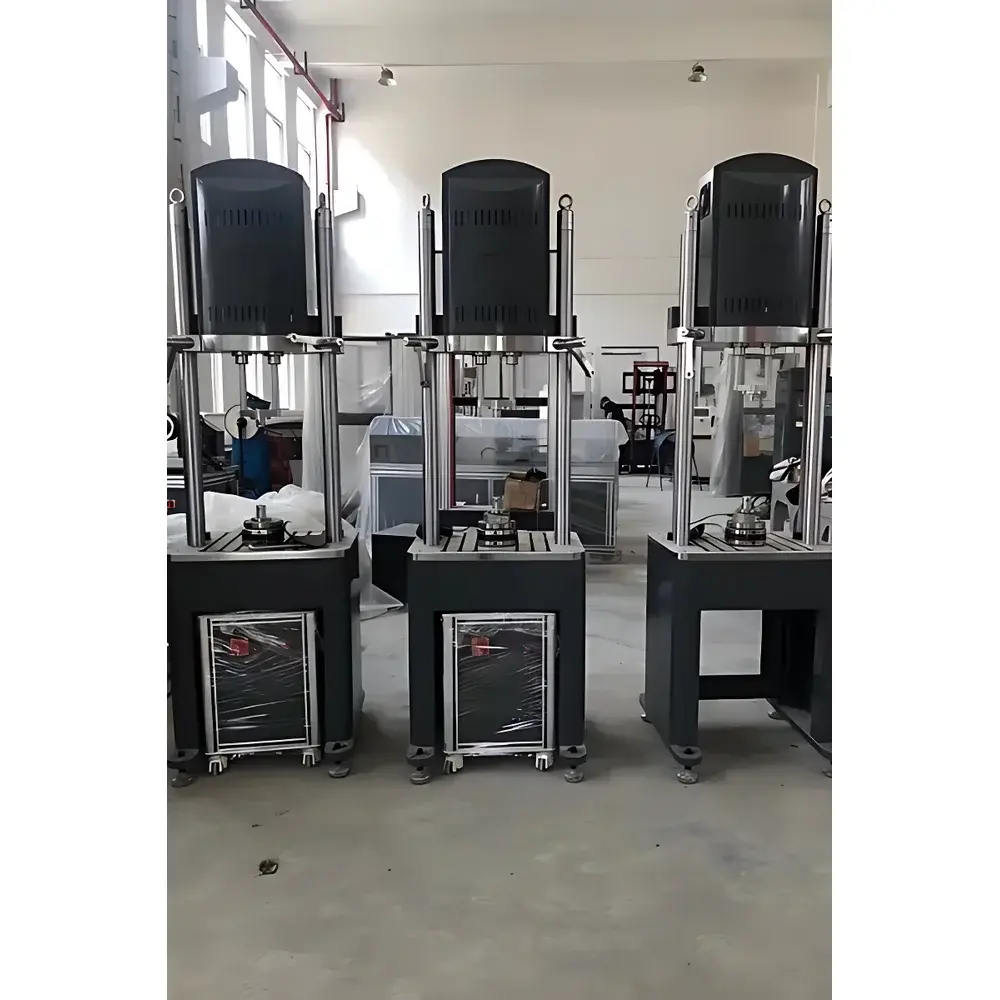
Hengyi HY(DP)5020WEER Microcomputer-Controlled Electromechanical Tension-Compression Fatigue Testing Machine
| Brand | Hengyi |
|---|---|
| Origin | Shanghai, China |
| Manufacturer Type | Direct Manufacturer |
| Product Category | Domestic |
| Model | HY(DP)5020WEER |
| Instrument Type | High-Frequency Fatigue Testing Machine |
| Maximum Test Load | ±5000 N |
| Frequency Range | 0.1–15 Hz |
| Actuator Stroke | 0–200 mm (or ±100 mm) |
| Displacement Resolution | 0.01 mm |
| Force Resolution | 0.01 N |
| Force Accuracy | Class 1 (±1% of reading) |
| Displacement Accuracy | Class 1 |
| Control Accuracy | ±1% |
| Waveform Options | Sine, Cosine, Square, Triangle, Sawtooth |
| Test Space (Tension/Compression) | 300 mm / 500 mm |
| Horizontal Clearance | 450 mm |
| Vertical Test Height | 500 mm |
| Dimensions (L×W×H) | ≈680 × 700 × 2500 mm |
| Power Supply | 380 V AC, 5 kW |
| Weight | 600 kg |
Overview
The Hengyi HY(DP)5020WEER Microcomputer-Controlled Electromechanical Tension-Compression Fatigue Testing Machine is a precision-engineered electromechanical fatigue system designed for low-to-medium amplitude, low-frequency cyclic loading applications in materials science, biomedical device validation, and mechanical component qualification. Unlike hydraulic servo systems, this machine employs a high-torque brushless servo motor coupled with a precision ball-screw actuator to deliver repeatable, low-noise, and energy-efficient force application. Its operating principle relies on closed-loop digital control of load and displacement signals via real-time feedback from integrated load cells and linear variable differential transformers (LVDTs), enabling precise waveform generation—including sine, cosine, square, triangle, and sawtooth profiles—across a programmable frequency range of 0.1 to 15 Hz. The system is particularly suited for fatigue life assessment of orthopedic implants (e.g., femoral heads, acetabular cups), polymer-based structural components, miniature fasteners, and thin-section metallic specimens where thermal drift, fluid contamination, or high maintenance overhead associated with hydraulic systems are undesirable.
Key Features
- Electromechanical actuation architecture eliminating hydraulic oil, seals, and associated leakage or viscosity-related performance drift
- Class 1 force accuracy (±1% of reading) over a dynamic range of 50 N to 5000 N, verified per ISO 7500-1 and ASTM E4 standards
- Displacement resolution of 0.01 mm and Class 1 displacement accuracy, supported by high-linearity LVDT feedback
- Programmable waveform generation with independent control of amplitude, frequency, mean load, and cycle count
- Integrated microcomputer controller with intuitive Windows-based human-machine interface (HMI), supporting real-time data visualization and parameter logging
- Rigid C-frame construction with 450 mm horizontal clearance and 500 mm vertical test height, optimized for specimen accessibility and fixture integration
- Modular test space configuration: standard 300 mm tensile stroke and 500 mm compressive stroke; customizable per ISO 148-1 Annex A requirements for implant testing fixtures
Sample Compatibility & Compliance
The HY(DP)5020WEER accommodates specimens ranging from small-diameter bone screws (Ø2–6 mm) to full-size hip joint prostheses (up to 50 mm diameter), provided within its dimensional envelope and load capacity. Standard grips include wedge-type tensile clamps and flat-faced compression platens; custom tooling (e.g., ASTM F2118-compliant femoral head retention fixtures) can be integrated upon request. The system supports compliance with key international standards including ISO 148-1 (metallic materials — Charpy impact testing), ASTM F2118 (standard practice for fatigue testing of total hip joint prostheses), and ISO 7206-4 (implants for surgery — partial and total hip joint prostheses). All calibration certificates traceable to NIM (National Institute of Metrology, China) and compatible with GLP audit documentation protocols.
Software & Data Management
The embedded control software provides synchronized acquisition of load, displacement, and cycle count at up to 1 kHz sampling rate. Raw data export is supported in CSV and Excel-compatible formats, with optional timestamped metadata (operator ID, test ID, environmental conditions). Audit-trail functionality records all parameter changes, start/stop events, and calibration interventions—meeting basic requirements for FDA 21 CFR Part 11 compliance when deployed in regulated environments. Remote monitoring via Ethernet interface enables integration into centralized lab management systems (LIMS) and supports scheduled automated test sequences without manual intervention.
Applications
- Fatigue life evaluation of orthopedic implants under physiological loading profiles (e.g., gait-cycle-simulated waveforms)
- Cyclic compression testing of porous titanium scaffolds and biodegradable polymer matrices
- Load-controlled endurance testing of miniature springs, MEMS packaging substrates, and dental abutments
- Material property mapping for elastomers and thermoplastics using staircase fatigue protocols (ISO 12106)
- Educational and R&D use in university mechanics labs requiring stable, low-maintenance cyclic loading platforms
FAQ
What is the maximum allowable specimen height for compression testing?
The standard vertical test height is 500 mm, accommodating specimens up to 500 mm in compressed length. Custom column extensions are available for taller assemblies.
Does the system support closed-loop strain control?
No—this model implements load- and displacement-controlled modes only. Strain control requires external extensometry and firmware upgrade, available as an optional module.
Is third-party calibration certification included with delivery?
Yes, each unit ships with a factory calibration report traceable to NIM, covering force and displacement channels. On-site recalibration services are offered annually.
Can the machine operate continuously for extended durations (e.g., 100,000+ cycles)?
Yes—the electromechanical drive system is rated for continuous operation at ≤10 Hz and ≤3000 N mean load, with thermal protection and duty-cycle monitoring built into the controller firmware.
What safety features are implemented during unattended testing?
Hardware interlocks include emergency stop circuitry, overload cutoff (>110% FS), stroke limit switches, and real-time anomaly detection (e.g., sudden load drop >5% within 10 ms).



