
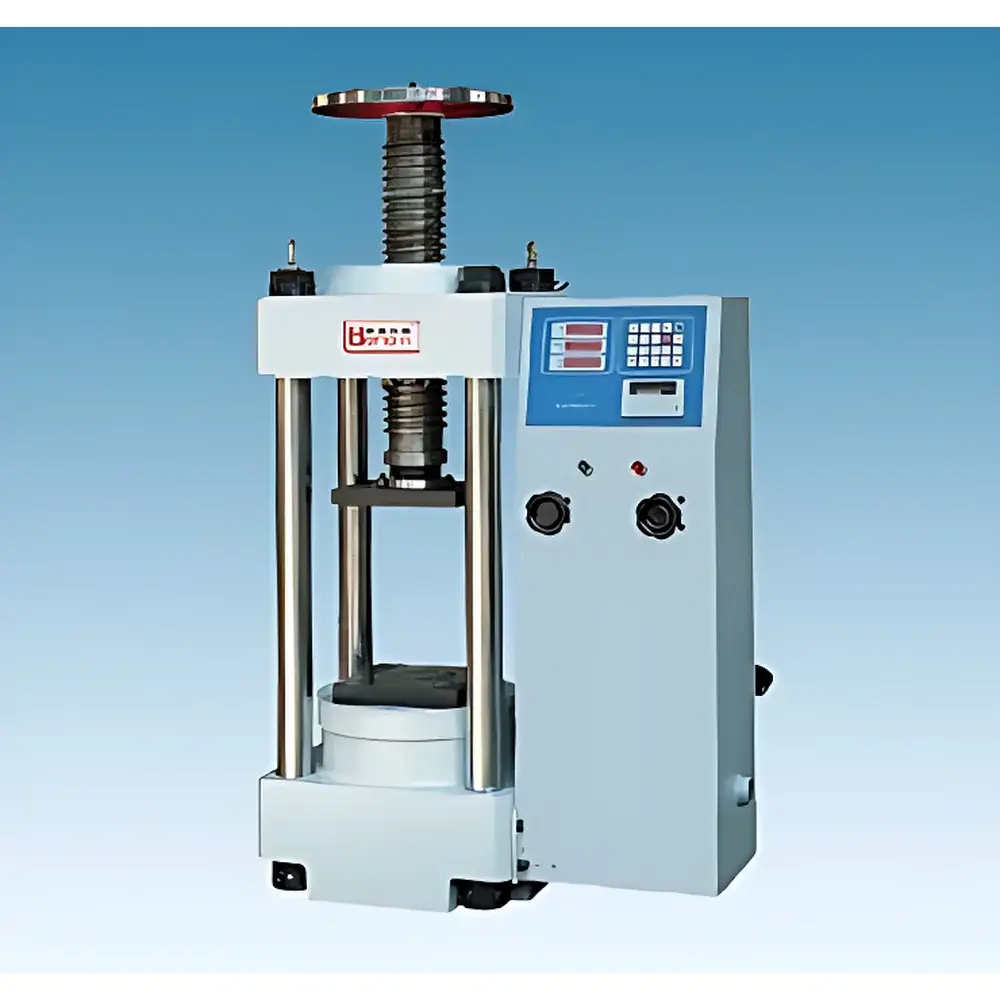
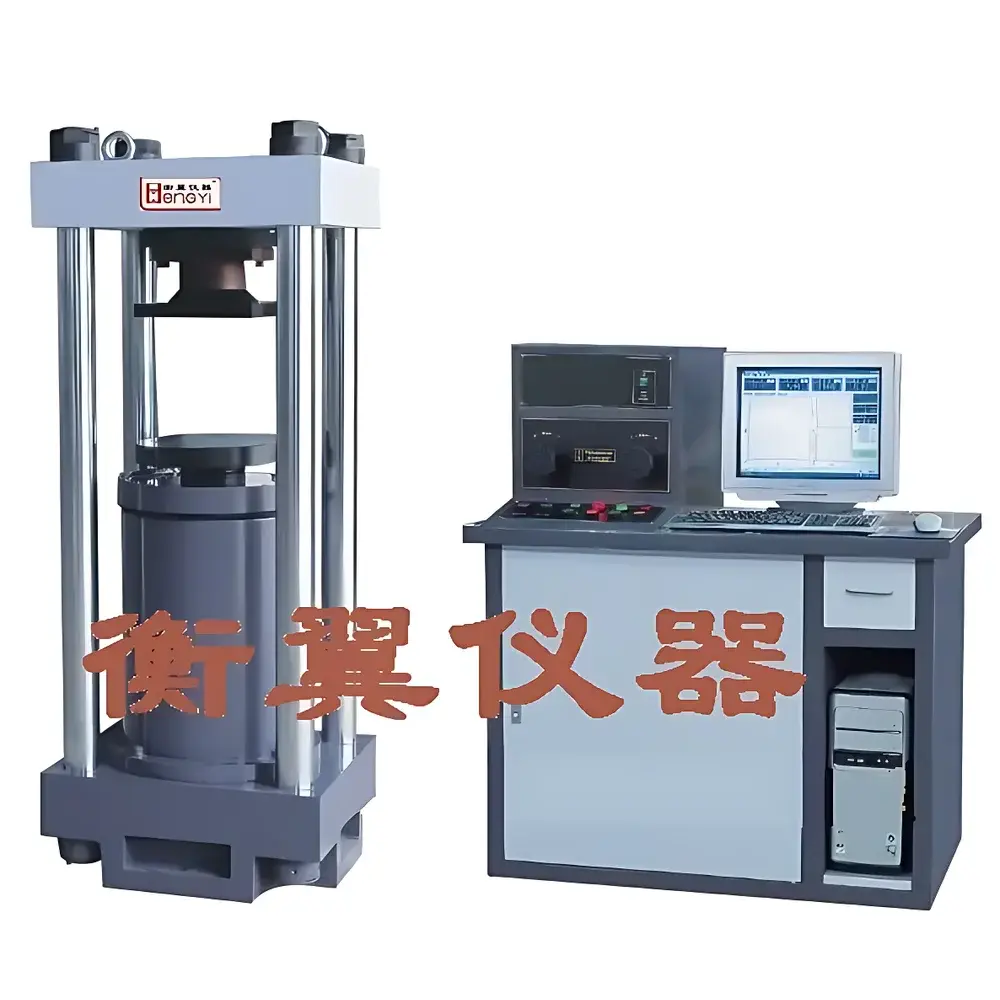
Hengyi HY(YE)-200008 Microcomputer-Controlled Electro-Hydraulic Compression Testing Machine
| Brand | Hengyi |
|---|---|
| Origin | Shanghai, China |
| Manufacturer Type | Direct Manufacturer |
| Model | HY(YE)-200008 |
| Max Load Capacity | 2000 kN |
| Accuracy Class | Class 1 (GB/T 3159 & ISO 7500-1) |
| Force Measurement Range | 200–2000 kN |
| Force Indication Relative Error | ±1% |
| Internal Clear Span | 450 mm |
| Upper/Lower Platen Dimensions | 240 × 240 mm |
| Piston Stroke | 80 mm |
| Motor Power | 0.75 kW |
| Net Weight | ~800 kg |
| Overall Dimensions (W×D×H) | 850 × 500 × 1480 mm |
| Deformation Indication Accuracy | ±0.5% of reading |
| Displacement Indication Relative Error | ±0.5% of reading |
| Stress Rate Control Range | 1–60 N/mm²/s |
| Strain Rate Control Range | 0.00025–0.0025 s⁻¹ |
| Closed-Loop Control Accuracy (Force/Displacement/Deformation) | ±1% of set value |
| Key Components | High-Precision Electro-Hydraulic Proportional Valve, Dual High-Accuracy Load & Displacement Sensors, Microcomputer-Based Electro-Hydraulic Proportional Control System, Real-Time Closed-Loop Test Software with A4 Color Report Generation and Database Storage |
Overview
The Hengyi HY(YE)-200008 is a microcomputer-controlled electro-hydraulic compression testing machine engineered for high-reliability mechanical characterization of rigid construction materials under uniaxial compressive loading. It operates on the principle of servo-controlled hydraulic actuation, where a precision electro-hydraulic proportional valve regulates oil flow to maintain closed-loop control over load, displacement, or strain rate—enabling compliant execution of standardized quasi-static compression protocols per ASTM C39/C109, ISO 7500-1, GB/T 3159, and EN 12390-3. Designed specifically for quality assurance laboratories in civil engineering, precast concrete production, highway infrastructure development, and building materials certification, the system delivers repeatable, traceable, and audit-ready test outcomes across batch validation, R&D verification, and regulatory submission workflows.
Key Features
- Class 1 force accuracy (per ISO 7500-1 and GB/T 3159), validated across 10–100% of full scale (200–2000 kN)
- Dual-channel high-fidelity sensing: calibrated load cell (±0.5% FS linearity) and linear variable differential transformer (LVDT) displacement transducer (±0.5% reading)
- Electro-hydraulic proportional control architecture enabling precise stress-rate (1–60 N/mm²/s) and strain-rate (0.00025–0.0025 s⁻¹) regulation
- Automated piston positioning via integrated AC servo motor and precision ball screw lifting mechanism (80 mm stroke, 450 mm internal clearance)
- Standardized 240 × 240 mm hardened steel platens with parallelism tolerance ≤0.02 mm/m, suitable for standard concrete cubes (150 mm), cylinders (150 × 300 mm), and masonry units
- Real-time closed-loop software interface supporting force–displacement, force–time, and stress–strain curve acquisition with configurable sampling rates up to 100 Hz
- Integrated thermal-stable hydraulic power unit (0.75 kW motor, low-noise vane pump) with pressure relief, filtration, and temperature monitoring
Sample Compatibility & Compliance
The HY(YE)-200008 accommodates standard and non-standard specimens conforming to major international and national standards including ASTM C39 (concrete cylinders), ASTM C109 (mortar cubes), ISO 4108 (masonry prisms), GB/T 50081 (Chinese standard for concrete mechanical testing), and EN 12390-3 (European hardened concrete compression). Its 450 mm clear span and robust frame (800 kg mass, reinforced cast-iron base and column assembly) ensure minimal frame deflection (<0.05 mm/kN) during high-load testing. All hardware and firmware comply with electromagnetic compatibility (EMC) requirements per IEC 61326-1 and functional safety guidelines for industrial machinery (IEC 60204-1). Calibration certificates are traceable to CNAS-accredited national metrology institutes.
Software & Data Management
The embedded Windows-based closed-loop control software provides ISO/IEC 17025-aligned data integrity features: user-level access control (administrator/operator/guest), electronic signature support, full audit trail (including parameter changes, test initiation, and report generation timestamps), and automatic metadata tagging (operator ID, specimen ID, environmental conditions). Test data—including raw sensor time-series, derived curves, peak load, modulus of elasticity, and failure mode annotations—are stored in encrypted SQLite databases with optional export to CSV, PDF, or XML formats. A4 color reporting includes customizable templates compliant with GLP and internal QA documentation requirements; all reports embed digital signatures and calibration validity periods.
Applications
- Compressive strength evaluation of concrete, mortar, grout, and autoclaved aerated concrete (AAC)
- Mechanical property assessment of fired clay bricks, concrete blocks, and natural stone specimens
- Quality conformance testing for ready-mix concrete delivery batches per ASTM C94 or GB/T 14902
- Long-term durability studies involving accelerated aging followed by residual strength measurement
- Calibration verification of field rebound hammers and ultrasonic pulse velocity devices
- Supporting third-party certification for CE marking (EN 12390 series) and CCC certification (China Compulsory Certification)
FAQ
What standards does this machine directly support for compression testing?
ASTM C39, C109, C469; ISO 7500-1, 4108, 679; EN 12390-3; GB/T 3159, 50081, 2542.
Is the system compliant with FDA 21 CFR Part 11 or EU Annex 11 requirements?
While not a pharmaceutical-grade system, its audit trail, electronic signature, and data integrity controls align with core principles of 21 CFR Part 11 for non-GxP environments; formal validation packages are available upon request.
Can the machine perform cyclic or multi-step loading protocols?
Yes—the closed-loop software supports programmable multi-segment load–displacement profiles, including hold steps, ramp reversals, and conditional termination triggers.
What maintenance intervals are recommended for the hydraulic system?
Oil replacement every 2,000 operating hours or biannually; filter cartridge replacement every 1,000 hours; annual recalibration of load cell and LVDT sensors by accredited service provider.
Does the system include GLP-compliant documentation for laboratory accreditation?
Yes—factory calibration certificate, installation qualification (IQ), operational qualification (OQ), and user training records are provided as part of standard delivery.



