
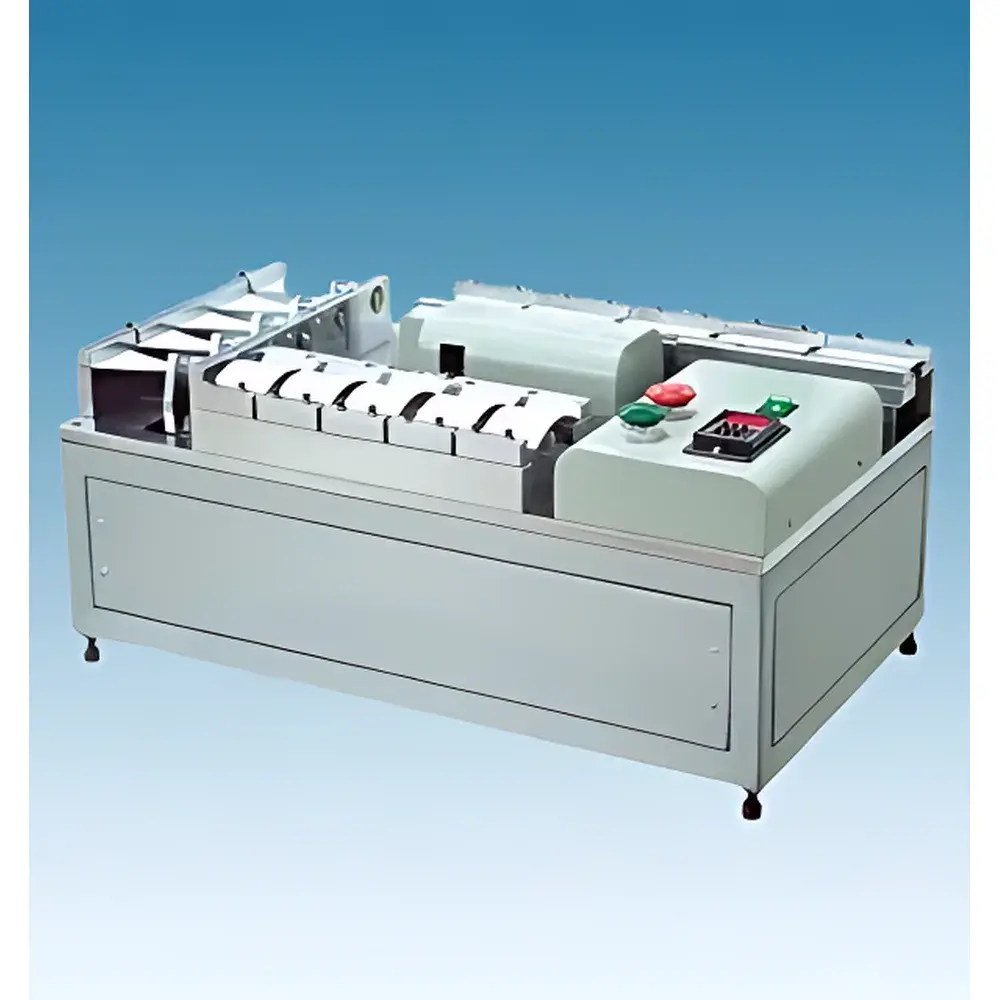
Hengyi HY(IC)EH Dynamic Bending and Torsion Tester
| Brand | Hengyi |
|---|---|
| Origin | Shanghai, China |
| Manufacturer Type | Direct Manufacturer |
| Country of Origin | China |
| Model | HY(IC)EH |
| Price Range | USD 1,400 – 2,800 |
| Voltage | AC 220 V ±5% |
| Power Consumption | 35 W |
| Bending/Torsion Speed | 30 rpm / 0.5 Hz |
| Cycle Count Range | 1–9999 cycles |
| Torsion Angle | ±15° ±1° (bidirectional, d = 86 mm |
| Long-edge Max Displacement | 20 mm (0.00 mm, −1.00 mm) |
| Long-edge Min Displacement | 2 mm ±0.50 mm |
| Short-edge Max Displacement | 10 mm (0.00 mm, −1.00 mm) |
| Short-edge Min Displacement | 1 mm ±0.50 mm |
| Fixture Mounting Dimensions | Fully Compliant with GB/T 16649.1, GB/T 17554.1–2006, ISO/IEC 7816-1998, and ISO/IEC 10373 |
Overview
The Hengyi HY(IC)EH Dynamic Bending and Torsion Tester is a precision-engineered mechanical test system designed specifically for evaluating the structural integrity and fatigue resistance of contact and contactless smart cards under standardized cyclic mechanical stress. It operates on the principle of controlled, repeatable angular displacement and lateral deflection—applying simultaneous bending and torsional loads to simulate real-world handling conditions such as card insertion, removal, and pocket flexing. The instrument complies fully with international and national standards including ISO/IEC 7816-1998 (Identification cards — Integrated circuit(s) cards), ISO/IEC 10373 (Test methods for identification cards), GB/T 16649.1 (Integrated circuit cards — Part 1: Physical characteristics), and GB/T 17554.1–2006 (Identification cards — Test methods — Part 1: Mechanical characteristics). Its robust architecture ensures high reproducibility across thousands of loading cycles, making it suitable for quality assurance laboratories, R&D departments, and third-party certification bodies engaged in card validation per ISO/IEC 17025-accredited workflows.
Key Features
- Bi-directional torsion capability with precise ±15° angular control (±1° accuracy) at a fixed pivot diameter of 86 mm, enabling full 30° total twist per cycle
- Independent bending actuation with programmable long-edge displacement range (1–20 mm) and short-edge displacement range (1–10 mm), each with calibrated tolerance bands
- High-stability electromechanical drive system integrating a Taiwan-made STK AC speed-controlled motor and a Hengyi-designed high-ratio gear reduction unit for smooth, low-vibration motion
- Dual-channel optical counting system with real-time cycle tracking and automatic termination at user-defined cycle limits (1–9999)
- Standardized fixture interface conforming strictly to dimensional requirements specified in GB/T 16649.1 and ISO/IEC 7816, ensuring interchangeability and test repeatability across labs
- Low-power operation (35 W nominal) and compact footprint (670 × 380 × 220 mm) optimized for benchtop deployment in regulated environments
Sample Compatibility & Compliance
The HY(IC)EH supports all standard ISO/IEC 7810 ID-1 format cards (85.6 × 53.98 × 0.76 mm), including magnetic stripe cards, contact IC cards (e.g., EMV-compliant payment cards), contactless RFID cards (e.g., MIFARE, DESFire), and hybrid dual-interface cards. Sample clamping is achieved via rigid, non-marring fixtures that preserve surface integrity during testing. All mechanical parameters—including angular resolution, displacement linearity, and cycle timing—are traceable to national metrological standards. The system is routinely deployed in laboratories conducting conformance testing for EMVCo, PCI SSC, and Common Criteria evaluations, where documented adherence to ISO/IEC 17025 clause 6.4 (Equipment) and clause 7.7 (Ensuring validity of results) is mandatory.
Software & Data Management
While the base HY(IC)EH model operates via front-panel digital controls and embedded logic, optional PC-based software (Hengyi TestSuite v3.x) provides enhanced data logging, cycle-by-cycle displacement/torque trend visualization, pass/fail threshold configuration, and export-ready CSV/PDF reporting. Audit trails include operator ID, timestamp, environmental temperature/humidity (when interfaced with external sensors), and calibration status flags. The software supports 21 CFR Part 11-compliant electronic signatures and role-based access control when deployed in GLP/GMP-regulated environments. Raw counter data and limit-switch event logs are stored internally with battery-backed memory retention (>10 years).
Applications
- Accelerated fatigue assessment of embedded antenna loops in contactless smart cards under repeated torsional strain
- Evaluation of interfacial adhesion strength between laminated card layers during cyclic bending
- Verification of chip module solder joint reliability under combined bending-torsion loading per JEDEC JESD22-B113
- Pre-certification testing for banking-grade EMV Level 1 physical durability requirements
- Comparative analysis of substrate materials (PVC, PETG, polycarbonate) for mechanical longevity
- Root cause analysis of field failures related to card warping, delamination, or contact loss
FAQ
Does the HY(IC)EH meet ISO/IEC 10373-1 Annex D requirements for torsion testing?
Yes—the instrument implements the exact torsion geometry, angular amplitude, and cycling frequency specified in Clause D.3.2, including bidirectional 15° rotation about the defined axis and controlled dwell time between reversals.
Can the system accommodate non-ID-1 card formats (e.g., mini-SIM, microSD adapters)?
No—fixture design and motion kinematics are dimensionally locked to ISO/IEC 7810 ID-1 specifications. Custom tooling is not supported under standard warranty terms.
Is calibration documentation provided with shipment?
Each unit ships with a factory calibration certificate referencing traceable standards for angular displacement (optical encoder), cycle count (NIST-traceable timer), and mechanical alignment (laser interferometry report available upon request).
What maintenance intervals are recommended for long-term accuracy?
Gearbox lubrication and encoder alignment verification are recommended every 12 months or after 50,000 cycles—whichever occurs first—using Hengyi-certified service technicians.
Is the tester compatible with automated test systems (ATS) via digital I/O or serial protocol?
Yes—RS-232 and dry-contact TTL I/O ports support integration into larger test benches, enabling synchronization with environmental chambers or vision-based defect detection modules.



