
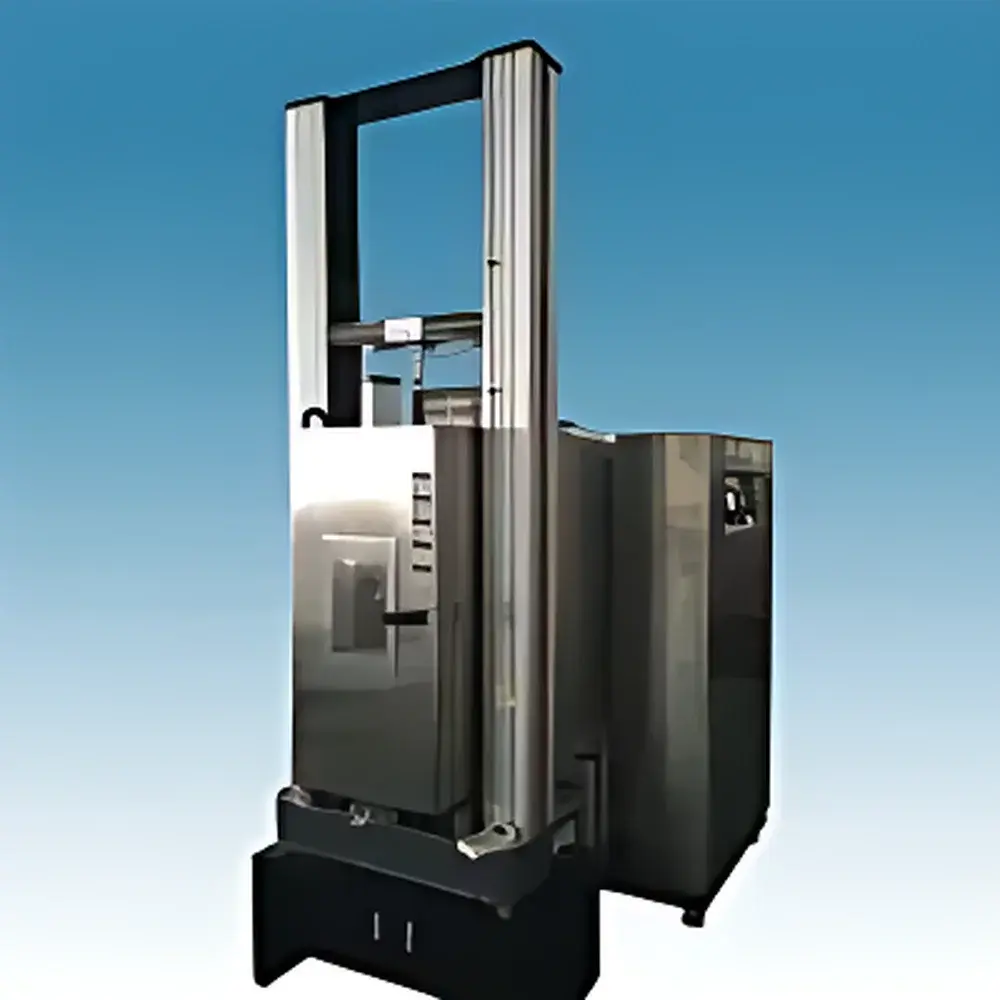
Hengyi HY-3080GWE High-Temperature Tensile Testing Machine for Porous Ceramics
| Brand | Hengyi |
|---|---|
| Origin | Shanghai, China |
| Manufacturer Type | Direct Manufacturer |
| Product Category | Domestic |
| Model | HY-3080GWE |
| Instrument Type | Electromechanical Universal Testing Machine |
| Load Capacity | 30 kN |
| Accuracy Class | ≤0.5 |
| Effective Test Width | 380 mm |
| Effective Stroke | 800 mm |
| Test Speed Range | 0.001–500 mm/min |
| Speed Accuracy | ±0.5% of indicated value |
| Force Resolution | ±500,000 counts at full scale |
| Displacement Accuracy | ±0.5% of indicated value |
| Strain Measurement Accuracy | ±0.5% of indicated value |
| Stress Control Rate Range | 0.005–6% FS/s |
| Strain Control Rate Range | 0.002–6% FS/s |
| Constant-Load/Displacement/Strain Accuracy | ±1% (for setpoint <10% FS), ±0.1% (for setpoint ≥10% FS) |
| Power Supply | 220 V AC, 750 W |
| Host Dimensions | 700 × 420 × 1510 mm |
| Host Weight | 210 kg |
Overview
The Hengyi HY-3080GWE High-Temperature Tensile Testing Machine is an electromechanical universal testing system engineered for precise mechanical characterization of porous ceramics and ceramic matrix composites (CMCs) under elevated temperature conditions. Designed with a robust龙门 (gantry-type) architecture, the system integrates high-stiffness load frames, thermally stable actuation, and precision-controlled environmental chambers—enabling uniaxial tensile, compressive, and shear testing from ambient up to 1200 °C (configurable per furnace specification). Its measurement principle relies on closed-loop servo control of crosshead displacement and load feedback via a high-resolution load cell (30 kN nominal capacity), coupled with extensometry or non-contact strain measurement options. The machine complies with fundamental metrological requirements defined in ISO 7500-1 (static calibration of force-proving instruments) and ASTM E4 (load verification of testing machines), forming the foundational traceability for materials qualification in aerospace, nuclear, and advanced energy applications.
Key Features
- Gantry-style rigid frame with 210 kg mass and reinforced aluminum-steel hybrid construction ensures minimal deflection (<0.02 mm/kN) during high-load thermal cycling.
- 0.5-class accuracy certified force measurement system: ±0.5% indication error across full 30 kN range, with 500,000-count resolution and no internal range switching.
- Wide dynamic speed range: 0.001–500 mm/min, digitally controlled with ±0.5% speed fidelity—critical for creep, stress-relaxation, and quasi-static fracture studies.
- Integrated multi-mode control architecture supporting load-, displacement-, and strain-controlled test profiles—including ramp-hold, cyclic loading, and programmed rate transitions.
- Dual-speed motorized crosshead with jog functionality and electronic limit protection prevents overtravel damage during setup or thermal expansion compensation.
- Modular fixture interface compliant with ISO 26203-2 and ASTM D3039 standards, accommodating custom-designed high-temperature grips (e.g., ceramic-coated wedge, split-sleeve, or hydraulic clamping).
- Real-time overload protection triggers at 110% of full-scale load; automatic diagnostics continuously monitor drive voltage, current, and sensor integrity.
Sample Compatibility & Compliance
The HY-3080GWE accommodates cylindrical, rectangular, and dog-bone specimens up to 380 mm wide and 800 mm gauge length—ideal for sintered porous alumina, silicon carbide foams, and fiber-reinforced CMCs. High-temperature testing requires compatible fixtures and furnace integration (optional): standard configurations support inert-atmosphere furnaces (Ar/N₂) with thermocouple-based PID control and axial thermal gradient management (<±5 °C over 50 mm gauge length). The system meets mechanical verification criteria in ISO 5893 and supports test method execution aligned with ASTM C1211 (tensile strength of advanced ceramics), ISO 13314 (compression of porous metals), and ASTM D5766/D5528 (open-hole tension and compression of polymer-matrix composites). Full audit trails, user-level access controls, and electronic signature capability align with GLP and FDA 21 CFR Part 11 requirements when paired with validated HENGYITEST software configuration.
Software & Data Management
The HENGYITEST control and analysis platform operates on Windows OS with deterministic real-time kernel extension. It acquires synchronized data streams at up to 10 kHz (load, displacement, extensometer, thermocouple), storing raw values with IEEE-754 double-precision floating-point encoding. Users define test protocols using hierarchical templates—each specifying control mode, target rates, hold durations, and termination conditions (e.g., “stop at 0.2% plastic strain” or “terminate after 10⁴ cycles”). Post-test, the software computes ASTM-compliant parameters: ultimate tensile strength (UTS), Young’s modulus (via secant or tangent methods), Poisson’s ratio (with biaxial strain input), yield offset (0.2%), and fracture toughness proxies. Curve visualization includes stress–strain, load–displacement, and time-series overlays; localized zoom, feature-point annotation, and multi-curve statistical comparison (mean ± SD) are natively supported. Export formats include CSV, XML (ASTM E1431-compliant), and PDF reports with embedded metadata (operator ID, calibration certificate IDs, environmental logs).
Applications
- Mechanical property mapping of porous ceramic scaffolds for biomedical implants—evaluating strength degradation vs. porosity gradients.
- Thermo-mechanical fatigue assessment of SiC/SiC composites used in gas turbine hot-section components.
- Interfacial debonding quantification in fiber-reinforced oxide ceramics via micro-tensile testing with in-situ heating.
- Creep rupture life prediction under constant load at 1000 °C, with compliance to ISO 204 methodology.
- Validation of finite element models through direct correlation of experimental stress–strain hysteresis loops with simulated constitutive responses.
- Quality assurance testing of batch-produced refractory tiles per DIN 51068 and JIS R 2611 specifications.
FAQ
What maximum temperature can the HY-3080GWE achieve during tensile testing?
Standard furnace integration supports up to 1200 °C in inert atmosphere; vacuum or reducing environments require optional furnace upgrades and specialized grip materials.
Is the system compatible with third-party extensometers or digital image correlation (DIC) systems?
Yes—the analog/digital I/O ports support industry-standard LVDTs, clip-on extensometers (e.g., Zwick Roell 250 mm), and DIC synchronization triggers (TTL pulse output).
How is force calibration traceability maintained?
Calibration follows ISO/IEC 17025 procedures using NIST-traceable deadweight standards; certificate includes uncertainty budget and as-found/as-left data.
Can the software generate reports compliant with ISO 17025 accredited laboratories?
When deployed with configured electronic signatures, audit logs, and version-controlled test methods, the software satisfies documentation requirements for ISO/IEC 17025 clause 7.8.
What safety interlocks are implemented for high-temperature operation?
Dual-channel thermal cutoff (furnace surface + specimen zone), door-open emergency stop, and real-time power anomaly detection prevent uncontrolled thermal excursions.



