
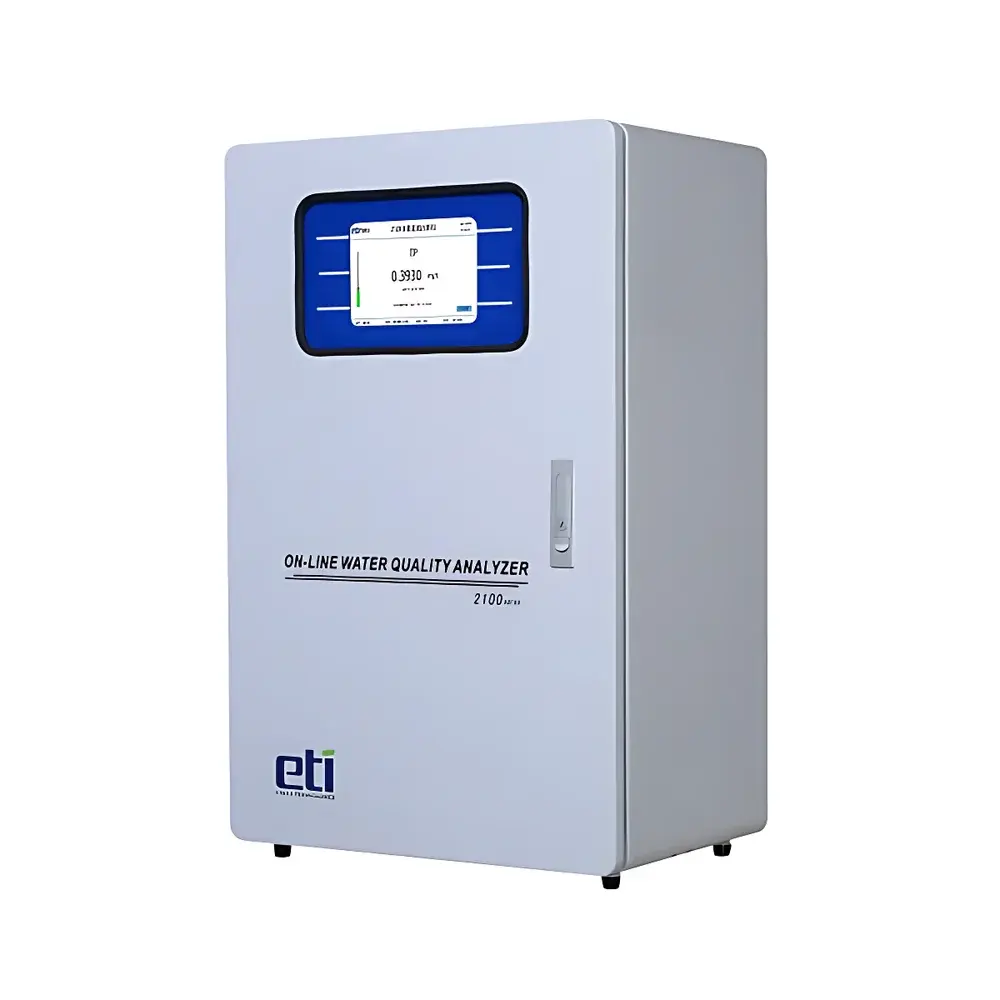
ETI 2100Plus Online Water Quality Analyzer
| Brand | ETI |
|---|---|
| Origin | Guangdong, China |
| Manufacturer Type | Authorized Distributor |
| Product Category | Domestic (China-Made) |
| Model | 2100Plus Online Water Quality Analyzer |
| Instrument Type | Online Water Quality Monitoring System |
| Measurable Parameters | Cu, Cr, Pb, Cd, Fe, Mn, Ni, Zn, Ag, Al, NH₃-N, CN⁻, Phenol, Total Phosphorus, Total Nitrogen, S²⁻, SiO₃²⁻, NO₃⁻, NO₂⁻, PO₄³⁻, K⁺, Na⁺, Ca²⁺, F⁻, Cl⁻ |
| Analytical Methods | Colorimetry (for most parameters), Ion-Selective Electrode (ISE) Potentiometry (for NH₃-N, K⁺, Na⁺, Ca²⁺, F⁻, Cl⁻) |
Overview
The ETI 2100Plus Online Water Quality Analyzer is an integrated, multi-parameter continuous monitoring system engineered for real-time assessment of inorganic ions, nutrients, heavy metals, and toxic compounds in surface water, groundwater, wastewater effluents, and drinking water distribution networks. It operates on two complementary analytical principles: photometric colorimetry for spectrophotometric quantification of analytes forming stable chromophores (e.g., NH₃-N via indophenol blue, total phosphorus via molybdenum blue, nitrate via cadmium reduction), and potentiometric detection using solid-state or liquid-membrane ion-selective electrodes (ISEs) for direct measurement of free ionic activity (e.g., F⁻, Cl⁻, Ca²⁺, Na⁺). The system is designed for unattended operation under ambient environmental conditions, with automated reagent delivery, precise flow control, temperature-compensated detection, and built-in calibration verification protocols—ensuring long-term stability and data integrity required for regulatory compliance reporting.
Key Features
- Modular multi-analyte architecture: Supports up to 25 discrete parameters simultaneously via configurable sensor modules and dedicated reaction manifolds.
- Dual-method platform: Integrated colorimetric channels (LED-based optical path, 450–850 nm selectable wavelengths) coexist with ISE ports featuring low-drift reference electrodes and auto-zeroing circuitry.
- Automated wet chemistry: Peristaltic pumping, solenoid-valve-driven reagent sequencing, and air-segmented flow eliminate manual intervention and reduce carryover risk.
- Robust environmental housing: IP66-rated enclosure with internal temperature stabilization (15–35 °C operating range) and corrosion-resistant fluidic path (PVDF, PTFE, borosilicate glass).
- Self-diagnostic capability: Real-time monitoring of lamp intensity, electrode potential drift, pump performance, and reagent depletion; alerts generated per ISO/IEC 17025 traceability requirements.
- Remote accessibility: Embedded Ethernet (TCP/IP) and optional 4G LTE module enable secure remote configuration, firmware updates, and alarm notification via SNMP or MQTT protocols.
Sample Compatibility & Compliance
The 2100Plus accepts raw water samples with turbidity ≤ 100 NTU and suspended solids ≤ 50 mg/L without pre-filtration; optional inline filtration (5 µm) and UV digestion (for total cyanide or orthophosphate liberation) are available as add-ons. All colorimetric methods conform to established standard test procedures—including ASTM D1292 (fluoride), ISO 7890-3 (ammonia), ISO 6878 (total phosphorus), ISO 11908 (cyanide), and EPA Method 353.2 (nitrate)—and support method validation documentation per GLP guidelines. ISE measurements meet ISO 10523 (pH) and ISO 10304-1 (anions) metrological frameworks. Data logging complies with audit-trail requirements aligned with FDA 21 CFR Part 11 when paired with ETI’s certified software suite.
Software & Data Management
The analyzer integrates with ETI AquaView™ v4.2, a Windows-based SCADA-compatible platform supporting multi-station network deployment. It provides time-synchronized data acquisition at user-defined intervals (1 min to 24 h), automatic QC flagging (e.g., calibration drift > ±5%, blank absorbance deviation > 0.02 AU), and export in CSV, XML, or MODBUS TCP formats. All measurement events—including calibrations, maintenance logs, and fault recovery—are timestamped and digitally signed. Historical datasets are stored locally (SD card, 32 GB) and mirrored to cloud-hosted servers with TLS 1.3 encryption. Audit trails are immutable and exportable for regulatory submission.
Applications
- Drinking water treatment plants: Continuous monitoring of disinfection by-products precursors (NH₃-N, NO₂⁻), corrosion indicators (Fe, Mn, Cu), and regulatory endpoints (F⁻, Cl⁻, NO₃⁻).
- Industrial effluent discharge compliance: Real-time tracking of heavy metals (Pb, Cd, Cr⁶⁺, Ni) against local discharge limits (e.g., China’s GB 8978-1996, EU WFD Annex X).
- Surface water quality surveillance: Early warning detection of nutrient loading (TP, TN, PO₄³⁻), algal bloom drivers (SiO₃²⁻, NO₃⁻), and accidental contamination events (CN⁻, phenol).
- Wastewater reuse facilities: Verification of tertiary treatment efficacy via simultaneous measurement of residual N-species, phosphate, and hardness ions (Ca²⁺, Mg²⁺).
- Research & academic monitoring networks: High-frequency temporal profiling for hydrochemical modeling and contaminant transport studies.
FAQ
What sample pretreatment is required before analysis?
Minimal pretreatment is needed for most applications; however, highly turbid or particulate-laden samples (>100 NTU) should be filtered inline (5 µm) to prevent manifold clogging. Digestion (UV or persulfate) is required only for total phosphorus, total nitrogen, or total cyanide determination.
Can the system operate unattended for extended periods?
Yes—the 2100Plus supports ≥30 days of continuous operation between maintenance cycles, assuming standard reagent volumes (2 L reservoirs) and ambient temperature stability. Reagent level sensors trigger low-volume alarms and can interface with automated replenishment systems.
How is calibration verified and maintained?
Daily automated zero/span checks use certified standards; multi-point calibration curves (up to 5 points) are stored per parameter. Drift correction algorithms apply slope/intercept adjustments based on daily verification results, with full recalibration recommended every 7–14 days depending on matrix complexity.
Is the system compatible with third-party SCADA or LIMS platforms?
Yes—it supports OPC UA, MODBUS TCP, and ASCII serial protocols for seamless integration into existing industrial automation infrastructure. API documentation and driver libraries are provided for custom LIMS interfacing.
Does the analyzer meet international certification requirements for field-deployed instrumentation?
The 2100Plus conforms to IEC 61326-1 (EMC), IEC 61000-4 series (surge/ESD immunity), and carries CE marking. While not certified to UL/CSA for North American hazardous locations, it meets EN 17025 competency criteria for testing laboratories when operated within validated method scopes.
Related Products







