
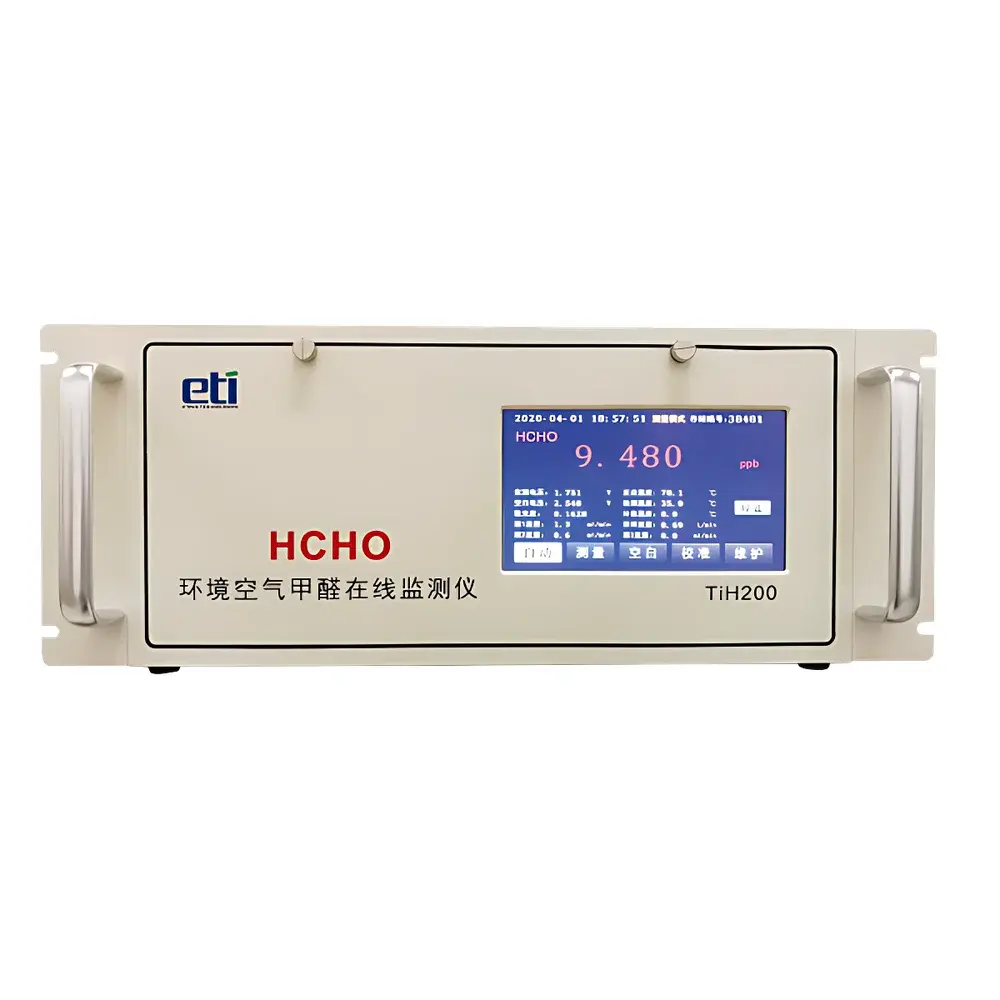
ETI TiH200 Formaldehyde Online Analyzer
| Brand | ETI |
|---|---|
| Origin | Guangdong, China |
| Manufacturer Type | Authorized Distributor |
| Country of Origin | China |
| Model | TiH200 |
| Pricing | Upon Request |
| Measurement Principle | Optical Colorimetry (Long-Path Liquid-Phase Absorption Spectrophotometry) |
| Measurement Range | 0–100 / 500 / 1000 / 5000 ppb (user-selectable full-scale ranges) |
| Resolution | 0.001 ppb |
| Repeatability | ≤2% RSD |
| Sampling Method | Integrated Diaphragm Pump |
| Response Time (t₉₀) | ≤150 s |
| Operating Temperature | 5–40 °C |
| Relative Humidity Range | 10–95% RH (non-condensing) |
Overview
The ETI TiH200 Formaldehyde Online Analyzer is a fully automated, laboratory-grade ambient air monitoring system engineered for continuous, real-time quantification of formaldehyde (HCHO) at trace levels. It employs long-path liquid-phase absorption spectrophotometry — a validated optical colorimetric method in which gaseous formaldehyde is selectively absorbed into an aqueous reagent solution, followed by derivatization with acetylacetone under controlled thermal and pH conditions to form a stable yellow chromophore (3,5-diacetyl-1,4-dihydrolutidine, DDL). The resulting solution is circulated through a high-transmittance quartz flow cell with an effective optical path length of up to 100 cm, enabling sub-part-per-trillion (ppt) effective detection limits. Unlike gas-phase UV absorption or electrochemical sensors, this wet-chemistry approach eliminates cross-sensitivity to common interferents such as acetaldehyde, acetone, and other aliphatic carbonyls — a critical advantage in complex urban or indoor air matrices. The instrument operates unattended for extended periods and meets the analytical performance requirements outlined in EPA TO-11A, ISO 16000-3, and HJ 1227–2021 (China’s Ambient Air Formaldehyde Determination Standard).
Key Features
- Integrated sample conditioning: Built-in particulate filter, hydrophobic membrane dryer, and temperature-stabilized absorption coil ensure consistent mass transfer efficiency across variable humidity (10–95% RH) and temperature (5–40 °C) conditions.
- Modular reagent delivery system: Precision peristaltic pumps and solenoid valves enable programmable reagent dosing, reaction time adjustment (1–10 min), and zero/scale calibration without manual intervention.
- Optical measurement architecture: Dual-beam photometer with thermoelectrically stabilized tungsten-halogen light source and silicon photodiode detector; wavelength fixed at 412 nm for maximum DDL absorbance sensitivity.
- Electrical–fluidic isolation: All fluidic components (PFA tubing, quartz flow cell, reagent reservoirs) are physically segregated from control electronics via IP65-rated enclosure partitions, ensuring long-term reliability in industrial environments.
- Embedded Linux-based controller: Real-time OS supports scheduled maintenance cycles, event-triggered diagnostics, and fault logging compliant with IEC 62443-3-3 cybersecurity guidelines.
- Self-diagnostic operation: Automatic daily zero check (using purified air scrubbed of formaldehyde), multi-point span verification, and flow-path integrity validation via pressure decay test.
Sample Compatibility & Compliance
The TiH200 is validated for direct analysis of ambient air, indoor air, and stack effluents with particulate loading <10 µg/m³ and total volatile organic compound (TVOC) concentration <5 ppmv. It complies with national and international regulatory frameworks including China’s HJ 1227–2021, U.S. EPA Compendium Method TO-11A (for sorbent tube–based validation), and ISO 16000-3:2019 (Indoor air — Part 3: Determination of formaldehyde and other carbonyls). Its measurement uncertainty (<5% at 20 ppb, k=2) satisfies QA/QC requirements for Level 2 monitoring networks per EU Directive 2008/50/EC. All internal wetted materials — including PFA, quartz, and EPDM-free elastomers — are certified non-leaching per USP Class VI and FDA 21 CFR 177.2600 standards.
Software & Data Management
The analyzer runs ETI’s proprietary Analytical Control Suite (ACS v3.2), a web-accessible interface supporting remote configuration, data visualization, and audit-trail generation. ACS implements role-based user access (operator, technician, administrator), electronic signatures, and immutable data logging aligned with FDA 21 CFR Part 11 and EU Annex 11 requirements. Raw absorbance values, calculated concentrations, system status flags, and maintenance timestamps are exported in CSV/NetCDF formats compatible with EPA’s AQS, EEA’s AirBase, and custom LIMS integrations. Optional Modbus TCP and OPC UA gateways enable seamless integration into SCADA and building management systems (BMS).
Applications
- Ambient air quality monitoring networks (urban, roadside, background stations)
- Indoor air quality (IAQ) assessment in schools, hospitals, offices, and residential buildings
- Occupational exposure monitoring in furniture manufacturing, plywood production, and textile finishing facilities
- Validation of air purification systems and catalytic oxidation units
- Research studies on atmospheric HCHO photochemistry and VOC oxidation pathways
- Compliance reporting for LEED IEQ Credit 2, WELL Building Standard W02, and China Green Building Label certification
FAQ
What is the minimum detectable concentration (MDL) under typical operating conditions?
The instrument achieves an MDL of 0.003 ppb (3 ppt) at 100-cm path length and 10-minute averaging, based on 3σ of repeated zero-air measurements.
Does the system require external calibration gas standards?
No — calibration is performed using liquid standard solutions traceable to NIST SRM 2559 (aqueous formaldehyde); gas-phase permeation tubes are not required.
How often does the reagent need replacement?
Standard reagent cartridges (250 mL capacity) support ≥30 days of continuous operation at 1-sample-per-hour frequency; shelf life is 12 months when refrigerated.
Can the TiH200 be deployed outdoors without climate-controlled housing?
Yes — the enclosure meets IP55 rating and includes internal thermostatic regulation; optional solar-powered environmental shelter kits are available for remote sites.
Is the software compliant with GLP/GMP data integrity requirements?
Yes — ACS v3.2 provides full ALCOA+ compliance (Attributable, Legible, Contemporaneous, Original, Accurate), including electronic audit trails, user authentication, and data backup encryption.







