
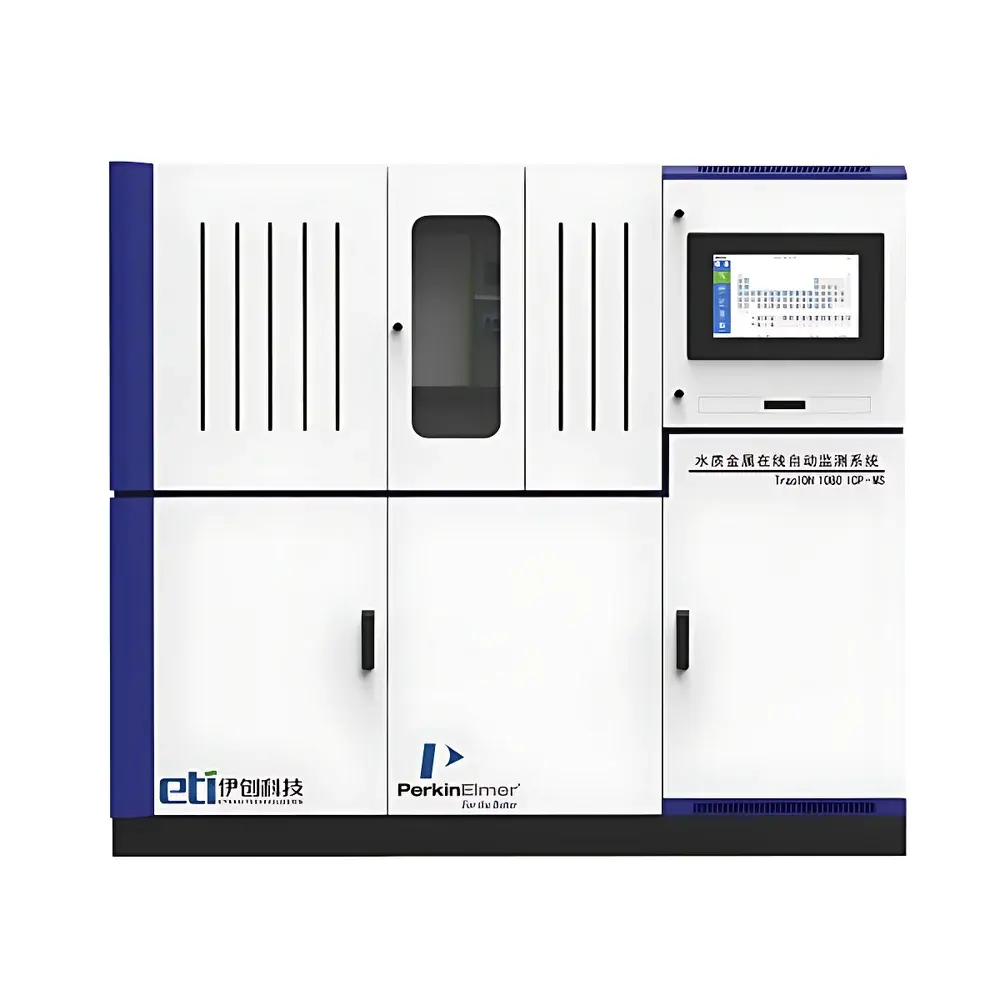
TrasION 1080 ICP-MS Online Water Heavy Metals Monitoring System
| Brand | ETI |
|---|---|
| Origin | Guangdong, China |
| Manufacturer Type | Authorized Distributor |
| Country of Origin | China |
| Model | TrasION 1080 ICP-MS |
| Quotation | Upon Request |
Overview
The TrasION 1080 ICP-MS Online Water Heavy Metals Monitoring System is an industrial-grade, fully automated in-line analytical platform engineered for continuous, real-time elemental quantification in aqueous matrices. It integrates a high-sensitivity inductively coupled plasma mass spectrometry (ICP-MS) detection core—based on the NexION™ tandem quadrupole mass spectrometer architecture—with purpose-built liquid handling, online sample introduction, and integrated pre-concentration/separation modules. The system operates on the fundamental principle of plasma ionization: aqueous samples are nebulized into fine aerosols, transported into a 7,000–10,000 K argon plasma where elements are atomized and ionized with near-complete efficiency, and the resulting ions are extracted through a vacuum interface into a double-focusing mass analyzer. Mass separation is achieved via sequential quadrupole filtering (Q1 → collision/reaction cell → Q2), enabling isobaric interference removal (e.g., 40Ar16O+ on 56Fe+) and polyatomic suppression through controlled reaction chemistry (e.g., NH3, He, O2). This architecture delivers sub-pictogram-per-liter (ppt) detection limits for over 70 elements—including As, Cd, Cr(VI), Cu, Hg, Ni, Pb, Sb, Se, Tl, U, and V—making it suitable for regulatory compliance monitoring against WHO, EPA Method 200.8, ISO 17294-2, and China’s HJ 657–2013 standards.
Key Features
- Integrated online sample pretreatment module featuring patented solid-phase extraction (SPE) cartridges and matrix-matched internal standard addition—designed to eliminate interferences from Cl−, Ca2+, and organic humics while preserving ultra-trace analyte integrity
- Automated multi-mode acquisition: supports scheduled periodic analysis (e.g., every 5–30 min), event-triggered sampling (e.g., pH or conductivity anomaly), and manual override via secure web interface
- Dual-channel RS485 Modbus RTU and TCP/IP Ethernet communication protocols for seamless integration into SCADA, DCS, or LIMS environments
- Self-diagnostic hardware monitoring: real-time tracking of plasma stability, torch alignment, vacuum integrity, detector voltage, and gas flow consistency
- Modular cabinet design (1950 mm W × 950 mm D × 1800 mm H) compliant with IP54 ingress protection, suitable for installation in municipal water intake stations, industrial effluent channels, and drinking water treatment plants
Sample Compatibility & Compliance
The TrasION 1080 accepts raw surface water, groundwater, treated drinking water, wastewater influent/effluent, and cooling tower recirculation streams without manual filtration or acid digestion. Sample introduction is compatible with 0.45 µm inline filtration and optional UV/persulfate oxidation for total recoverable metal speciation. All operational parameters—including dwell time, sweep count, integration period, and reaction gas flow—are configurable per element to meet method-specific requirements. The system supports full audit trail generation and electronic signature capability aligned with FDA 21 CFR Part 11 and GLP/GMP data integrity principles. Calibration verification includes daily autotune, multi-point bracketing calibration curves, and certified reference material (CRM) spike recovery checks traceable to NIST SRM 1640a and ERM-AE113.
Software & Data Management
The embedded ETI AquaControl™ v4.2 software provides browser-based remote operation (Chrome/Firefox/Edge), role-based user access control (admin/operator/auditor tiers), and automated report generation in PDF/CSV formats. Data storage adheres to ISO/IEC 27001-aligned encryption protocols; raw spectral files (.raw), processed results (.csv), and system logs are retained for ≥18 months on redundant RAID-1 SSDs. Trend visualization includes moving-average concentration plots, exceedance alerts (configurable thresholds + SMS/email escalation), and comparative overlay of historical baselines. Software validation documentation—including IQ/OQ/PQ test scripts and configuration item traceability—is supplied as part of the delivery package.
Applications
- Real-time surveillance of source water intakes for early warning of heavy metal contamination events (e.g., mining runoff, pipeline leaching)
- Compliance monitoring at wastewater discharge points under national emission standards (e.g., China’s GB 8978–1996, EU Industrial Emissions Directive 2010/75/EU)
- Process control in semiconductor fab ultrapure water loops requiring <10 fg/L detection capability for Co, Ni, and Zn
- Long-term trend analysis for environmental impact assessments (EIAs) and watershed health modeling
- Validation support for membrane filtration and ion exchange treatment efficacy across municipal and industrial facilities
FAQ
Does the TrasION 1080 require daily manual maintenance?
No—routine operations are fully automated. Scheduled maintenance intervals are 3 months for torch cleaning, 6 months for cone replacement, and annually for vacuum pump oil change. All tasks are guided by onboard diagnostics and logged in the maintenance calendar.
Can the system quantify species-specific metals such as Cr(VI) or methylmercury?
The base configuration measures total elemental concentrations. For speciation, optional hyphenated coupling with online HPLC or GC modules is available under custom integration agreements.
Is remote firmware update supported?
Yes—secure OTA (over-the-air) updates are delivered via HTTPS with SHA-256 signature verification and rollback capability in case of interruption.
What is the minimum sample volume required per analysis cycle?
2.5 mL for full-element screening mode; 0.8 mL for targeted 10-element rapid scan (cycle time ≤ 4.2 minutes).
How does the system handle high-TDS or saline samples?
Dilution-on-demand (1:5 to 1:50) and dynamic reaction cell (DRC) mode with methane gas are activated automatically when conductivity exceeds 2,000 µS/cm or chloride > 500 mg/L.
Related Products







