
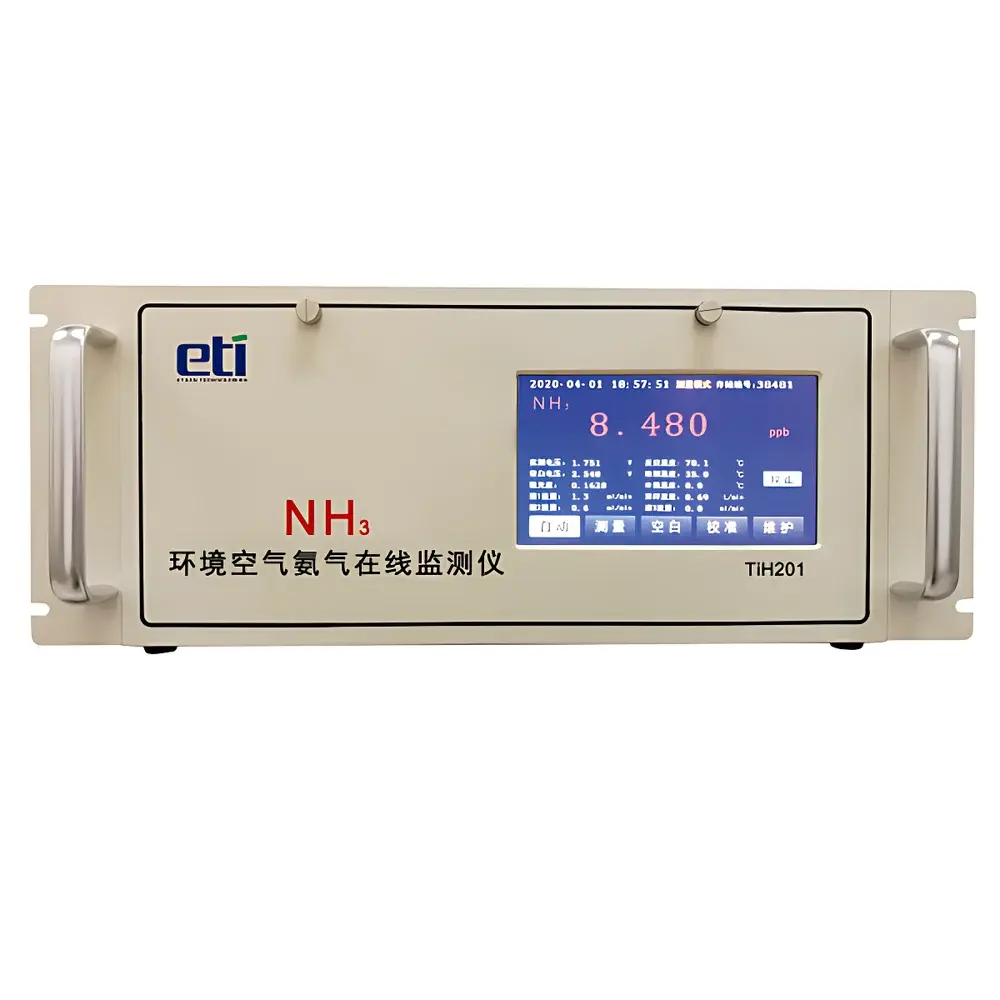
ETI TiH201 Online Ammonia Analyzer
| Brand | ETI |
|---|---|
| Origin | Guangdong, China |
| Manufacturer Type | Authorized Distributor |
| Country of Manufacture | China |
| Model | TiH201 |
| Instrument Type | Online Analyzer |
| Measurement Principle | Wet-Chemical Derivatization + Long-Path Optical Absorption (Indophenol Blue Method) |
| Compliance | Designed for continuous ambient air and industrial stack monitoring per EPA Method IO-5 (Ammonia by Indophenol Blue), ASTM D1426–22 (Standard Test Methods for Nitrogen in Water), and aligned with ISO 8573-1:2010 (for compressed air quality assessment where applicable) |
Overview
The ETI TiH201 Online Ammonia Analyzer is a robust, field-deployable instrument engineered for continuous, real-time quantification of gaseous ammonia (NH₃) in ambient air, flue gas, biogas streams, and industrial process exhaust. It operates on the well-established indophenol blue colorimetric method—a wet-chemical derivatization technique standardized under U.S. EPA Method IO-5 and ASTM D1426–22. In this process, sampled ammonia is absorbed into an acidic buffer solution, followed by sequential reaction with sodium nitroprusside, phenol, and hypochlorite under controlled pH and temperature to form the stable blue-colored indophenol dye. The resulting solution is circulated through a long-path optical flow cell (typically 1–2 m effective path length), where absorbance at 630–650 nm is measured via high-stability LED photometry. This dual-stage approach—gas-to-liquid transfer followed by spectrophotometric detection—ensures high selectivity against common interferents (e.g., amines, NO₂, SO₂) and delivers sub-ppb detection limits with excellent long-term stability.
Key Features
- Continuous online operation with automated sampling, reagent delivery, and waste handling—designed for unattended deployment over 30+ days
- Integrated temperature- and humidity-compensated sampling module with heated stainless-steel inlet line (up to 120 °C) to prevent NH₃ adsorption loss and condensation artifacts
- Optical detection system featuring dual-beam LED photometry and thermally stabilized flow cell to minimize drift (<0.5% FS/week)
- Onboard calibration verification using certified NH₃-permeation tubes or zero/span gas injection ports compliant with ISO/IEC 17025 traceability requirements
- Rugged IP65-rated enclosure suitable for outdoor installation; operating ambient range: −20 °C to +50 °C
- Modular design supporting optional integration with particulate filters, denuders, or acid-coated annular denuder systems for speciated NH₃ measurement in complex matrices
Sample Compatibility & Compliance
The TiH201 is validated for use across diverse sampling environments: ambient urban/rural air (EPA AQS network compatibility), agricultural emission plumes (livestock barns, fertilizer application zones), municipal wastewater treatment off-gases, and coal-fired or biomass combustion flue streams (with optional dilution and cooling modules). Its analytical output meets data quality objectives (DQOs) specified in EU Directive 2008/50/EC (Ambient Air Quality Directive) Annex VII and supports reporting under national emission inventories (e.g., EMEP/EEA Guidebook Tier 2). All reagents—including sodium nitroprusside, phenol, and sodium hypochlorite—are supplied in pre-quantified, shelf-stable cartridges to ensure batch-to-batch consistency and reduce operator error. The system maintains full audit trail logging for all maintenance events, calibration actions, and raw absorbance data—fully compatible with GLP and ISO 17025 laboratory quality management frameworks.
Software & Data Management
The TiH201 is operated via embedded Linux-based firmware with a web-accessible GUI (HTTPS-enabled) supporting remote configuration, diagnostics, and real-time data visualization. Raw absorbance values, calculated NH₃ concentration (ppb or µg/m³), system status flags (flow rate, temperature, reagent level, lamp intensity), and QA/QC metrics are logged at user-selectable intervals (1–60 min) and exported in CSV or NetCDF format. Data export interfaces include Modbus TCP, RS-485 (ASCII/RTU), and optional MQTT publishing for integration into SCADA, EMS, or cloud-based environmental data platforms (e.g., AWS IoT Core, Azure IoT Hub). All calibration records, alarm logs, and firmware updates are time-stamped and digitally signed—meeting FDA 21 CFR Part 11 requirements for electronic records and signatures when deployed in regulated industrial hygiene or pharmaceutical manufacturing settings.
Applications
- Ambient air quality monitoring networks requiring regulatory-grade NH₃ data for PM₂.₅ secondary aerosol modeling
- Source apportionment studies linking agricultural NH₃ emissions to regional haze formation and nitrogen deposition mapping
- Process control and compliance monitoring in chemical synthesis plants, refrigeration facilities, and semiconductor fabrication cleanrooms
- Long-term ecosystem research assessing atmospheric nitrogen loading impacts on sensitive habitats (e.g., heathlands, alpine meadows)
- Validation of satellite-based NH₃ retrievals (e.g., IASI, CrIS, TROPOMI) through ground-truthing campaigns
- Mobile monitoring deployments using vehicle-mounted TiH201 units coupled with GPS-synchronized georeferenced concentration mapping
FAQ
What is the lower limit of detection (LOD) for the TiH201 under typical ambient conditions?
The instrument achieves a 3σ LOD of 0.05 ppb (15-min average) in clean air mode with 2-m optical path and standard reagent chemistry.
Can the TiH201 operate in high-humidity environments without signal suppression?
Yes—the integrated heated sampling line (up to 120 °C) and Nafion™-based moisture removal stage ensure minimal NH₃ loss and negligible water vapor interference across 10–95% RH.
Is the system compatible with existing air quality data infrastructure (e.g., AQS, EEA AirBase)?
Yes—output formats and metadata tagging conform to AQXML v3.0 and EEA Air Quality Data Exchange Format (AQDX) specifications.
How frequently must reagents be replaced during continuous operation?
Standard reagent cartridges support ≥30 days of uninterrupted operation at 10-min sampling intervals; usage logs trigger predictive maintenance alerts via email or SNMP trap.
Does the TiH201 require annual third-party certification for regulatory compliance?
While not mandated for all applications, ETI recommends biannual verification against NIST-traceable NH₃ standards per ISO/IEC 17025 to maintain data defensibility in enforcement contexts.
Related Products







