
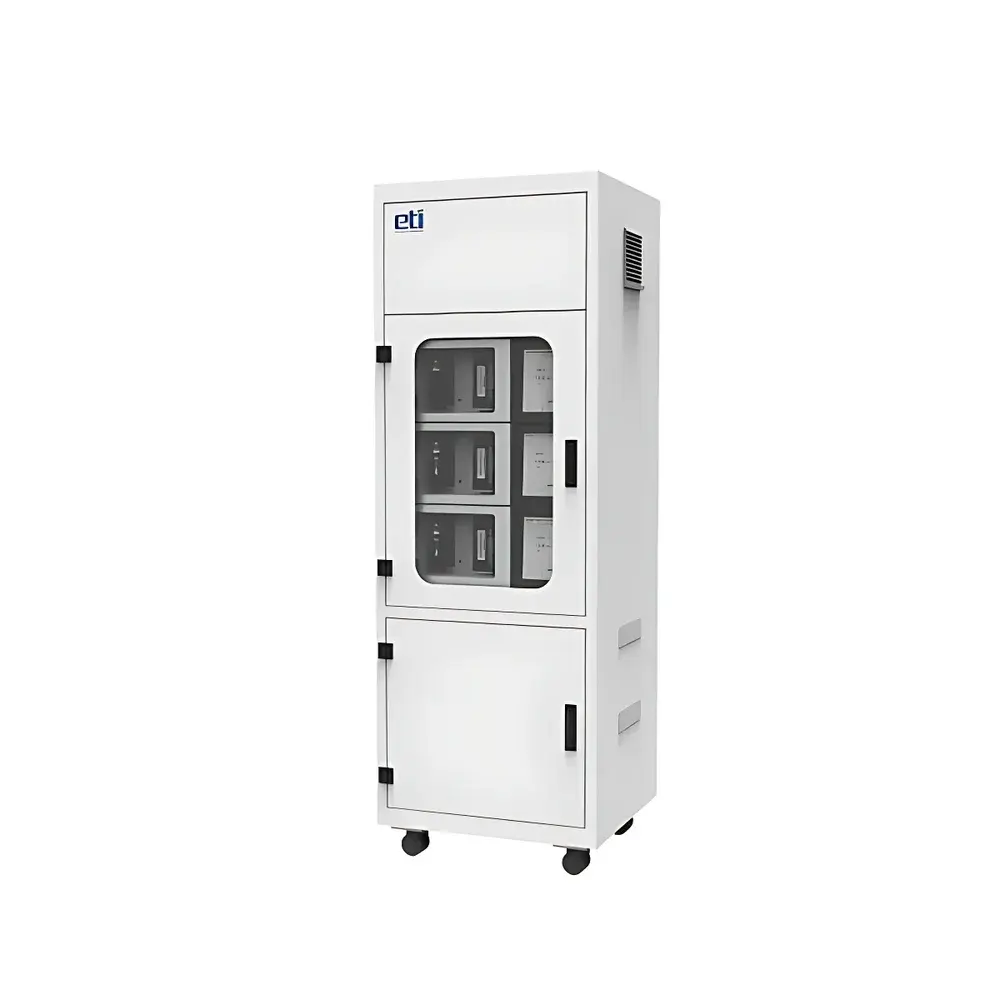
ETI 2020 Total Nitrogen Online Water Analyzer
| Brand | ETI |
|---|---|
| Origin | Guangdong, China |
| Manufacturer Type | Authorized Distributor |
| Country of Manufacture | China |
| Model | ETI 2020 TN |
| Detection Principle | Alkaline Potassium Persulfate Digestion – UV-Vis Spectrophotometry |
| Measurement Range | 0–5 / 0–10 / 0–50 mg/L TN (selectable) |
| Measurement Modes | Cyclic, Trigger-Controlled, Point-Interval, Continuous, Manual |
| Verification Modes | Remote, Manual, Automatic (Time-Based & Threshold-Triggered) |
| Output Signals | 4–20 mA analog output |
| Power Supply | 220 ± 22 VAC, 50 ± 0.5 Hz |
| Module Dimensions | 490 mm (W) × 400 mm (D) × 210 mm (H) |
| Cabinet Dimensions | 600 mm (W) × 550 mm (D) × 1750 mm (H) |
| Sample Introduction | Multi-channel rotary valve with low-reagent-consumption design |
| Fluidic Precision | High-accuracy peristaltic or syringe pump (±0.5% volumetric repeatability) |
| Dilution Capability | Patented intelligent dilution with auto-range switching |
| Data Integrity Features | Audit trail-enabled calibration logging, QC event timestamping, and configurable data retention |
Overview
The ETI 2020 Total Nitrogen Online Water Analyzer is an industrial-grade, continuous-monitoring instrument engineered for regulatory-compliant quantification of total nitrogen (TN) in diverse aqueous matrices. It operates on the standardized alkaline potassium persulfate digestion method (aligned with ISO 11908:2019 and EPA Method 351.2), followed by spectrophotometric detection of nitrate at 220 nm (and optionally 275 nm for turbidity correction). This dual-wavelength approach ensures robust compensation for organic interference and suspended solids, delivering high specificity and reproducibility in real-world effluent and surface water applications. Designed for unattended operation in municipal wastewater treatment plants, drinking water distribution systems, industrial discharge monitoring stations, and source water protection zones, the analyzer meets the functional requirements of long-term deployment under variable ambient conditions—supporting continuous data acquisition with minimal operator intervention.
Key Features
- Patented intelligent dilution system enabling seamless auto-ranging across 0–5, 0–10, and 0–50 mg/L TN spans without manual recalibration.
- High-precision fluid handling architecture incorporating a calibrated syringe pump (volumetric accuracy ±0.5%) for consistent reagent and sample metering.
- Multi-port rotary selection valve minimizing reagent carryover and reducing consumables usage by up to 35% versus conventional solenoid-valve manifolds.
- Integrated power-loss recovery protocol: retains configuration, calibration history, and active measurement state during unexpected outages; resumes operation within <60 seconds post-power restoration.
- Modular cabinet design supports co-location of up to four independent analyzers (e.g., TN, TP, NH₃-N, COD) in a single 600 mm wide footprint, facilitating multi-parameter compliance reporting.
- Configurable operational logic: supports scheduled cyclic analysis, event-triggered sampling (e.g., flow-proportional or level-based), fixed-interval point measurements, or fully manual override via HMI or remote command.
Sample Compatibility & Compliance
The ETI 2020 is validated for use with raw and treated surface water, groundwater, potable water, municipal sewage influent/effluent, and industrial process discharges (including textile, food processing, and chemical manufacturing effluents). It complies with key performance criteria outlined in ISO 5667-3 for sampling preservation and ISO 15839 for online water quality sensor validation. All calibration and verification events—including standard solution checks, spike recovery tests, and blank verification—are logged with immutable timestamps and user-identifiable metadata, satisfying audit requirements under ISO/IEC 17025 and supporting GLP/GMP-aligned environmental monitoring programs. The system’s 4–20 mA and Modbus RTU (RS485) outputs enable direct integration into SCADA and DCS platforms compliant with IEC 61131-3.
Software & Data Management
Embedded firmware provides web-accessible configuration via HTTPS-secured interface (TLS 1.2+), supporting role-based access control (administrator, operator, viewer). All measurement data, QC logs, alarm states, and maintenance records are stored locally with configurable retention (default: 90 days, extendable to 365 days). Export formats include CSV and XML, compatible with LIMS and enterprise environmental data management systems. Audit trails capture every parameter change, calibration action, and verification result—including operator ID, timestamp, pre- and post-adjustment values—meeting FDA 21 CFR Part 11 electronic record requirements when deployed in regulated utility environments.
Applications
- Real-time compliance monitoring at NPDES or EU Urban Wastewater Treatment Directive (91/271/EEC) discharge points.
- Early-warning detection of nutrient loading shifts in reservoirs and intake rivers serving drinking water facilities.
- Process optimization feedback for biological nutrient removal (BNR) units in activated sludge systems.
- Industrial pretreatment verification for facilities subject to local sewer authority TN limits.
- Long-term trend analysis in watershed-scale monitoring networks requiring stable, low-maintenance instrumentation.
FAQ
What digestion method does the ETI 2020 employ, and is it aligned with international standards?
It uses alkaline potassium persulfate digestion followed by UV-Vis spectrophotometry—fully consistent with ISO 11908:2019, EPA Method 351.2, and Chinese standard HJ 636-2012.
Can the analyzer perform automatic quality control without operator input?
Yes—it supports time-scheduled and concentration-threshold-triggered automatic verification using certified standard solutions, with full traceability of each event.
Is remote diagnostics and firmware update capability available?
Yes—the embedded web server enables secure remote configuration, real-time status monitoring, and over-the-air firmware updates via authenticated HTTPS sessions.
How is data integrity ensured during extended power interruptions?
Non-volatile memory preserves all calibration coefficients, method parameters, and recent measurement history; the system performs self-diagnostic upon restart and resumes scheduled operations without manual reinitialization.
Does the modular cabinet support third-party sensor integration?
The cabinet includes DIN-rail mounting, 24 VDC auxiliary power rails, and configurable dry-contact alarm outputs—enabling hybrid deployments with external pH, conductivity, or turbidity sensors using industry-standard protocols.







