
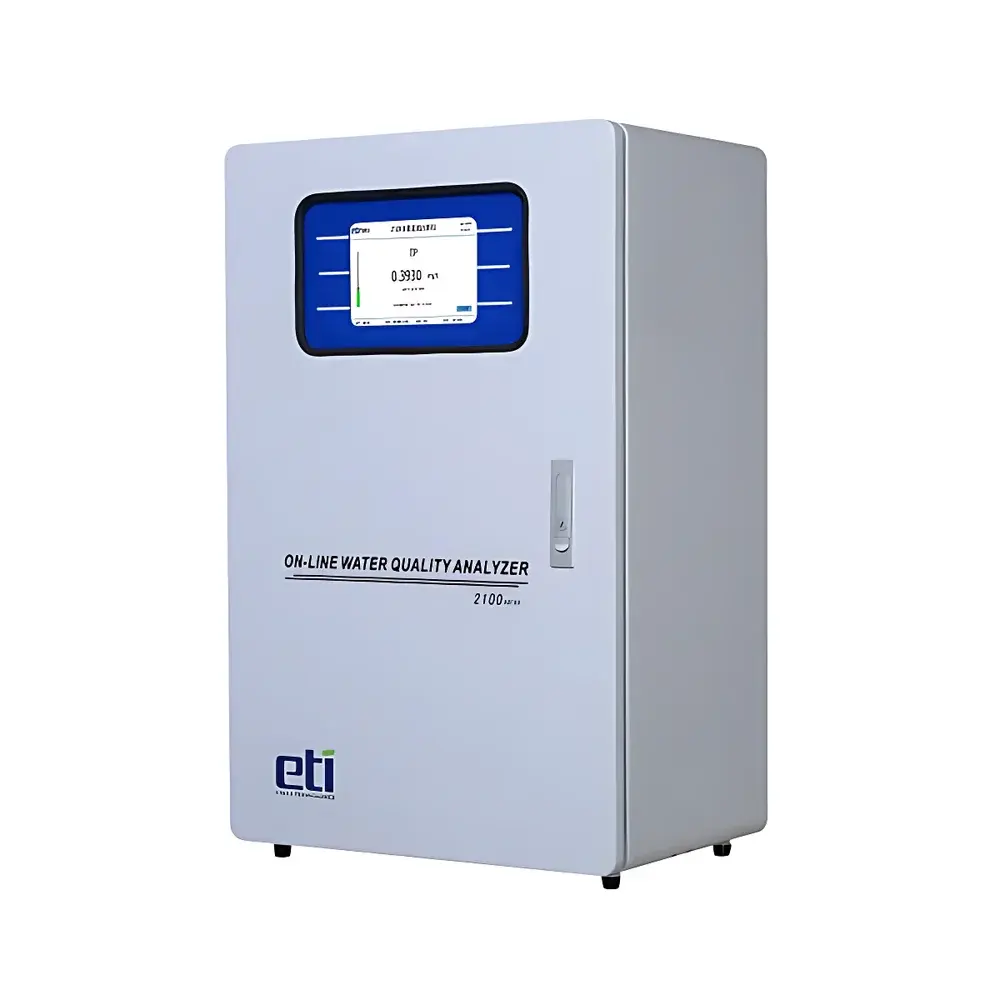
ETI 2100Plus Online Total Phosphorus Analyzer
| Brand | ETI |
|---|---|
| Origin | Guangdong, China |
| Manufacturer Type | Authorized Distributor |
| Product Origin | Domestic (China) |
| Model | 2100Plus Total Phosphorus |
| Instrument Type | Online Analyzer |
| Detection Principle | Photometric Method (Peroxodisulfate Digestion – Ammonium Molybdate Spectrophotometry) |
| Analysis Time | < 10 min |
| Accuracy/Precision | ≤ ±5% FS |
| Resolution | 0.001 mg/L |
| Measurement Range | 0–2 / 0–10 / 0–50 mg/L (selectable) |
| Measurement Modes | Cyclic, Trigger-Controlled, Point-in-Time, Continuous, Manual |
| Verification Modes | Remote, Manual, Automatic (time-based or limit-exceeded) |
| Signal Output | 4–20 mA, RS232 / RS485 |
| Power Supply | 220 ± 22 VAC, 50 ± 0.5 Hz |
| Enclosure Dimensions | 520 mm (W) × 380 mm (D) × 800 mm (H) |
| Net Weight | ~45 kg (excluding reagents) |
Overview
The ETI 2100Plus Online Total Phosphorus Analyzer is an automated, laboratory-grade photometric system engineered for continuous, unattended monitoring of total phosphorus (TP) concentration in diverse aqueous matrices. It operates on the standardized peroxodisulfate digestion–ammonium molybdate spectrophotometric method (aligned with ISO 6878:2004 and EPA Method 365.4), ensuring regulatory traceability across environmental and industrial water applications. The instrument fully automates sample pretreatment—including high-efficiency alkaline persulfate oxidation under controlled temperature and pressure—to convert all phosphorus species (orthophosphate, condensed phosphates, organophosphorus compounds) quantitatively into orthophosphate. Subsequent acidification, complexation with ammonium molybdate in the presence of antimony potassium tartrate, and reduction with ascorbic acid yield a stable heteropoly blue complex. Absorbance is measured at 880 nm using a precision optical path with temperature-stabilized LED light source and solid-state photodetector, delivering high linearity and long-term photometric stability.
Key Features
- Patented intelligent dilution module enabling automatic range switching between 0–2, 0–10, and 0–50 mg/L—eliminating manual intervention during dynamic concentration fluctuations.
- High-accuracy micro-syringe injection pumps (±0.5% volumetric repeatability) for precise metering of sample, digestant, reagents, and calibration standards.
- Integrated power-loss recovery protocol: retains configuration, calibration history, and pending analysis queue; resumes operation automatically upon power restoration without data loss.
- Modular fluidic architecture with quick-release connectors and tool-free access to reaction coil, digestion chamber, and optical cell—reducing mean time to repair (MTTR) to under 15 minutes.
- Flexible operational sequencing: supports programmable cycles for analysis, multi-point calibration, spike recovery checks, blank verification, and scheduled maintenance alerts.
- Remote quality control capability including standard addition, reference material verification, and automated drift compensation via onboard certified check standards.
Sample Compatibility & Compliance
The 2100Plus is validated for direct online deployment in raw surface water, drinking water distribution systems, municipal wastewater influent/effluent, industrial process streams, and landfill leachate. Its robust sample handling accommodates turbidities up to 200 NTU and suspended solids ≤ 150 mg/L without filtration—enabled by optimized flow-through digestion and particulate-tolerant optical detection. All analytical procedures comply with ISO/IEC 17025:2017 requirements for competence of testing laboratories. Data integrity safeguards meet FDA 21 CFR Part 11 expectations for electronic records and signatures, including audit-trail logging of all user actions, method changes, calibration events, and alarm conditions. Instrument firmware supports GLP/GMP-aligned reporting templates and exportable .csv/.xlsx data logs with embedded timestamps and operator IDs.
Software & Data Management
The analyzer integrates with ETI’s AquaLink™ Supervisory Software (v4.2+), a Windows-based platform supporting centralized fleet management across multiple analyzers. Real-time status dashboards display live absorbance curves, digestion efficiency metrics, reagent consumption forecasts, and predictive maintenance alerts. All measurement data are time-stamped, digitally signed, and stored locally in encrypted SQLite databases with configurable retention policies (default: 180 days). Raw spectra, calibration coefficients, QC results, and event logs synchronize securely via TLS 1.2 to cloud-hosted instances or on-premise SCADA/MES systems through OPC UA or Modbus TCP protocols. Audit trails are immutable and exportable in PDF/A-1b format for regulatory submission.
Applications
- Real-time compliance monitoring at wastewater treatment plant discharge points per EU Urban Wastewater Treatment Directive (91/271/EEC) and China’s GB 18918–2002 Class I-A limits.
- Early-warning detection of phosphorus loading spikes in reservoirs and source water intakes to support adaptive coagulant dosing control.
- Process optimization in phosphate removal units (e.g., enhanced biological phosphorus removal, tertiary chemical precipitation) via feedback-controlled ferric chloride dosing.
- Industrial effluent monitoring for electroplating, fertilizer manufacturing, and food processing facilities subject to local TP discharge permits.
- Long-term trend analysis in ecological monitoring networks assessing eutrophication risk in lakes and estuaries.
FAQ
What digestion method does the 2100Plus employ, and how is it validated?
It uses high-temperature alkaline peroxodisulfate digestion (120 °C, 30 min) validated per ISO 6878:2004 and verified against NIST SRM 2973 for total phosphorus recovery (>98.5% across 0.05–50 mg/L range).
Can the instrument operate without on-site technician intervention for extended periods?
Yes—designed for unattended operation up to 30 days with standard reagent packs; includes low-reagent alarms, clog detection, and self-diagnostic routines for pump wear, lamp intensity decay, and optical path fouling.
Is method customization supported for non-standard matrices or regulatory variants?
Yes—AquaLink™ allows full parameterization of digestion time/temperature, reagent concentrations, reaction dwell times, and calibration curve fitting algorithms (linear, quadratic, or user-defined polynomial).
How is data security and regulatory compliance ensured during remote access?
Role-based authentication (LDAP/Active Directory integration), end-to-end TLS encryption, electronic signature workflows, and tamper-evident audit logs satisfy ISO 27001, FDA 21 CFR Part 11, and China’s GB/T 35273–2020 personal information protection requirements.
What maintenance intervals are recommended for optimal performance?
Optical cell cleaning every 7 days; digestion chamber descaling every 30 days; pump tubing replacement every 90 days; annual full metrological verification using traceable phosphorus standards.
Related Products







