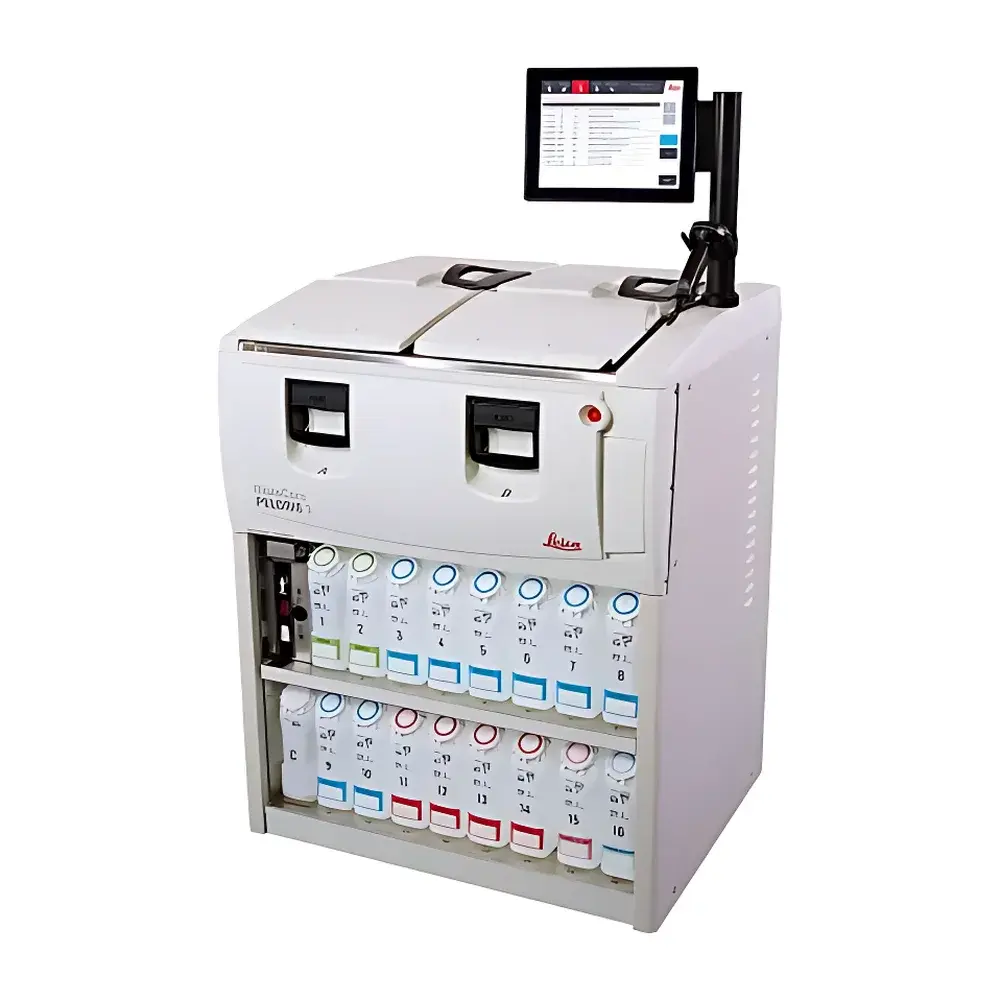
Leica HistoCore PEGASUS & HistoCore PEGASUS Plus Dual-Chamber Tissue Dehydrator
| Brand | Leica |
|---|---|
| Origin | USA |
| Model | HistoCore PEGASUS & HistoCore PEGASUS Plus Dual-Chamber Tissue Dehydrator |
| Capacity | Up to 400 specimens per run |
| Chamber Configuration | Two independent, thermally isolated processing chambers |
| Reagent Management | Color-coded, RFID-enabled reagent bottles with volume tracking |
| Compliance | Designed for GLP/GMP-aligned histopathology laboratories |
| Software | Leica Application Suite (LAS) v5.x with audit trail and user access control |
Overview
The Leica HistoCore PEGASUS and HistoCore PEGASUS Plus are fully automated, dual-chamber tissue dehydrators engineered for high-throughput, precision-controlled histological specimen preparation in clinical pathology and research laboratories. Based on sequential solvent exchange principles—replacing water in fixed tissue with graded alcohols, followed by xylene or xylene substitutes and finally molten paraffin—the system executes programmable dehydration, clearing, and infiltration cycles under tightly regulated temperature, pressure, and timing parameters. The dual-chamber architecture enables simultaneous, fully independent processing of two distinct tissue cohorts (e.g., routine biopsies vs. fatty or dense surgical specimens), eliminating cross-program interference and ensuring optimal morphological preservation across heterogeneous sample types. Each chamber operates with autonomous fluid delivery, vacuum/pressure control, and thermal regulation, supporting reproducible, ISO 15189-compliant pre-analytical workflows.
Key Features
- Dual independent processing chambers with separate reagent reservoirs, heating elements, and vacuum/pressure manifolds—enabling concurrent execution of two non-identical protocols without cross-contamination or thermal crosstalk.
- High-capacity specimen handling: accommodates up to 400 standard histology cassettes (e.g., Leica ActivFlo cassettes) per full run across both chambers, scalable via optional cassette carriers and stacking trays.
- Intelligent reagent management system featuring color-coded, barcoded, and RFID-tagged reagent bottles; real-time volume monitoring, low-level alerts, and automatic log generation for reagent lot traceability.
- Precision temperature control (±0.5 °C) across all stations—including alcohol, xylene-substitute, and paraffin baths—ensuring consistent tissue penetration and minimizing shrinkage or hardening artifacts.
- Integrated safety architecture: leak detection sensors, overpressure relief valves, solvent vapor containment with activated carbon filtration, and emergency stop with chamber isolation.
- Modular design compliant with ISO 13485 manufacturing standards; CE-marked per IEC 61010-1 and IEC 61326-1 for laboratory equipment safety and EMC performance.
Sample Compatibility & Compliance
The HistoCore PEGASUS platform supports broad tissue compatibility—including delicate biopsy specimens, fatty tissues (e.g., breast or adipose), fibrous connective tissues, and calcified samples—through customizable time/temperature/solvent profiles. It is validated for use with Leica-certified reagents (e.g., Leica Clearify™ xylene substitute, Leica Paraffin Embedding Medium) and third-party ASTM D7213-compliant solvents. All operational logs—including cycle start/end timestamps, reagent usage, temperature deviations, and user interventions—are stored with cryptographic integrity for FDA 21 CFR Part 11 compliance when configured with LAS v5.x audit trail and electronic signature modules. The system meets CLSI H25-A3 requirements for tissue processor qualification and supports laboratory accreditation under CAP, COLA, and UK NEQAS histopathology assessment frameworks.
Software & Data Management
Controlled via Leica Application Suite (LAS) v5.x, the HistoCore PEGASUS offers role-based access (administrator, technician, supervisor), protocol versioning, and secure network integration (DICOM-SR compatible metadata export). Cycle data—including real-time chamber pressure curves, solvent temperature gradients, and reagent consumption histograms—is archived in SQLite3 databases with daily encrypted backups. Audit trails record all critical events (e.g., program edits, reagent changes, emergency stops) with user ID, timestamp, and IP address, satisfying GLP documentation requirements. Optional integration with LIS/HIS systems is supported through HL7 v2.5.1 and ASTM E1384 interfaces.
Applications
- Routine diagnostic histopathology: parallel processing of small biopsies and large resection specimens in high-volume hospital labs.
- Research tissue banking: standardized dehydration of frozen-thawed or post-mortem tissues requiring low-temperature solvent protocols.
- Immunohistochemistry (IHC) and molecular pathology prep: optimized dehydration profiles preserving antigenicity and nucleic acid integrity for downstream FISH, NGS, or RT-qPCR.
- Quality assurance programs: automated calibration verification using NIST-traceable thermal probes and gravimetric reagent validation kits.
- Training and education: preloaded teaching protocols with step-by-step visual guidance for histotechnician certification programs.
FAQ
Can the two chambers run different reagent sets simultaneously?
Yes—each chamber maintains physically segregated reagent lines, reservoirs, and waste paths, enabling concurrent use of ethanol/xylene and isopropanol/clearify protocols without carryover risk.
Is remote monitoring supported?
Yes, via Leica Remote Connect (LRC) module with TLS 1.2-secured web interface, push notifications for cycle completion or error states, and SNMP v3 integration for enterprise IT monitoring.
What validation documentation is provided?
Factory-installed IQ/OQ documentation per ISO/IEC 17025, including temperature uniformity mapping reports, vacuum decay test records, and reagent delivery accuracy certificates.
How does the system handle fatty tissue processing?
Through extended low-temperature alcohol incubation steps and programmable agitation cycles, minimizing lipid leaching while maintaining cellular architecture—validated per CAP checklist ANP.22120.
Is service support available globally?
Leica Biosystems provides certified field service engineers in >90 countries, with SLAs covering 4-hour remote diagnostics and 24–72 hour on-site response depending on contract tier.