
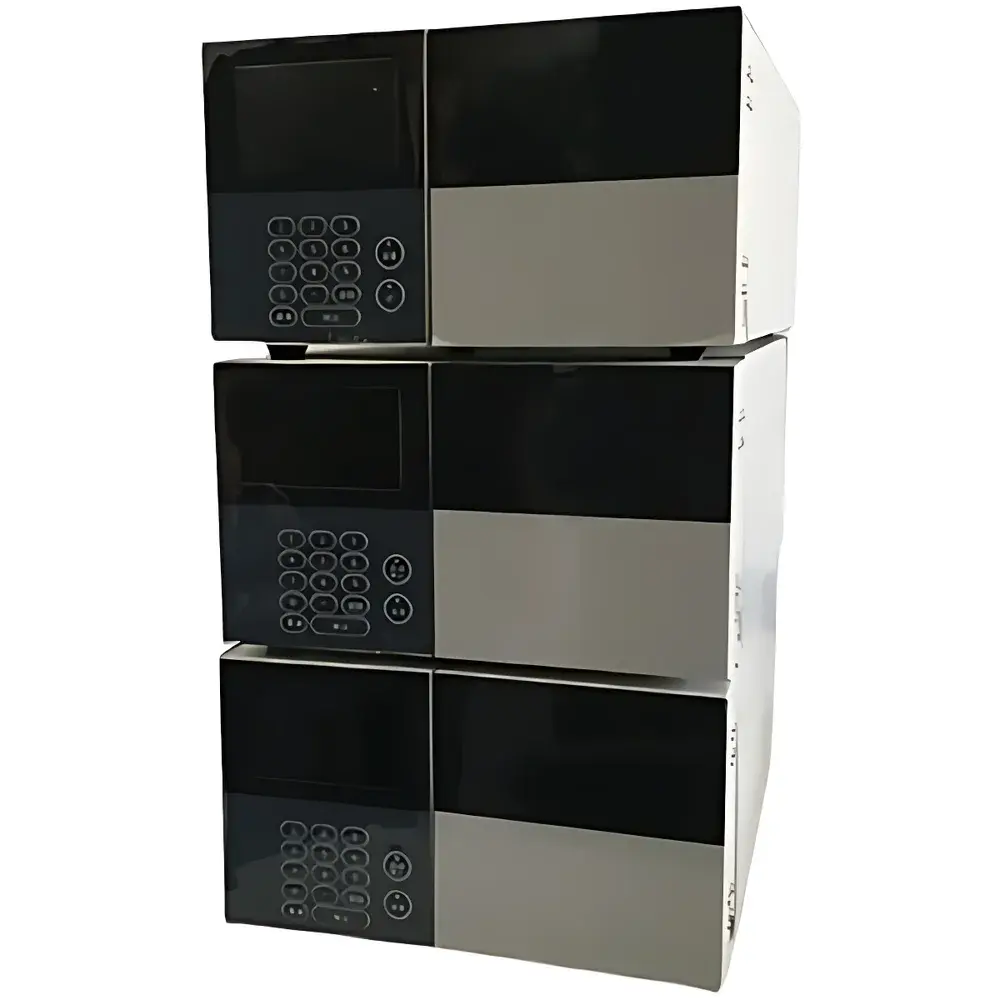
JKRDA LC-2100 Ultra-High Performance Liquid Chromatograph
| Brand | JKRDA |
|---|---|
| Origin | Beijing, China |
| Manufacturer Type | Authorized Distributor |
| Origin Category | Domestic (PRC) |
| Model | LC-2100 |
| Instrument Type | Ultra-High Performance Liquid Chromatograph (UHPLC) |
| Application Scope | General-Purpose Analytical Use |
| Pump Flow Range | 0.001–10.000 mL/min (0.001 mL/min increments) |
| Flow Accuracy | ≤±1% (at 1.0 mL/min, 8.5 MPa, methanol, 25°C) |
| Flow Precision | RSD ≤0.25% |
| Maximum Operating Pressure | 42 MPa |
| Pressure Pulsation | <0.1 MPa (at 1.0 mL/min, 8.5 MPa, methanol, 25°C) |
| UV-Vis Detector Wavelength Range | 190–740 nm |
| Wavelength Accuracy | ±1 nm |
| Wavelength Repeatability | ±0.1 nm |
| Spectral Bandwidth | 8 nm |
| Baseline Noise | ≤5×10⁻⁶ AU (methanol, 1 mL/min, 254 nm, 20°C) |
| Baseline Drift | ≤±1×10⁻⁴ AU/h (methanol, 1 mL/min, 254 nm, 20°C) |
| Detection Limit | ≤4×10⁻⁹ g/mL (naphthalene in methanol) |
| Flow Cell Volume | 10 µL |
| Optical Path Length | 10 mm |
| Light Source | Deuterium Lamp (2000 h lifetime) / Optional Tungsten Lamp |
| Communication Interface | RS-232 |
| Power Supply | AC 220 V, 50/60 Hz |
| Power Consumption | 100 W |
| Dimensions (W×D×H) | 360×260×170 mm |
| Weight | 13 kg (pump), 10 kg (detector) |
Overview
The JKRDA LC-2100 Ultra-High Performance Liquid Chromatograph (UHPLC) is an integrated analytical system engineered for precision, robustness, and operational consistency in routine and method-development laboratories. It employs high-pressure liquid chromatography (HPLC) principles—specifically isocratic and gradient elution—using a dual-piston, floating-type reciprocating pump architecture to deliver stable solvent delivery across a wide flow range (0.001–10.000 mL/min). The system couples this with a high-sensitivity, dual-lamp UV-Vis detector featuring cross-optical-path design and thermally stabilized optics, enabling accurate quantification of analytes from 190 nm to 740 nm. Designed for compliance with standard laboratory workflows, the LC-2100 supports both standalone operation and full computer control via RS-232 interface, facilitating integration into networked QA/QC environments where traceability and audit readiness are essential.
Key Features
- High-stability dual-plunger pump with auto-flushing pump head and pressure-compensated solvent compressibility correction—reducing seal wear and minimizing pulsation (<0.1 MPa at operating conditions).
- Three-point flow calibration curves and multi-point parameter correction ensure long-term volumetric accuracy (≤±1% at 1.0 mL/min) and reproducibility (RSD ≤0.25%).
- Programmable overpressure and underpressure protection protocols—including automatic shutdown at low-pressure thresholds—to safeguard column integrity and system safety.
- UV-Vis detector equipped with imported deuterium lamp (2000 h rated lifetime) and optional tungsten lamp, supporting broad-spectrum analysis with ±1 nm wavelength accuracy and ±0.1 nm repeatability.
- Optimized optical path with 10 mm flow cell and 8 nm spectral bandwidth delivers low baseline noise (≤5×10⁻⁶ AU) and minimal drift (≤±1×10⁻⁴ AU/h), critical for low-concentration quantitation.
- Compact modular footprint (360×260×170 mm per unit) enables flexible benchtop deployment in teaching labs, QC departments, and pilot-scale production monitoring stations.
Sample Compatibility & Compliance
The LC-2100 is compatible with reversed-phase, normal-phase, ion-exchange, and size-exclusion chromatographic columns (up to 4.6 mm ID, 250 mm length) and accommodates common mobile phases including water/acetonitrile, water/methanol, and buffered salt systems. Its hardware and firmware architecture support method transfer from legacy HPLC platforms and align with widely adopted regulatory frameworks. While not pre-certified for 21 CFR Part 11, the system’s RS-232 communication protocol, software-controllable parameters, and deterministic detector response enable integration with validated chromatography data systems (CDS) that implement electronic signatures, audit trails, and user access controls per GLP/GMP requirements. Method documentation, instrument logs, and raw signal outputs can be exported in ASCII or CSV formats for third-party validation and reporting.
Software & Data Management
The LC-2100 operates under PC-based acquisition and control software supporting real-time chromatogram visualization, peak integration (tangent skim, valley-to-valley, Gaussian fit), retention time locking, and calibration curve generation (linear, quadratic, weighted). All instrument parameters—including flow rate, gradient profile, wavelength selection, gain setting, and data collection rate—are programmable and stored as method files. Raw detector output is sampled at ≥10 Hz with 24-bit ADC resolution, ensuring fidelity for kinetic studies and narrow peak detection. Software-generated reports include system suitability metrics (theoretical plates, tailing factor, resolution), and support PDF/Excel export. Data files adhere to open-format conventions to facilitate import into LIMS or statistical analysis tools such as JMP or Python-based chemometrics pipelines.
Applications
- Pharmaceutical QC: Assay of active pharmaceutical ingredients (APIs), related substances testing, and dissolution profile analysis per USP and ICH Q2(R2) guidelines.
- Food & Feed Safety: Quantification of mycotoxins (e.g., aflatoxin B1), synthetic antioxidants (BHA/BHT), vitamins (A, D, E), and amino acid profiles in compound feed formulations.
- Chemical Manufacturing: Reaction monitoring, purity assessment of intermediates, and residual solvent analysis per ICH Q3C.
- Academic & Teaching Labs: Hands-on training in separation science fundamentals, method optimization exercises, and undergraduate capstone projects requiring reproducible retention behavior and peak symmetry evaluation.
- Environmental Screening: Analysis of phenolic pollutants, PAHs, and pesticide residues in water extracts using EPA Method 8330B-compatible protocols.
FAQ
Is the LC-2100 compliant with FDA 21 CFR Part 11?
The instrument itself does not include built-in electronic signature or audit trail functionality. However, its RS-232 interface and deterministic data output allow seamless integration with validated third-party CDS platforms that meet Part 11 requirements.
What column dimensions and particle sizes are supported?
The system is optimized for columns up to 4.6 mm internal diameter and 250 mm length, and supports sub-2 µm particles when operated within its 42 MPa pressure limit—making it suitable for UHPLC-grade separations with appropriate backpressure management.
Can the UV-Vis detector perform simultaneous dual-wavelength analysis?
No—the detector operates in single-wavelength mode per acquisition event; however, wavelength switching is software-programmable with <100 ms settling time, enabling rapid sequential monitoring at two wavelengths.
Does the pump support gradient mixing internally?
Yes—the LC-2100 includes a high-pressure gradient module capable of precise binary solvent blending with dynamic proportioning and real-time compressibility compensation.
What maintenance intervals are recommended for the pump seals and UV lamp?
Pump seals should be inspected every 3,000–5,000 operating hours; the deuterium lamp is rated for 2,000 hours and features automatic usage logging in the control software.





