
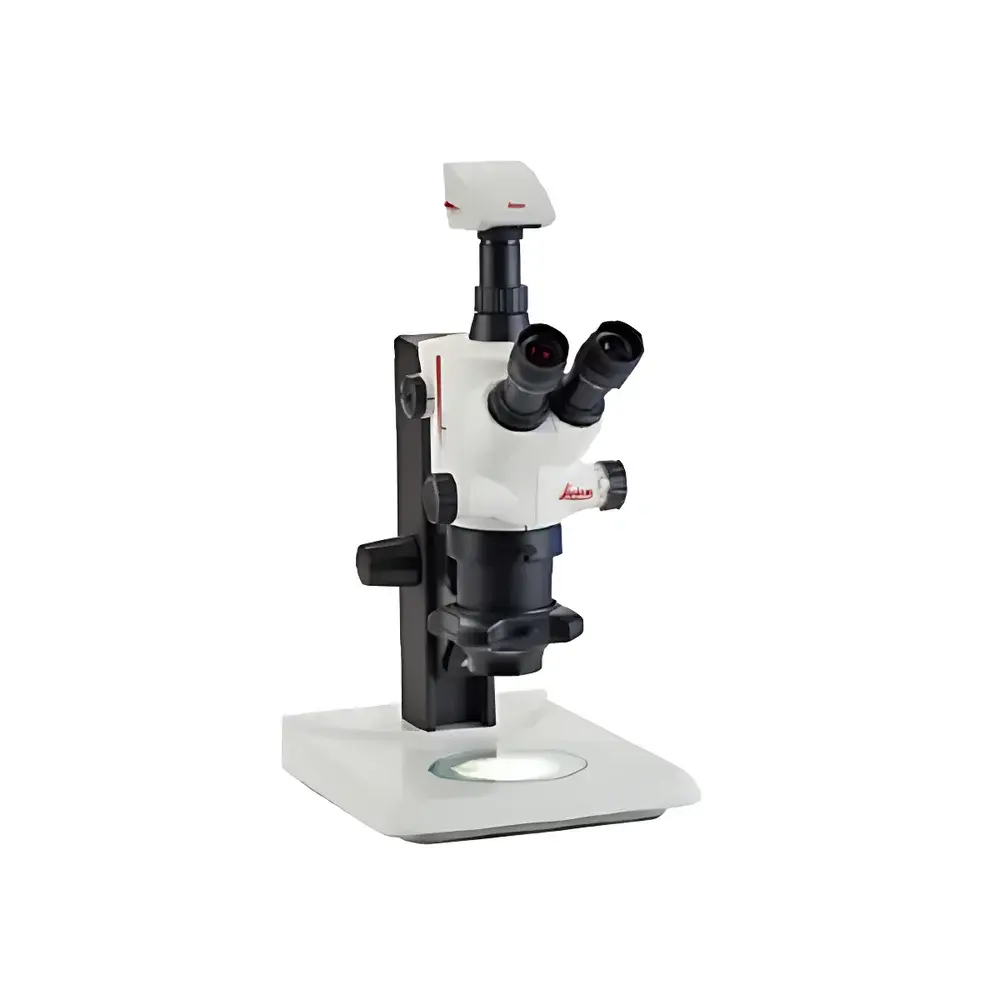
Leica S APO Stereo Microscope for Routine Inspection
| Brand | Leica |
|---|---|
| Origin | USA |
| Manufacturer Type | Authorized Distributor |
| Origin Category | Imported |
| Model | Leica S APO Stereo Microscope for Routine Inspection |
| Pricing | Available Upon Request |
Overview
The Leica S APO Stereo Microscope for Routine Inspection is an advanced modular stereo imaging system engineered for high-precision visual inspection, quality assurance, and micro-manipulation tasks in industrial, electronics, and life science laboratories. Built upon Leica Microsystems’ proprietary apochromatic (APO) optical design and infinite-corrected optical path, the instrument delivers diffraction-limited resolution, exceptional color fidelity, and minimal chromatic and spherical aberration across its full 8:1 continuous zoom range. Its core optical architecture employs a Greenough-style dual-path stereoscopic configuration with matched APO-corrected objective and eyepiece optics—ensuring true 3D depth perception, consistent magnification linearity, and high contrast even at maximum 80× total magnification. Designed for routine but demanding applications—including PCB solder joint inspection, micro-assembly verification, cell sorting, and micromanipulation—the S APO integrates ergonomic engineering with metrological-grade optical performance, supporting both transmitted and reflected illumination modalities without compromise.
Key Features
- 8:1 continuous zoom ratio (0.8×–8× objective zoom) combined with 10× widefield eyepieces and 1× auxiliary lens yields a calibrated total magnification range of 8× to 80×—fully parfocal and laterally stable across all settings.
- 75 mm working distance maintained throughout the entire zoom range—enabling unobstructed access for probes, tweezers, or manipulators during live inspection or micro-intervention tasks.
- Ergonomic 38° inclined binocular tube with adjustable interpupillary distance (55–75 mm) and diopter compensation—reducing cervical strain and ocular fatigue during extended use sessions.
- Integrated C-mount image port with fixed 1× coupling optics—compatible with industry-standard CMOS/CCD cameras (e.g., Leica DFC series, FLIR Blackfly, Basler ace) for documentation, measurement, and real-time streaming.
- Modular illumination support: includes optional ring LED fluorescent illuminator with adjustable intensity and multi-segment dimming—optimized for low-glare observation of highly reflective surfaces (e.g., solder joints, metallized traces, polished alloys).
- Apochromatic optical train certified to ISO 10934-1 (optical microscopy — terminology and definitions) and compliant with DIN EN ISO 9001 quality management requirements for optical instrumentation manufacturing and calibration traceability.
Sample Compatibility & Compliance
The Leica S APO accommodates a broad spectrum of opaque, translucent, and semi-transparent specimens without requiring sectioning or coating—ideal for intact electronic assemblies, mechanical components, botanical samples, and live biological preparations. Its long working distance and large stage clearance permit direct observation of objects up to 120 mm in height. The system supports both incident (reflected) and transmitted (epi- and trans-illuminated) light paths via interchangeable base modules (e.g., Leica TL4000 LED transmission stand). All optical components meet RoHS Directive 2011/65/EU and REACH Annex XVII substance restrictions. For regulated environments, the microscope’s mechanical stability, repeatable zoom calibration, and documented optical performance align with GLP audit requirements per OECD Principles of Good Laboratory Practice (ENV/MC/CHEM(98)17) and support IQ/OQ validation protocols under FDA 21 CFR Part 11-compliant digital imaging workflows when paired with validated acquisition software.
Software & Data Management
When integrated with Leica Application Suite X (LAS X) Core or LAS X Lite, the S APO enables automated image capture, measurement annotation (distance, area, angle), Z-stack generation, and report export in PDF, TIFF, or CSV formats. LAS X complies with FDA 21 CFR Part 11 for electronic records and signatures—including user access control, audit trail logging, and secure data archiving. Optional modules support GxP-aligned workflow templates, measurement uncertainty calculation per ISO/IEC 17025, and DICOM export for cross-platform integration with LIMS or ELN systems. Raw image metadata (magnification, illumination mode, timestamp, operator ID) is embedded in EXIF headers and preserved through all processing stages.
Applications
- Electronics Manufacturing: Visual inspection of solder paste deposition, reflow defects, BGA underfill voids, flex circuit trace integrity, and post-rework verification at ≤20 µm feature resolution.
- Quality Control Labs: Dimensional verification of machined parts, surface defect mapping (scratches, pits, porosity), and coating uniformity assessment per ASTM E112 (grain size) and ISO 4287 (surface roughness).
- Life Sciences: Embryo handling, oocyte enucleation, blastomere biopsy, and microinjection in IVF clinics—leveraging depth perception and vibration-damped staging.
- Materials Research: Fracture surface analysis, fiber orientation mapping in composites, and corrosion morphology evaluation on metallic or ceramic substrates.
- Forensic & Failure Analysis: Toolmark comparison, gunshot residue particle identification, and counterfeit component authentication via optical signature matching.
FAQ
Is the Leica S APO compatible with third-party digital cameras?
Yes—the integrated C-mount port accepts standard 1″ sensor cameras with 1× relay optics; mechanical and optical back focal length specifications conform to ANSI/NEMA MV-1.0-2017.
Does the system support motorized zoom or focus?
The base S APO model features manual zoom and focus controls; motorized zoom (Z-axis) and focus (F-axis) are available as factory-installed options with LAS X hardware synchronization.
What is the depth of field at 80× magnification?
At nominal 80× total magnification (8× zoom × 10× eyepieces), the calculated depth of field is approximately 0.28 mm—consistent with theoretical values for APO-corrected Greenough systems operating at f/12 effective aperture.
Can the microscope be calibrated for measurement traceability?
Yes—Leica-certified calibration services provide NIST-traceable magnification verification and stage scale certification per ISO/IEC 17025-accredited procedures; calibration certificates include uncertainty budgets.
Is service and technical support available globally?
Leica Microsystems maintains authorized service centers in over 40 countries, offering on-site preventive maintenance, optical alignment verification, and firmware/software updates aligned with IEC 61000-4 electromagnetic compatibility standards.





