
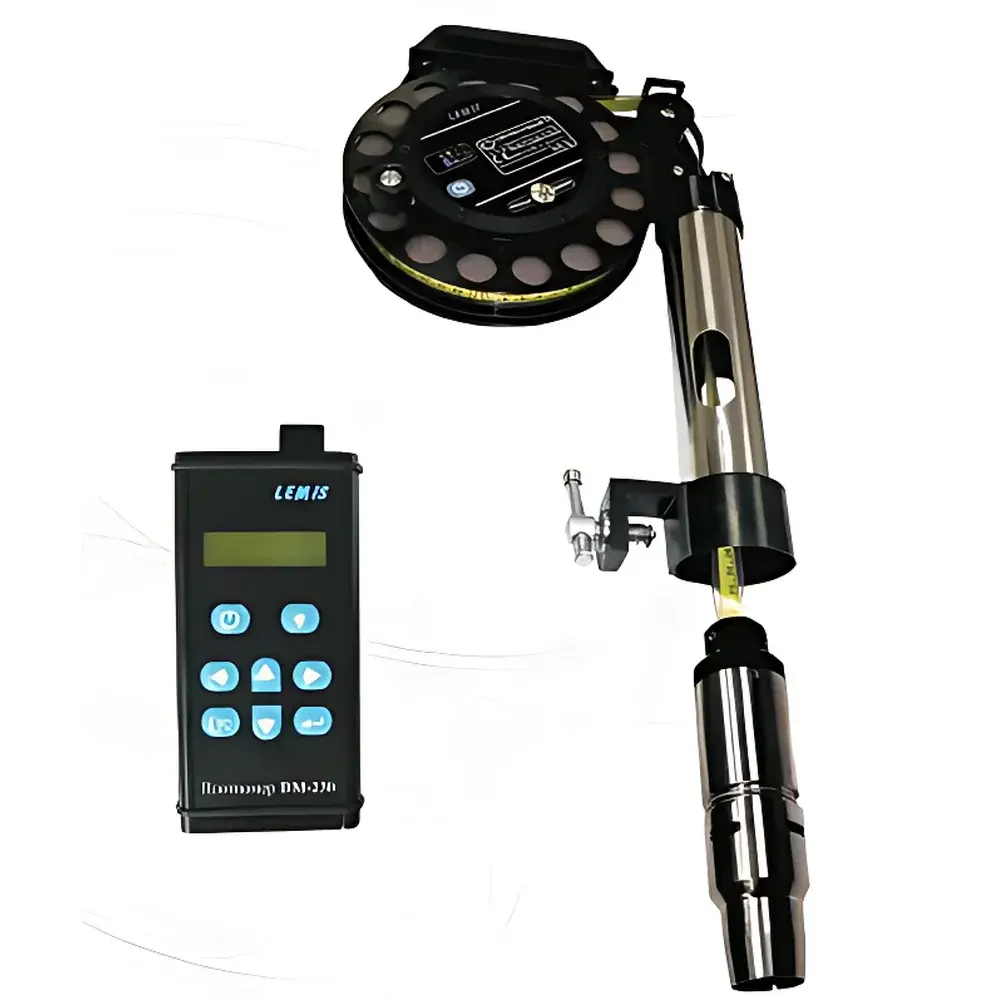
LEMIS DM-230.2A Portable Submersible Densimeter
| Brand | LEMIS / LEMIS Baltic |
|---|---|
| Model | DM-230.2A |
| Density Range | 0.6500–1.1000 g/cm³ |
| Density Accuracy | ±0.0005 g/cm³ (typical, per ISO 12185) |
| Operating Temperature Range | −40 to +85 °C |
| Submersion Depth | Up to 30 m |
| Data Storage Capacity | 998 measurements |
| Wireless Interface | Integrated Bluetooth® 4.2 for PC and portable printer connectivity |
| Calibration Compliance | Traceable to NIST and PTB standards |
| Hazardous Area Certification | ATEX II 2G Ex ib IIB T4 Gb / IECEx Ex ib IIB T4 Gb |
| Regulatory Listing | Registered in the State Register of Measuring Instruments (Eurasian Economic Union) |
Overview
The LEMIS DM-230.2A Portable Submersible Densimeter is an intrinsically safe, field-deployable instrument engineered for direct in-situ density and temperature measurement of petroleum liquids in vertical storage tanks, railcars, and marine barges—without sampling. It operates on the principle of hydrostatic pressure differential measurement combined with high-stability platinum resistance thermometer (PRT) sensing, enabling real-time determination of liquid density at any depth up to 30 meters. Unlike traditional hydrometers or laboratory-based oscillating U-tube densimeters, the DM-230.2A eliminates phase separation, thermal equilibration delay, and compositional drift associated with sample extraction. Its design conforms to the metrological requirements of ISO 12185 (Crude oil and petroleum products — Determination of density — Oscillating U-tube method) and supports ASTM D1298 (Standard Test Method for Density, Relative Density, or API Gravity of Crude Petroleum and Liquid Petroleum Products by Hydrometer Method) as a validated field alternative. The device delivers traceable, repeatable density values under dynamic operational conditions—including cryogenic (-40 °C) and high-temperature (+85 °C) environments common in arctic terminals and refinery off-gas handling.
Key Features
- True submersible operation: Fully sealed, pressure-compensated sensor probe rated for continuous immersion at depths up to 30 m (3 bar gauge)
- Simultaneous dual-parameter acquisition: High-resolution density (0.0001 g/cm³ display resolution) and temperature (±0.1 °C accuracy) measured at identical spatial coordinates
- Automatic temperature compensation: Real-time conversion of measured density to standardized reference temperatures (15 °C or 20 °C) per ISO 91-1 and ASTM D1250
- Ruggedized mechanical architecture: IP68-rated housing with shock-absorbing polymer overmold; certified for Zone 1 hazardous locations (ATEX/IECEx)
- Onboard data integrity: Internal non-volatile memory stores 998 timestamped, depth-tagged measurements with operator ID and GPS metadata (when paired with external GNSS module)
- Wireless telemetry: Bluetooth 4.2 Class 1 interface enables secure, encrypted transfer to Windows/Linux PCs or thermal printers without physical docking
- Ergonomic handheld design: Balanced weight distribution, tactile button layout, and auto-backlit LCD for low-light tank-top or night-shift operation
Sample Compatibility & Compliance
The DM-230.2A is validated for use with crude oil, naphtha, gasoline, diesel, fuel oil, lubricants, and other Newtonian and mildly non-Newtonian hydrocarbon streams exhibiting kinematic viscosities up to 500 mm²/s at 40 °C. It is not intended for highly aerated, foaming, or solid-laden suspensions. All factory calibrations are performed using certified reference materials traceable to NIST SRM 1827 (crude oil density standards) and PTB-certified water-glycerol mixtures. The instrument complies with GLP data integrity requirements through built-in audit trail logging (user actions, calibration events, firmware updates), satisfying FDA 21 CFR Part 11 electronic record provisions when used with validated software. It is registered in the EAEU State Register of Measuring Instruments (Certificate No. RU.C.32.003.A No. 78121), permitting legal metrology use across Russia, Belarus, Kazakhstan, Armenia, and Kyrgyzstan.
Software & Data Management
The DM-230.2A interfaces with LEMIS DensData Manager v3.2—a Windows-based desktop application supporting automated report generation in PDF/XLSX formats compliant with API RP 2552 and ISO 27953. Each measurement file contains raw sensor outputs, compensated density values, depth tags, ambient pressure logs, and cryptographic hash signatures for tamper detection. The software enforces role-based access control (RBAC), electronic signature workflows, and exportable audit trails required for ISO/IEC 17025-accredited laboratories. Optional cloud synchronization enables centralized fleet monitoring via LEMIS CloudLink™, with TLS 1.3 encryption and SOC 2 Type II–certified infrastructure.
Applications
- Commercial custody transfer verification: Direct reconciliation of tank inventory vs. pipeline flowmeter totals
- Stratification analysis: Vertical profiling to detect water bottoms, sediment layers, or API gravity gradients in aging crude blends
- Real-time quality surveillance: Early identification of contamination (e.g., diluent ingress, condensate carryover) during loading/unloading operations
- Fixed system validation: In-place verification of guided wave radar (GWR) or gamma-based density transmitters without process shutdown
- Emergency response metrology: Rapid assessment of spilled product density for containment modeling and recovery planning
- Regulatory compliance reporting: Generation of auditable density records for EPA SPCC, IMO MARPOL Annex I, and EU RED II sustainability declarations
FAQ
Is the DM-230.2A suitable for measuring ethanol-blended fuels?
Yes—its sensor materials and algorithmic compensation accommodate oxygenated blends up to E85, provided vapor pressure remains below 100 kPa abs.
Does the device require periodic recalibration in the field?
No routine recalibration is needed between annual metrological verification cycles; however, a two-point verification using certified density standards is recommended before each critical custody transfer event.
Can depth-specific measurements be exported with georeferenced coordinates?
When paired with a certified GNSS receiver (e.g., u-blox ZED-F9P), position-stamped measurement logs are embedded in the native .ddm file format.
What is the battery life under continuous submersion at −20 °C?
Minimum 12 hours of active measurement duty cycle, verified per IEC 60068-2-1 (cold test) and IEC 60068-2-2 (dry heat test).
How does the DM-230.2A handle viscous residues adhering to the sensor surface?
The probe incorporates a self-cleaning hydrophobic coating and optional ultrasonic vibration mode (activated via software command) to dislodge deposits without manual intervention.



