
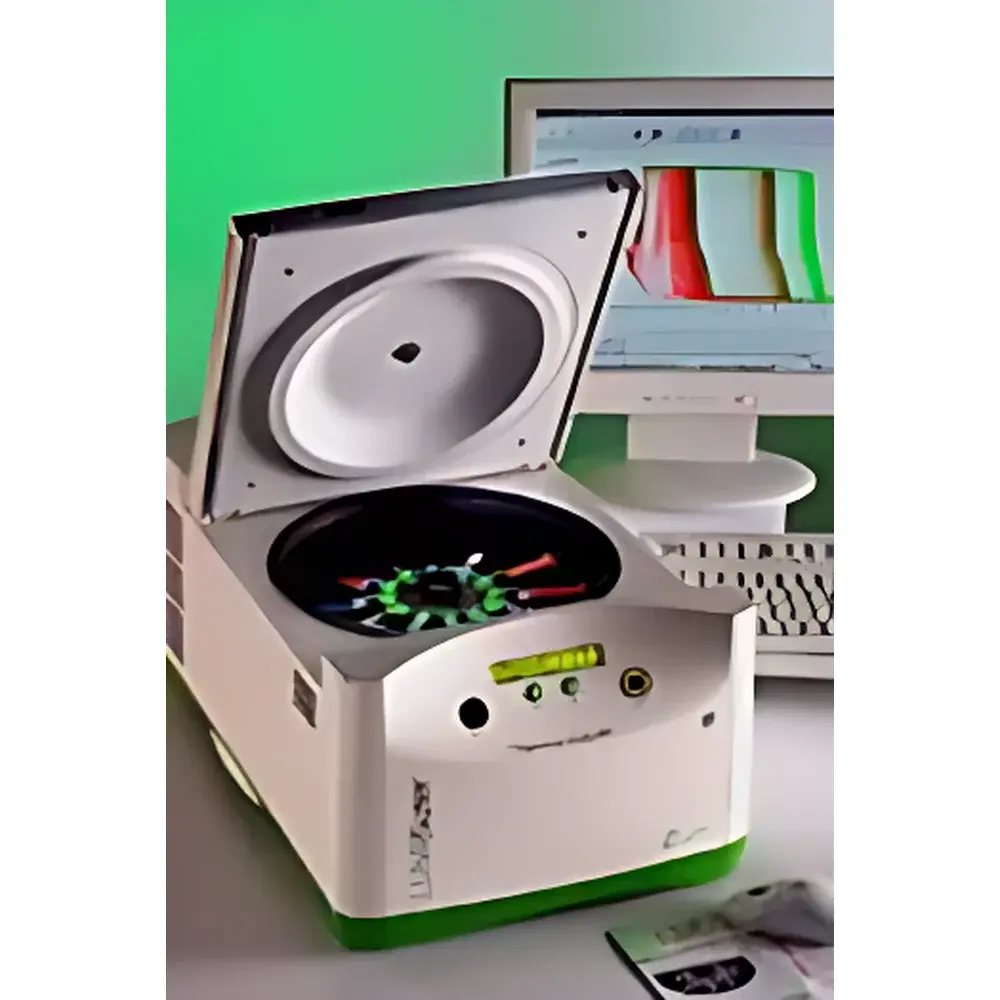
LUMiSizer 611 Full-Function Stability Analyzer by LUM GmbH
| Brand | LUM |
|---|---|
| Origin | Germany |
| Model | LUMiSizer 611 |
| Instrument Type | Benchtop Analytical Centrifuge |
| Max. Rotational Speed | 4,000 rpm |
| Max. Relative Centrifugal Force (RCF) | 4,000 × g |
| Sample Capacity | 12 positions × 0.1–2 mL |
| Optical Detection | Near-Infrared (NIR) Transmission Scanning |
| Temperature Control Range | 4–60 °C (ambient option available) |
| Particle Size Range | 0.01–1,000 µm |
| Sample Viscosity Range | 0.8–10⁸ mPa·s |
| Solid Concentration Range | 1–90 vol% |
| Separation Velocity Resolution | 0.01–1,000 µm/s |
| Dimensions (W×D×H) | 70 × 30 × 50 cm |
| Compliance | ISO 13318-2 (for particle size analysis by analytical centrifugation), GLP-ready architecture |
Overview
The LUMiSizer 611 Full-Function Stability Analyzer is an advanced analytical centrifuge engineered by LUM GmbH (Germany) for quantitative, high-resolution assessment of colloidal and dispersion stability. Unlike conventional centrifuges designed solely for sample pelleting or phase separation, the LUMiSizer 611 integrates patented near-infrared (NIR) transmission scanning with precisely controlled rotational acceleration to monitor real-time particle migration under defined gravitational or centrifugal fields. Its core measurement principle is based on analytical centrifugation—governed by Stokes’ law and sedimentation velocity theory—enabling direct quantification of sedimentation, flotation, creaming, aggregation, flocculation, and coalescence kinetics across the entire sample column. This allows for accelerated stability testing up to 2,500× faster than gravity-based methods, while maintaining thermodynamic relevance through programmable temperature control (4–60 °C) and precise RCF modulation (200–4,000 rpm, up to 4,000 × g). The system is validated per ISO 13318-2 for particle size distribution (PSD) determination and widely accepted in regulatory contexts for shelf-life prediction, formulation benchmarking, and root-cause analysis of instability mechanisms.
Key Features
- Simultaneous real-time monitoring of 12 independent samples using high-sensitivity NIR transmission optics and full-column scanning (0.1–2 mL per position)
- Microprocessor-controlled rotational speed regulation (200–4,000 rpm) with <±0.5% speed accuracy and <0.1 °C thermal stability
- Non-invasive, label-free optical detection enabling continuous acquisition of transmittance profiles at 100+ axial positions per scan
- Quantitative separation velocity profiling from 0.01 to 1,000 µm/s—resolving subtle destabilization phenomena invisible to visual inspection
- Integrated temperature control module supporting isothermal or gradient protocols (4–60 °C); ambient operation also supported
- Rugged benchtop design (70 × 30 × 50 cm) with CE-compliant safety interlocks, rotor imbalance detection, and automatic lid locking
Sample Compatibility & Compliance
The LUMiSizer 611 accommodates a broad spectrum of complex fluid systems without dilution or pretreatment: suspensions, emulsions, foams, colloidal dispersions, pastes, and slurries—with solid concentrations spanning 1–90 vol%, viscosities from 0.8 to 10⁸ mPa·s, and particle densities between 0.01 and 10 g/cm³. It supports particle sizing from 0.01 µm (e.g., silica nanoparticles, protein aggregates) to 1,000 µm (e.g., coarse pigment agglomerates, fat globules). Method development and validation align with international standards including ISO 13318-2 (analytical centrifugation), ISO 20998-1 (particle size analysis), and ASTM D7827 (emulsion stability testing). Data integrity meets GLP/GMP requirements via audit-trail-enabled software (SEPView), supporting FDA 21 CFR Part 11 compliance when deployed with appropriate IT infrastructure and user access controls.
Software & Data Management
SEPView™ (Windows-based) serves as the native acquisition, visualization, and interpretation platform. It provides synchronized real-time display of transmittance vs. time/position heatmaps, automated calculation of instability indices (e.g., sedimentation rate, interface velocity, depletion zone formation), and export of raw intensity profiles for third-party statistical analysis (e.g., MATLAB, Python pandas). All measurements are timestamped, user-annotated, and stored in encrypted binary format with metadata embedding (instrument ID, method parameters, environmental logs). Version-controlled method templates ensure reproducibility across labs; batch processing enables comparative stability ranking of formulations. Audit trails record all user actions—including parameter edits, data deletions, and report generation—meeting traceability mandates for regulated environments.
Applications
- Colloidal stability screening in pharmaceutical nanosuspensions, liposomal drug carriers, and biopolymer dispersions
- Dairy product shelf-life modeling (e.g., creaming kinetics in UHT milk, fat globule aggregation in infant formula)
- Food & beverage R&D: emulsion breakdown in dressings, sedimentation in fruit pulps, foam collapse in plant-based beverages
- Paint & coating formulation optimization—pigment settling resistance, anti-flocculation efficacy, rheological synergy
- Personal care product development: silicone droplet coalescence in antiperspirants, suspension stability in sunscreens
- Quality assurance workflows: lot-to-lot comparability, incoming raw material screening, post-sterilization stability verification
FAQ
How does the LUMiSizer 611 differ from a standard preparative centrifuge?
Unlike preparative centrifuges optimized for pelleting or phase separation, the LUMiSizer 611 is a dedicated analytical instrument that combines controlled centrifugal stress with spatially resolved optical detection to quantify dynamic instability mechanisms—not just endpoint separation.
Can it measure particle size distribution without calibration standards?
Yes—its first-principles-based analysis (Stokes–Einstein formalism coupled with sedimentation velocity modeling) enables absolute PSD determination without reference materials, provided density and viscosity are known or measured independently.
Is temperature control mandatory for all measurements?
No—ambient operation is supported; however, temperature stabilization is recommended for kinetic studies requiring thermodynamic consistency or for low-viscosity systems where thermal drift affects migration rates.
What sample tube formats are compatible?
Standard 2 mm pathlength quartz cuvettes (10 mm × 10 mm cross-section); custom tube geometries can be accommodated upon request with corresponding optical calibration.
Does SEPView support automated reporting for regulatory submissions?
Yes—customizable PDF/Excel reports include raw data plots, derived parameters, pass/fail criteria evaluation, and full audit trail export for inclusion in IND/NDA dossiers or internal QA documentation.



