
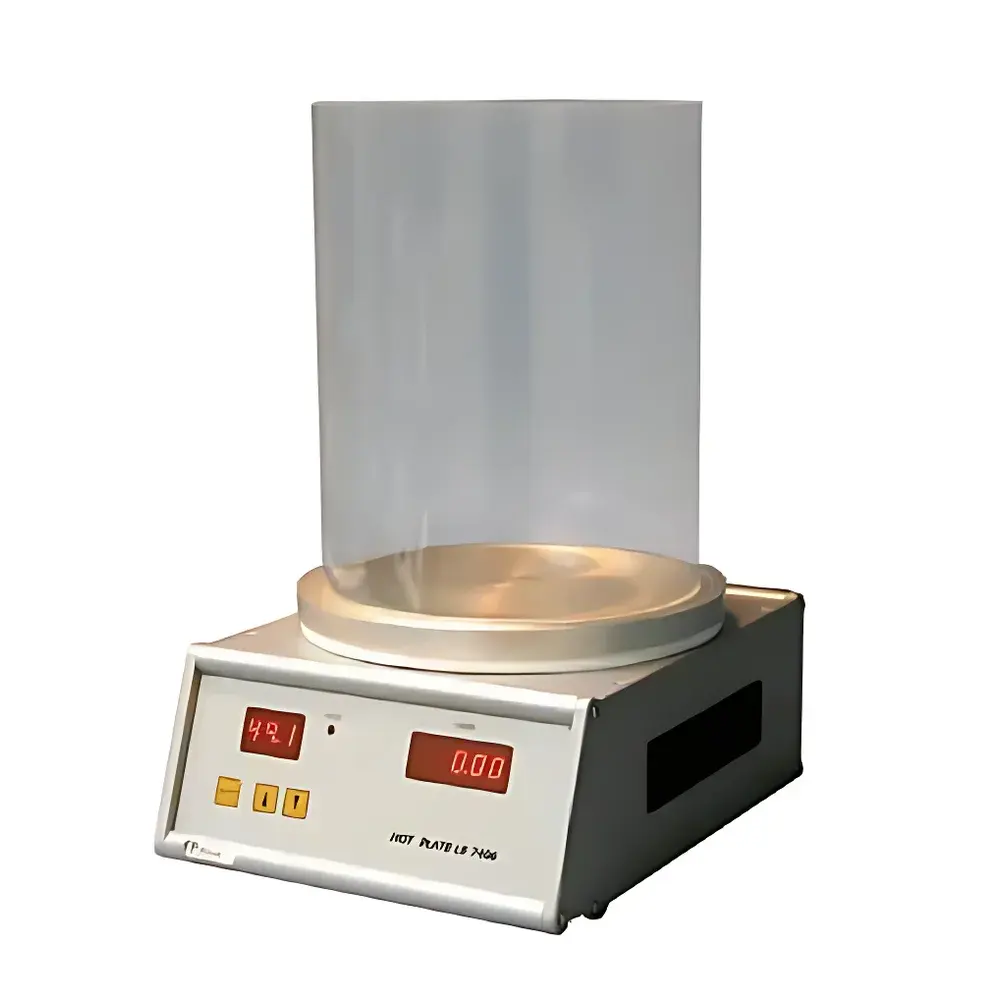
Panlab Hot Plate Analgesia Meter LE 7406
| Brand | Harvard Apparatus |
|---|---|
| Origin | USA |
| Model | LE 7406 |
| Heating Plate Material | Pure Aluminum |
| Heating Plate Dimensions (D × T) | 200 mm × 10 mm |
| Base Dimensions (L × W × H) | 200 mm × 300 mm × 110 mm |
| Cylinder Dimensions (D × H) | 200 mm × 250 mm |
| Temperature Range | 45–62 °C |
| Temperature Control Accuracy | ±0.1 °C |
| Reaction Time Resolution | 0.1 s |
| Input Control | Footswitch-activated timing |
| Data Output | RS-232 serial interface |
| Compliance | CE-marked |
| Optional Software | SeDaCom |
Overview
The Panlab Hot Plate Analgesia Meter LE 7406 is a precision-engineered thermal nociception testing system designed for quantitative assessment of analgesic efficacy in rodent models. Based on the classical hot plate assay first described by Eddy & Leimbach (1953), this instrument applies controlled, uniform surface heating to elicit reproducible withdrawal behaviors—primarily hind-paw licking and/or jumping—enabling objective measurement of thermal pain threshold latency. The system operates on the principle of centrally mediated nociceptive response, distinguishing it from peripheral reflex-based assays such as the tail-flick test. Its core architecture centers on a 200 mm diameter, 10 mm thick solid aluminum heating plate, selected for high thermal mass, minimal spatial temperature gradient (<±0.1 °C across surface), and rapid thermal equilibration. Temperature is digitally regulated within a clinically relevant range of 45–62 °C, with microprocessor-controlled feedback ensuring stability over extended experimental sessions. This level of thermal fidelity directly addresses historical limitations in assay variability associated with analog thermostats and uncalibrated heating elements.
Key Features
- Precision digital temperature control with ±0.1 °C accuracy across the entire 200 mm aluminum heating surface
- Footswitch-activated high-resolution timer (0.1 s resolution) for operator-independent reaction latency capture
- Modular acrylic restraint cylinder (200 mm Ø × 250 mm H) enabling rapid animal placement, visual monitoring, and easy cleaning between trials
- Integrated LED display for real-time temperature and latency readout; no external monitor required for basic operation
- RS-232 serial port for direct data streaming to host PC—supports timestamped event logging and batch export
- CE-certified design compliant with IEC 61010-1 safety standards for laboratory electrical equipment
- Robust mechanical construction: powder-coated steel base frame with vibration-damped mounting for stable platform performance
Sample Compatibility & Compliance
The LE 7406 is validated for use with common laboratory rodents including mice (C57BL/6, CD-1), rats (Sprague-Dawley, Wistar), and guinea pigs. Its open-cylinder configuration accommodates animals weighing up to 500 g without physical constraint, minimizing stress-induced confounds. All thermal protocols adhere to internationally accepted guidelines for ethical pain research, including the NIH Guide for the Care and Use of Laboratory Animals and Directive 2010/63/EU on the protection of animals used for scientific purposes. The system supports GLP-aligned documentation workflows when paired with SeDaCom software, enabling audit-ready trial logs with user authentication, electronic signatures, and immutable timestamping—features essential for preclinical pharmacology studies intended for regulatory submission (e.g., FDA IND or EMA CTA dossiers).
Software & Data Management
Optional SeDaCom (Software for Data Collection and Management) provides full experimental control via Windows-based GUI. It enables protocol-driven session definition (e.g., preset temperature ramp profiles, inter-trial intervals, animal ID tagging), real-time latency graphing, and automated calculation of mean latency ± SEM per treatment group. Export formats include CSV and Excel-compatible XLSX, facilitating downstream statistical analysis in GraphPad Prism, R, or SAS. SeDaCom implements role-based access control and satisfies FDA 21 CFR Part 11 requirements for electronic records and signatures when configured with appropriate IT infrastructure—including audit trail generation, password-protected user accounts, and data integrity validation checks.
Applications
- Preclinical screening of opioid and non-opioid analgesics (e.g., morphine, ibuprofen, gabapentin)
- Differentiation of central vs. peripheral mechanisms of action through comparative latency profiling
- Pharmacokinetic–pharmacodynamic (PK-PD) modeling of onset, peak effect, and duration of analgesia
- Neuropathic pain model validation (e.g., CCI, SNI) and therapeutic intervention assessment
- Teaching laboratories: standardized demonstration of nociceptive thresholds and dose–response relationships
- Quality control of compound batches in contract research organizations (CROs) supporting CNS drug development
FAQ
What species and weight ranges are supported?
Mice (18–35 g), rats (150–300 g), and guinea pigs (250–500 g) are routinely tested. The cylinder geometry ensures unobstructed observation while preventing escape or injury.
How is temperature uniformity verified across the heating surface?
Each unit undergoes factory calibration using NIST-traceable thermocouples at nine radial positions. Certified uniformity data (±0.1 °C max deviation) is included in the delivery documentation.
Can the system be integrated into automated behavioral phenotyping platforms?
Yes—RS-232 command protocol documentation is provided, enabling synchronization with third-party hardware (e.g., video tracking systems, environmental controllers) via TTL or ASCII-level triggering.
Is SeDaCom required for GLP compliance?
While manual data recording meets basic regulatory expectations, SeDaCom is recommended for full 21 CFR Part 11 and Annex 11 alignment due to its built-in electronic audit trail, user management, and data integrity safeguards.
Related Products



