
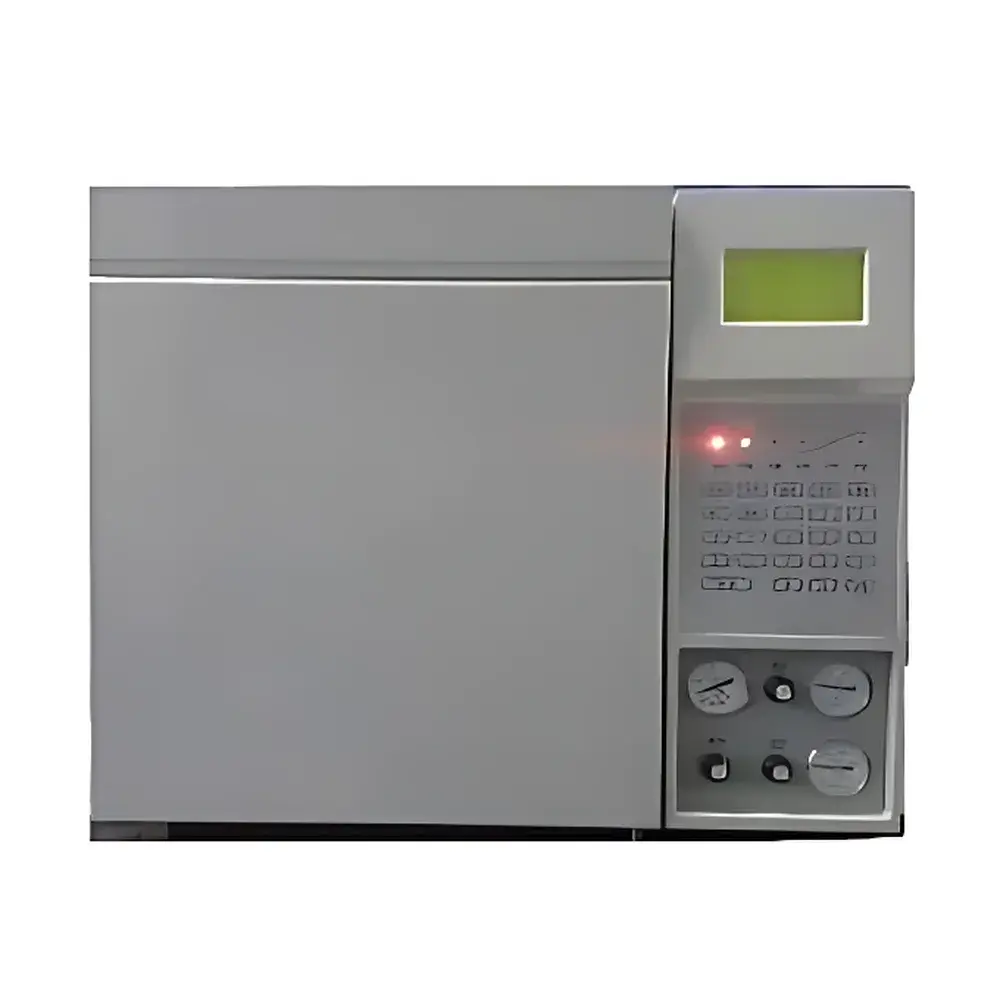
SP6900 Liquid Petroleum Gas (LPG) DME Analysis Gas Chromatograph
| Origin | Beijing, China |
|---|---|
| Manufacturer Type | Authorized Distributor |
| Origin Category | Domestic (PRC) |
| Model | SP6900 |
| Pricing | Available Upon Request |
| Temperature Control | 5-Channel Independent Zones |
| Oven Temperature Range | Ambient +15°C to 399°C |
| Temperature Accuracy | Better than ±0.1°C |
| Ramp Rate | 0.1–40°C/min |
| Programmed Temperature Steps | Up to 5 stages |
| Hold Time Range | 0–255 min per step |
| TCD Detector Sensitivity | ≥3500 mV·mL/mg |
| Baseline Noise | ≤0.02 mV |
| Drift | <0.1 mV/h |
| Instrument Weight | ~60 kg |
| Sample Introduction | Six-Port Rotary Valve |
| Data Output | Real-time digital display of LPG composition and purity via integrated PC software |
Overview
The SP6900 Liquid Petroleum Gas (LPG) DME Analysis Gas Chromatograph is a dedicated analytical platform engineered for the precise quantification of dimethyl ether (DME) and full hydrocarbon profiling in commercial LPG streams. It operates on the fundamental principle of gas-phase separation using capillary or packed column chromatography, coupled with thermal conductivity detection (TCD), a robust and universally applicable detector for permanent gases and light hydrocarbons. Unlike generic GC systems, the SP6900 integrates hardware and software optimizations specifically for the demanding matrix of liquefied petroleum gas — a mixture dominated by propane (C₃H₈), butane (C₄H₁₀), isobutane, propylene, and trace contaminants such as DME, methanol, and hydrogen sulfide. Its five-zone independent temperature control architecture ensures optimal resolution across volatile and semi-volatile components, while the six-port rotary valve enables reproducible, carrier-gas-driven sample introduction without manual syringe handling — critical for routine quality control in refinery off-gas, cylinder-filling stations, and regulatory compliance laboratories.
Key Features
- Five independently controlled temperature zones including oven, injector, and three detector compartments — enabling simultaneous optimization of separation efficiency, vaporization completeness, and detector stability.
- High-stability TCD with sensitivity ≥3500 mV·mL/mg and baseline noise ≤0.02 mV, calibrated for low-concentration DME detection (down to 0.05 vol% in LPG matrix) with linear dynamic range over three orders of magnitude.
- Five-stage programmable oven temperature ramping (0.1–40°C/min), supporting complex elution profiles required for co-eluting C₃/C₄ isomers and polar impurities.
- Integrated six-port rotary valve with heated sample loop (up to 150°C), eliminating condensation artifacts and ensuring quantitative transfer of liquefied samples under pressurized conditions.
- Real-time data acquisition and processing via embedded Windows-based software with customizable report templates compliant with ISO/IEC 17025 documentation requirements.
- Robust mechanical design (60 kg mass, vibration-damped chassis) suitable for industrial environments with ambient fluctuations and intermittent power supply.
Sample Compatibility & Compliance
The SP6900 is validated for direct analysis of vapor-phase LPG samples collected from cylinders, pipelines, or vaporizers at ambient pressure or regulated backpressure (up to 300 kPa). It accommodates both commercial-grade LPG (propane/butane blends) and specialty formulations containing up to 15 vol% DME. The system meets ASTM D2158 (Standard Test Method for Detection of Excessive Quantities of DME in Liquefied Petroleum Gases) and aligns with GB/T 13611–2018 (Chinese National Standard for Urban Gas Composition). All hardware and firmware support GLP-compliant audit trails, electronic signatures, and data integrity safeguards per FDA 21 CFR Part 11 when deployed in regulated QA/QC settings.
Software & Data Management
Acquisition and reporting are managed through ChromaLink SP6900 v3.x — a purpose-built application offering method editor, peak integration with retention time locking, calibration curve generation (single-point to multi-point), and automated purity calculation per component. Raw chromatograms and processed results are stored in vendor-neutral .cdf format (compatible with OpenChrom and Chromeleon), with optional SQL database archiving. Software supports user role-based access control, versioned method libraries, and export to CSV/PDF/Excel for integration into LIMS environments. Audit logs record all parameter changes, injection events, and report generations with timestamp and operator ID.
Applications
- Quantitative determination of DME adulteration in retail LPG — a critical test for fuel quality assurance and regulatory enforcement.
- Full compositional analysis of refinery LPG cuts to monitor fractionation efficiency and sulfur compound carryover.
- Batch release testing in cylinder-filling plants to verify compliance with EN 589 or GB 11174 specifications.
- Research into DME-LPG blending behavior, combustion characteristics, and material compatibility in domestic appliances.
- Monitoring of DME content during biogas upgrading and synthetic fuel synthesis processes where DME serves as intermediate or co-product.
FAQ
What sample preparation is required prior to injection?
None — the six-port valve system accepts direct vapor-phase sampling from pressurized LPG containers; no dilution, trapping, or derivatization is necessary.
Can the SP6900 quantify other oxygenates besides DME?
Yes — with appropriate column selection (e.g., Al₂O₃/KCl PLOT) and method validation, it detects methanol, ethanol, MTBE, and acetone at sub-0.1% levels.
Is method transfer possible from legacy GC platforms?
Yes — retention time alignment and peak identification are supported via built-in retention index calculation and spectral library matching tools.
Does the system support remote diagnostics and firmware updates?
Yes — optional Ethernet connectivity enables secure remote maintenance, performance verification, and over-the-air updates under IT-managed network policies.
What calibration standards are recommended for DME quantification?
Certified gas mixtures traceable to NIST SRM 1850 (LPG blend) or custom-certified DME-in-nitrogen standards at 0.1%, 1.0%, and 5.0% v/v are advised for initial qualification and periodic verification.
Related Products





