
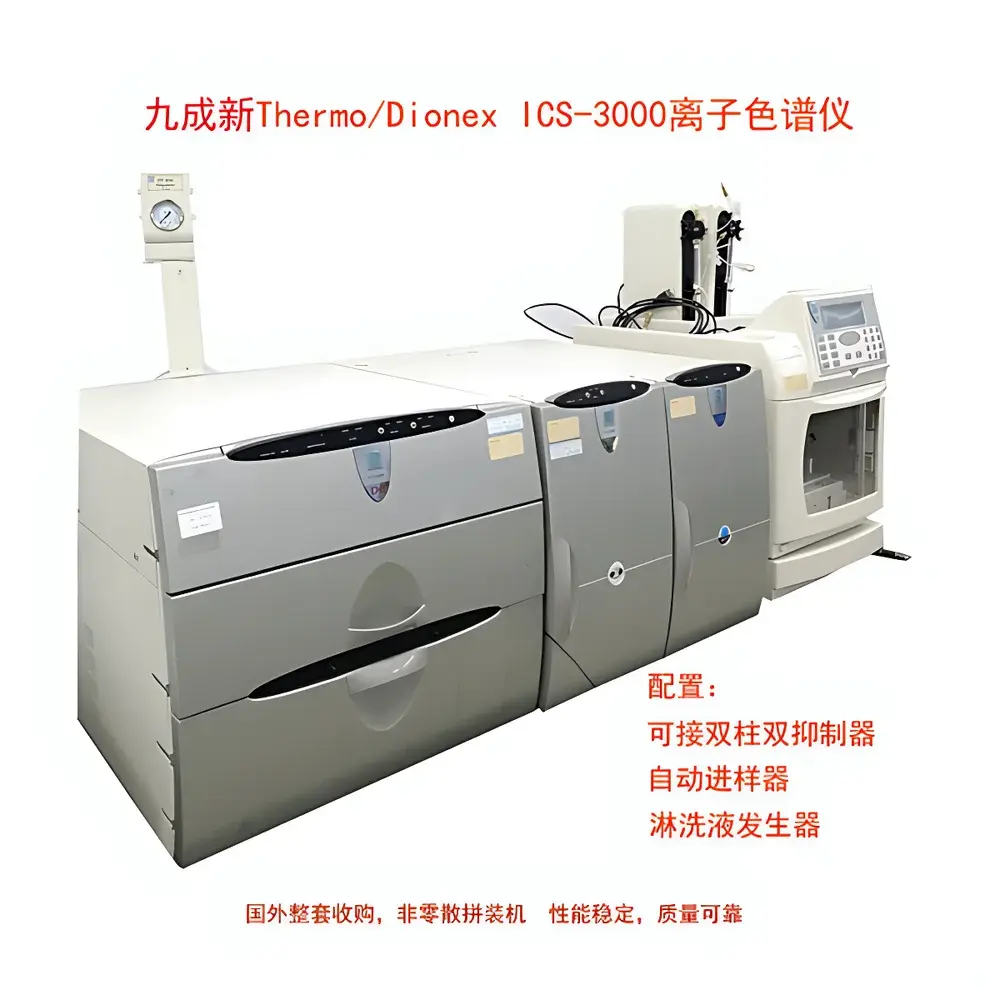
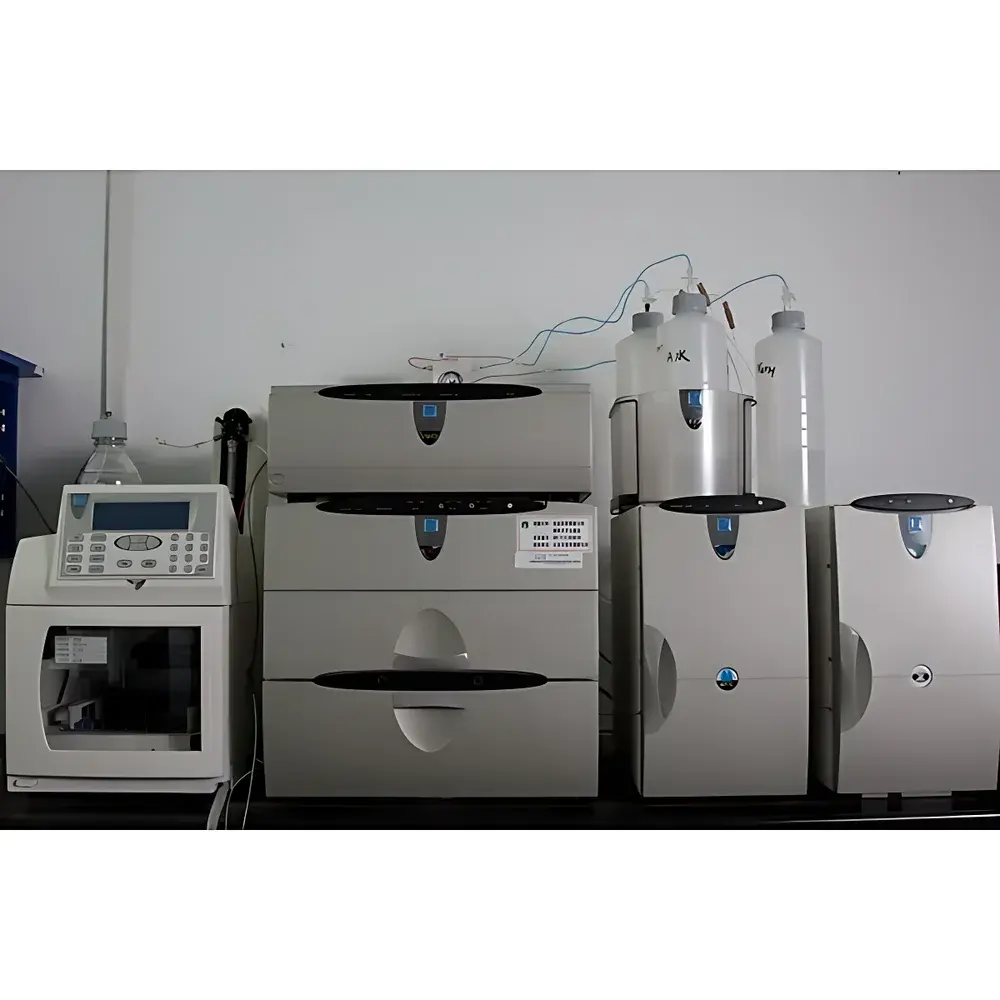
Thermo Fisher ICS-3000 High-Performance Ion Chromatograph for Anion Analysis in Dairy Products
| Brand | Thermo Fisher |
|---|---|
| Origin | USA |
| Model | ICS-3000 |
| Instrument Type | Laboratory Benchtop System |
| Pump Pressure Range | 0–35 MPa |
| Flow Rate Range | 0.00–5.00 mL/min |
| Eluent Flow Rate | 0.1–3.0 mL/min |
| Maximum Operating Pressure | 21 MPa |
| Column Oven Temperature Range | 30–60 °C |
| Temperature Reproducibility | ±0.2 °C |
| Eluent Concentration Range | 0.1–100 mM |
Overview
The Thermo Fisher ICS-3000 is a high-performance, modular ion chromatography (IC) system engineered for precise, reproducible anion analysis in complex food matrices—particularly dairy products. It operates on the principle of suppressed conductivity detection combined with optional dual-channel UV/Vis detection, enabling simultaneous quantification and peak purity verification of target anions such as iodide (I⁻) and thiocyanate (SCN⁻). The system employs hydrophilic anion-exchange chromatography with eluent generation technology, ensuring baseline stability, low background conductivity, and minimal matrix interference from proteins, lactose, and calcium salts commonly present in milk, whey, and infant formula. Designed for compliance-critical environments, the ICS-3000 supports audit-ready data handling and meets core requirements for GLP and GMP-aligned laboratories performing routine quality control or regulatory testing per ISO 17025 and AOAC Official Methods.
Key Features
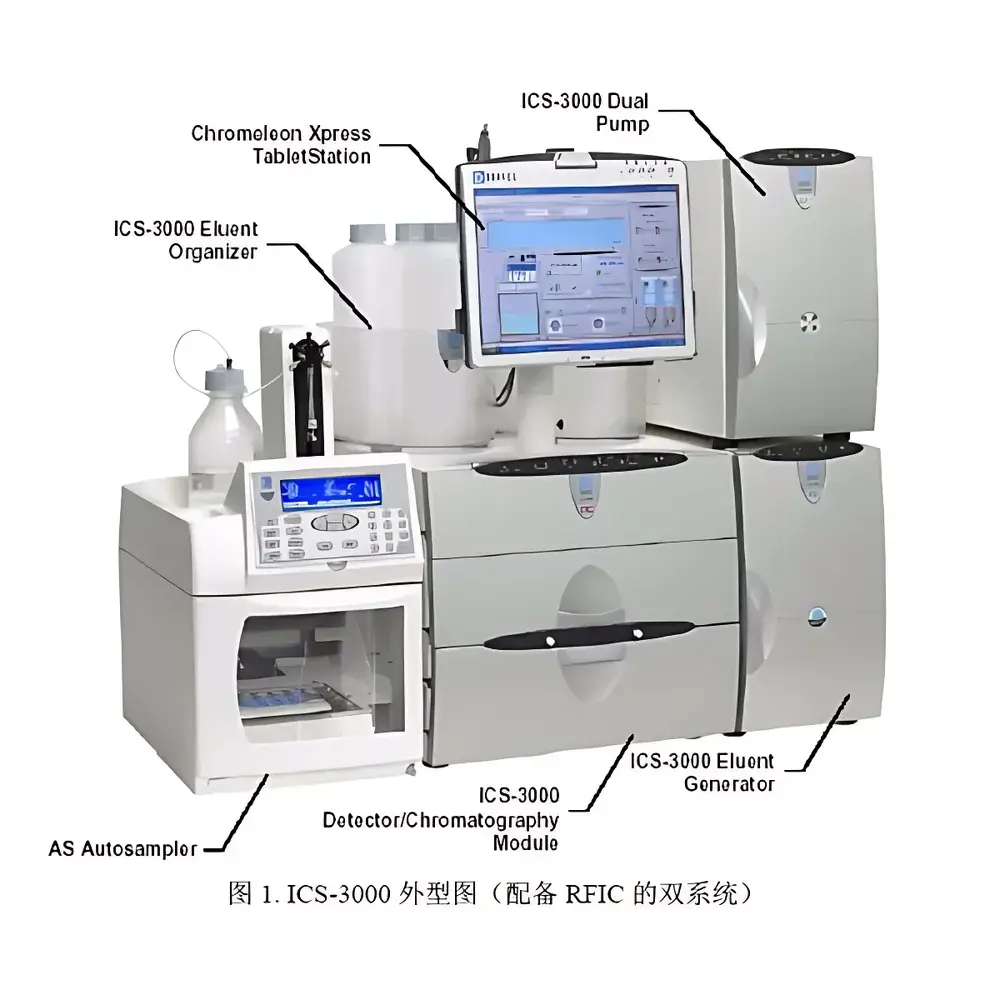
- Modular architecture integrating quaternary gradient pump, column oven, electrolytic eluent generator (EG), and dual-detector capability (conductivity + UV at 226 nm)
- Electrolytically generated potassium hydroxide (KOH) or methanesulfonic acid (MSA) eluents—eliminating manual preparation, improving reproducibility, and reducing carryover
- Temperature-controlled separation compartment (30–60 °C, ±0.2 °C stability) for retention time precision across multi-day sequences
- High-pressure compatibility (up to 35 MPa pump limit; 21 MPa system-rated operation) supporting sub-2 µm particle size columns for enhanced resolution
- Integrated auto-sampler with refrigerated tray (4 °C) to preserve labile analytes during extended batch runs
- Real-time conductivity suppression via ASRS™-ULTRA II or CSRS™-ULTRA II suppressors, delivering sub-µS/cm baseline noise
Sample Compatibility & Compliance
The ICS-3000 is validated for direct injection of centrifuged, filtered (0.22 µm nylon), and diluted dairy samples—including raw milk, UHT milk, whey protein isolates, and powdered infant formula—following AOAC 2019.01 and ISO 20649:2020 sample preparation protocols. Protein removal is achieved via ultrafiltration or acetonitrile precipitation without derivatization. The method demonstrates linearity (r² ≥ 0.999) over 0.5–500 µg/L for I⁻ and 5–2000 µg/L for SCN⁻, with LODs of 0.12 µg/L (I⁻, UV) and 0.8 µg/L (SCN⁻, conductivity). All analytical procedures are fully traceable and support 21 CFR Part 11-compliant electronic signatures, audit trails, and user access controls when operated with Chromeleon™ CDS v7.3 or later.
Software & Data Management
Chromeleon Chromatography Data System (CDS) provides full instrument control, sequence scheduling, peak integration using intelligent baseline algorithms, and automated report generation compliant with ISO/IEC 17025 clause 7.8. Calibration curves include weighted linear regression (1/x²), forced zero-intercept options, and automatic dilution correction. Raw data files (.cdf) retain full detector channel metadata, including real-time suppressor current, eluent concentration, and column backpressure logs—enabling forensic reprocessing and root-cause analysis of retention shifts. Secure database archiving supports role-based permissions, encrypted backups, and integration with LIMS via ASTM E1467 or HL7 interfaces.
Applications
- Quantification of iodide in infant formula against Codex Alimentarius STAN 72-1981 and GB 10765–2021 (30–150 µg/100 g)
- Detection of illicit thiocyanate adulteration in raw milk (threshold >1.5 mg/kg above natural baseline of ~0.9 mg/kg)
- Simultaneous profiling of nitrate, nitrite, sulfate, phosphate, and bromide in dairy processing water and cleaning-in-place (CIP) solutions
- Stability-indicating assays for iodine-fortified dairy beverages under accelerated shelf-life testing (ASLT)
- Method transfer support for QC labs implementing harmonized IC protocols across global manufacturing sites
FAQ
Can the ICS-3000 analyze iodide and thiocyanate in the same run without derivatization?
Yes—using a hydrophilic anion-exchange column (e.g., Thermo IonPac AS23) with KOH gradient elution and dual detection, both analytes are resolved in <15 min with no pre-column reaction required.
Is post-run column regeneration necessary after dairy sample injections?
No—routine washing with 100 mM NaOH between injections removes residual proteins and fats; column lifetime exceeds 2,000 injections under standard dairy QC conditions.
How does the system handle high-calcium matrices like whey permeate?
Calcium interference is mitigated by online cation removal using a Thermo IonPac CG19 guard column coupled in-line prior to the analytical column.
Does the system comply with EU Regulation (EC) No 1881/2006 for contaminants in foodstuffs?
Yes—the validated method meets the performance criteria (CCα, precision, trueness) specified in Commission Regulation (EU) 2021/808 for anion contaminant monitoring in dairy products.




