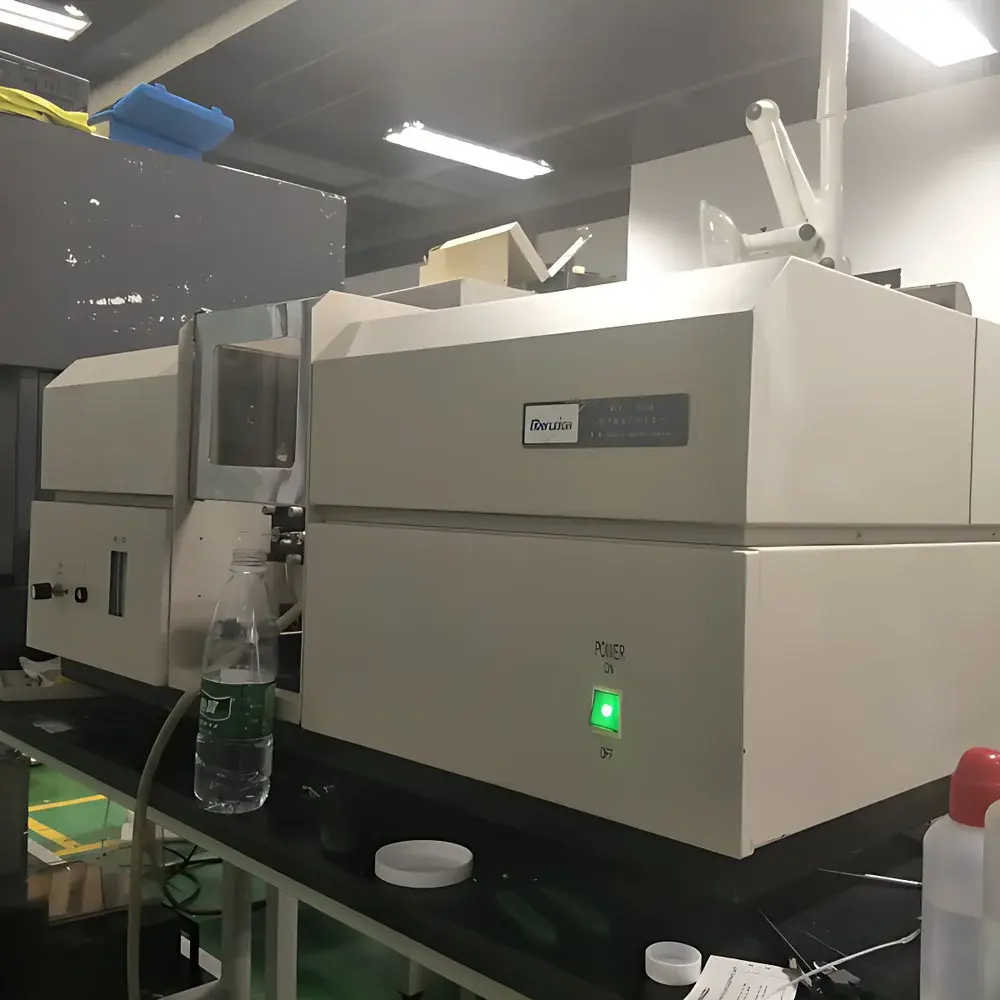
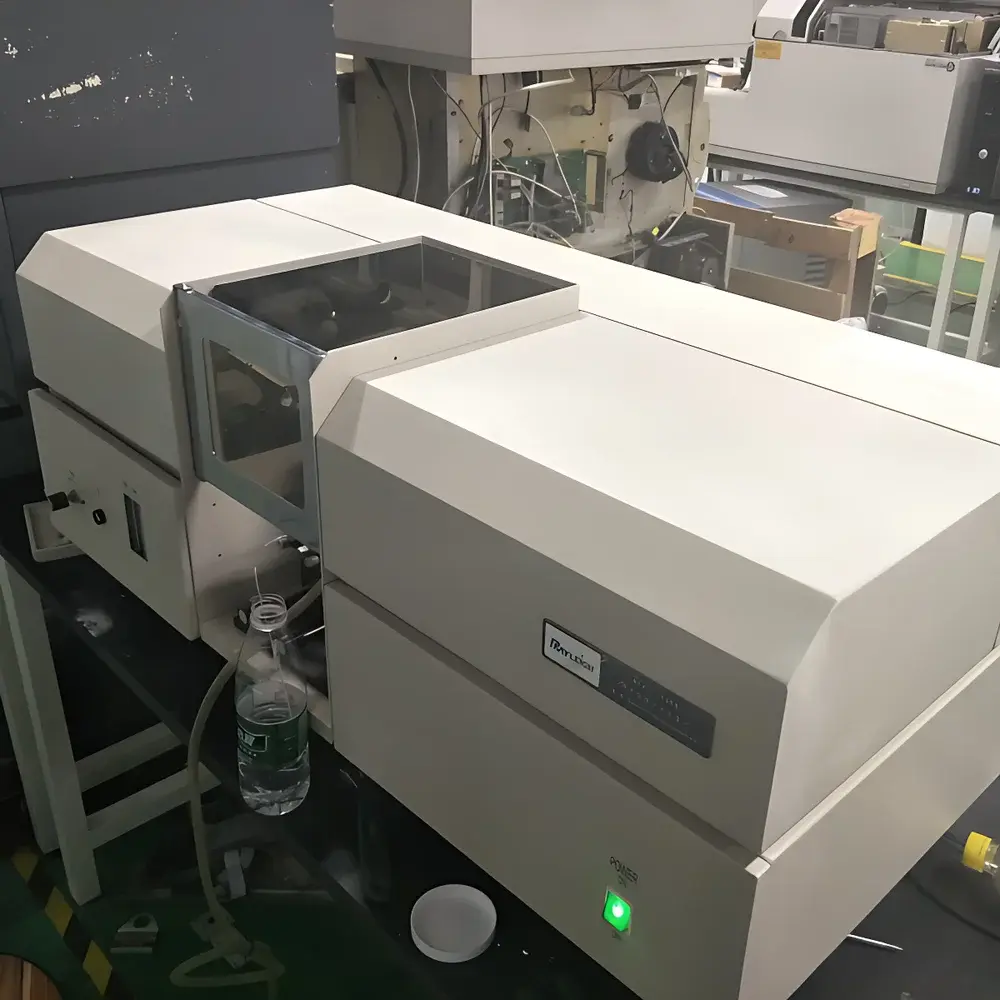
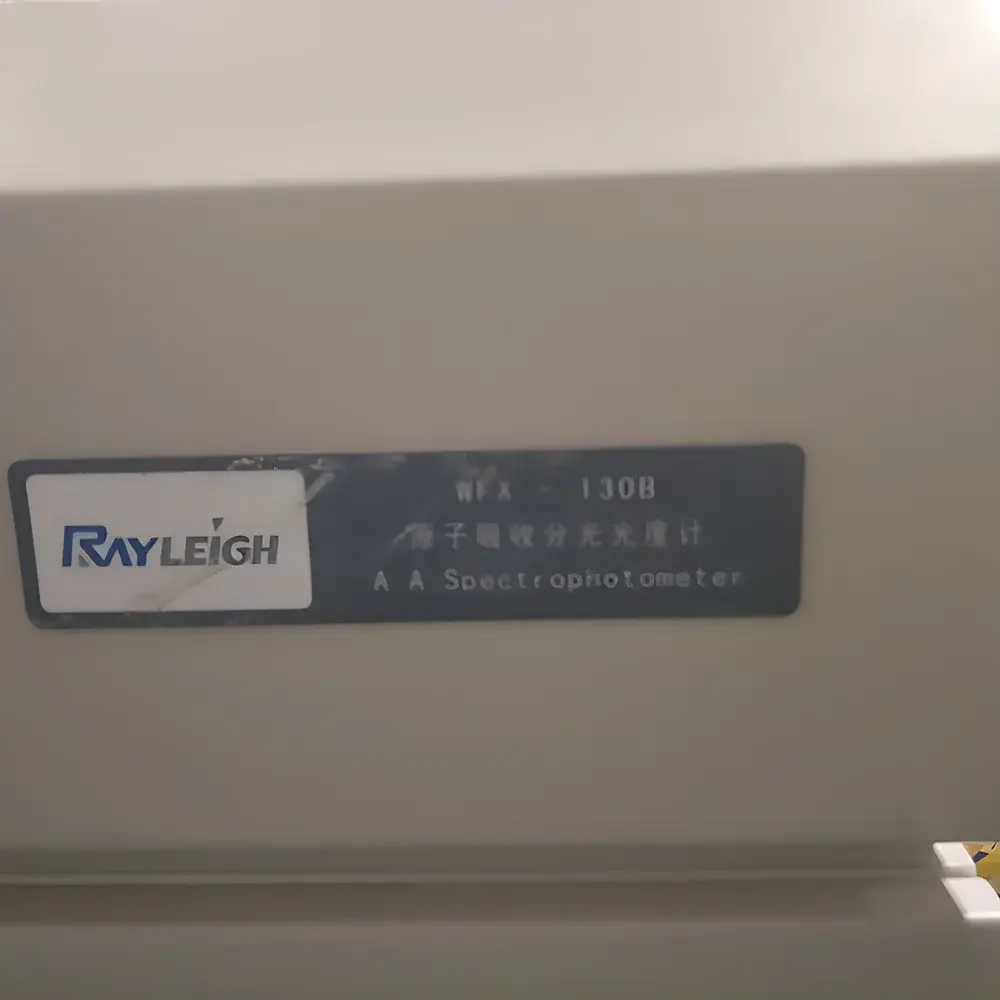
Beifen Ruili WFX-130B Flame Atomic Absorption Spectrophotometer
| Brand | Beifen Ruili |
|---|---|
| Origin | Beijing, China |
| Model | WFX-130B |
| Wavelength Range | 190–900 nm |
| Light Source | 4-lamp turret auto-switching (2 positions compatible with high-performance hollow cathode lamps) |
| Lamp Current Control | Wide-pulse 0–25 mA / Narrow-pulse 0–10 mA |
| Monochromator | Czerny-Turner type, 1800 lines/mm grating, 277 mm focal length, 250 nm blaze wavelength |
| Spectral Bandwidth | Multi-step automatic switching |
| Atomizer | 10 cm single-slit titanium burner, corrosion-resistant all-plastic nebulizer chamber, metal-sheathed high-efficiency glass nebulizer (6–7 mL/min uptake) |
| Background Correction | Deuterium lamp (≥30× correction at 1 Abs) and self-reversal (≥30× at 1.8 Abs) |
| Detector | High-sensitivity, broad-spectrum photomultiplier tube |
| Data System | Windows 98/Me/XP-compatible BRAIC software with automated calibration (standard addition, curve fitting), multi-element sequential analysis, statistical reporting (mean, SD, RSD), RS-232 interface |
| Dimensions & Weight | 1020 × 490 × 540 mm, 80 kg |
| Flame Temperature Range | 2300–2950 °C (oxygen-enriched air-acetylene system) |
| Operational Age | ≥7 years |
| Warranty | 6 months |
Overview
The Beifen Ruili WFX-130B Flame Atomic Absorption Spectrophotometer is a purpose-engineered benchtop instrument designed for quantitative elemental analysis of aqueous and acid-digested samples in environmental, geological, metallurgical, and quality control laboratories. It operates on the fundamental principle of atomic absorption spectroscopy (AAS): ground-state free atoms in a flame absorb characteristic radiation from a hollow cathode lamp, with absorbance proportional to analyte concentration per the Beer-Lambert law. Unlike conventional air-acetylene or nitrous oxide-acetylene systems, the WFX-130B employs an oxygen-enriched combustion system—patented under CN9210560.7—which elevates flame temperature to 2300–2950 °C while eliminating toxic N₂O handling and reducing acetylene consumption. This enables reliable determination of refractory elements—including Ca, Al, Ba, W, Mo, Ti, and V—without graphite furnace supplementation. The instrument’s optical architecture features a Czerny-Turner monochromator with an 1800-line/mm holographic grating (blazed at 250 nm) and 277 mm focal length, delivering high spectral resolution and stray light rejection across its 190–900 nm operating range.
Key Features
- Oxygen-enriched flame system: Enables high-temperature atomization (2300–2950 °C) without N₂O, improving sensitivity and precision for high-ionization-potential elements.
- 4-position automated lamp turret: Supports rapid sequential analysis; two positions accept high-current hollow cathode lamps for demanding applications.
- Dual-mode lamp power supply: Combines 400 Hz wide-pulse (0–25 mA) and 100 Hz narrow-pulse (0–10 mA) operation to optimize signal-to-noise ratio across element classes.
- Titanium single-slit burner (10 cm): Resists thermal stress and corrosion, ensuring long-term alignment stability and reproducible flame geometry.
- Corrosion-resistant all-plastic nebulizer chamber and metal-sheathed glass nebulizer: Minimizes memory effects and enhances aerosol generation efficiency (6–7 mL/min uptake).
- Dual background correction: Simultaneous deuterium lamp (≥30× correction at 1 Abs) and self-reversal (≥30× at 1.8 Abs) modes eliminate spectral interferences from molecular absorption and scattering.
- Integrated safety architecture: Monitors gas flow rates, flame status, air pressure, and fuel leakage; triggers audible/visual alarms and automatically shuts off fuel supply upon anomaly detection.
Sample Compatibility & Compliance
The WFX-130B is validated for analysis of liquid samples prepared by acid digestion (HNO₃/HCl/HF mixtures), dilution, or direct aspiration of low-matrix aqueous standards. It accommodates standard 16-mm borosilicate sample tubes and integrates with common laboratory peristaltic pumps. While originally developed and certified under Chinese national standards (e.g., JJG 694–2015 for AAS instruments), its operational parameters align with internationally recognized methodologies including ASTM D1688 (copper in water), ISO 11171 (trace metals in fuels), and USP for elemental impurities screening. Though not pre-certified for 21 CFR Part 11 compliance, the BRAIC software supports audit-trail-enabled data capture when deployed on validated Windows XP systems within GLP/GMP environments—provided local IT governance enforces user access controls, electronic signature protocols, and periodic backup validation.
Software & Data Management
The instrument is controlled via BRAIC—a native Windows 98/Me/XP application delivering full method development, acquisition, and reporting functionality. Key capabilities include automated wavelength scanning and peak search, dynamic spectral bandwidth selection (0.2, 0.4, 1.0, 2.0 nm), multi-point calibration with quadratic curve fitting or standard addition, and up to 20 replicate measurements with real-time statistical evaluation (mean, SD, %RSD). All raw absorbance values, calibration parameters, and QA/QC metrics (e.g., blank drift, sensitivity checks) are stored in structured binary files with timestamped metadata. Export options include CSV and Excel-compatible formats via RS-232 serial interface; printed reports conform to ISO/IEC 17025 documentation requirements when annotated with analyst ID, instrument ID, and date/time stamps.
Applications
- Environmental monitoring: Quantification of Ca, Mg, Fe, Mn, Zn, Cu, and Pb in drinking water, wastewater, and soil extracts per EPA Method 7000B.
- Geochemical analysis: Determination of Al, Ti, V, and Ba in acid-leached rock and sediment samples.
- Metallurgical QC: Rapid verification of alloy composition (e.g., Al in aluminum ingots, Mo in stainless steels) during production.
- Pharmaceutical excipient testing: Screening for catalytic metal residues (e.g., Ni, Co) in active pharmaceutical ingredients (APIs) per ICH Q3D guidelines.
- Agricultural labs: Routine analysis of K, Na, Ca, and Mg in plant tissue digests and fertilizer solutions.
FAQ
Is the WFX-130B compatible with modern operating systems such as Windows 10 or 11?
No—the BRAIC software was developed exclusively for Windows 98, Me, and XP. Operation on newer OS versions requires virtualization (e.g., VMware Workstation with XP guest OS) or dedicated legacy hardware.
Does the instrument include factory calibration certificates or traceable standards?
As a second-hand unit, original NIST-traceable calibration records are not included. Users must perform initial verification using certified reference materials (e.g., NIST SRM 1643e) and document performance against established acceptance criteria.
Can the oxygen-enriched flame system be retrofitted to older WFX models?
No—the combustion head, gas mixing manifold, and control firmware are model-specific and not field-upgradable across WFX-110B/120B/130B platforms.
What maintenance intervals are recommended for optimal long-term stability?
Burner alignment and nebulizer cleaning should occur before each analytical session; annual verification of monochromator wavelength accuracy and photomultiplier dark current is advised per ISO/IEC 17025 Clause 6.4.3.
Is technical support available for hardware repair or software troubleshooting?
Limited third-party service is available through authorized Beifen Ruili partners in China; no official English-language remote support or spare parts distribution network exists outside mainland China.
Related Products