
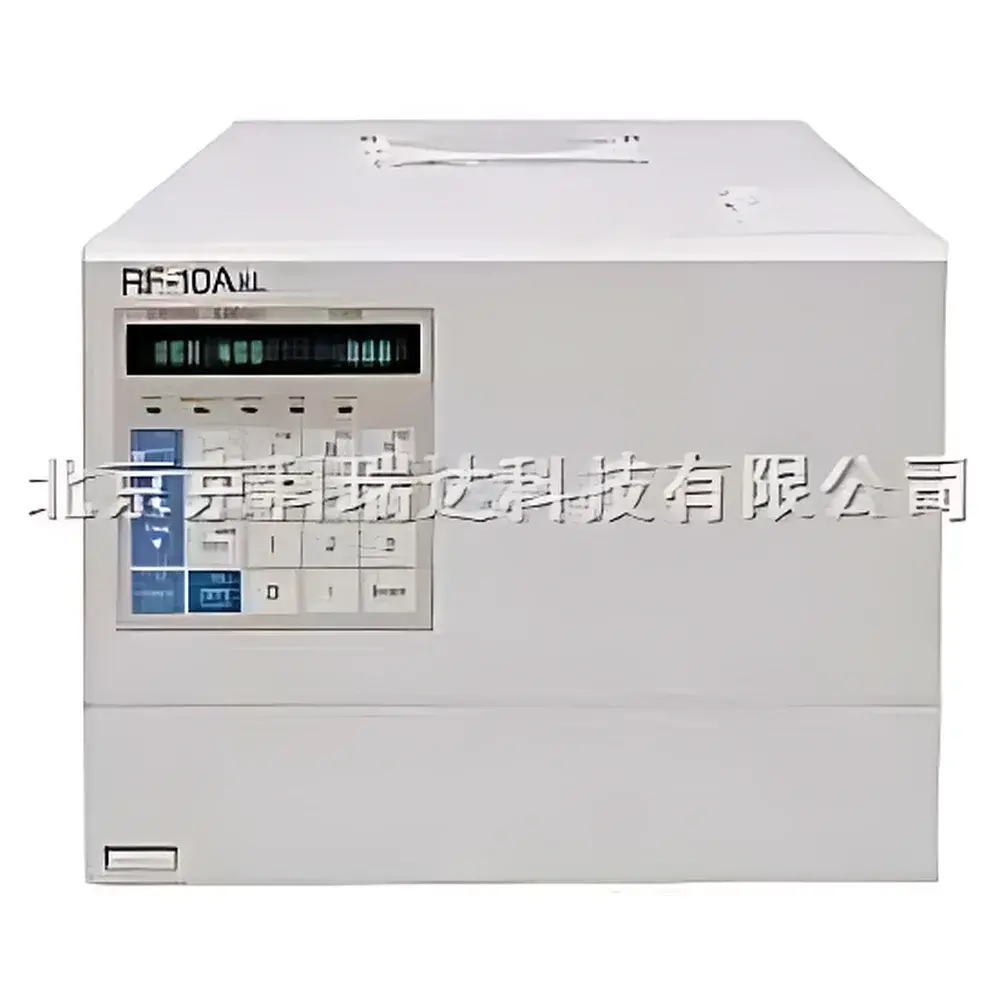
Shimadzu RF-10A Fluorescence Detector
| Origin | Japan |
|---|---|
| Manufacturer Type | Authorized Distributor |
| Origin Category | Imported |
| Model | RF-10A |
| Pricing | Upon Request |
Overview
The Shimadzu RF-10A Fluorescence Detector is a high-performance, modular optical detection system engineered for integration with high-performance liquid chromatography (HPLC) platforms—particularly those compliant with Shimadzu’s SCL-10A system controller architecture. Designed to meet stringent analytical requirements in regulated laboratories, the RF-10A operates on the principle of synchronous fluorescence detection: excitation light selectively promotes analyte electrons to higher energy states; upon relaxation, emitted photons are collected and quantified via a photomultiplier tube (PMT). Its optimized optical path—featuring a high-stability 150 W xenon lamp, holographic concave grating monochromators (F/2.4), and precision mirror alignment—delivers exceptional signal-to-noise (S/N) performance. With distilled water Raman S/N ≥300 (λex = 350 nm, integration time = 1.5 s), the detector enables reliable quantification of trace-level fluorophores—including polycyclic aromatic hydrocarbons (PAHs), amino acids, vitamins, pharmaceutical metabolites, and biomarkers—in complex matrices.
Key Features
- Advanced optical architecture: Dual concave holographic gratings for both excitation and emission paths ensure minimal stray light and high wavelength fidelity.
- High wavelength accuracy and reproducibility: ±2 nm absolute wavelength accuracy and ±0.2 nm repeatability across 200–650 nm (extendable to 200–900 nm with optional grating kits), validated via internal reference standards.
- Modular HPLC compatibility: Designed as a drop-in detector for existing Shimadzu LC systems (e.g., LC-10A, LC-20A series) and third-party HPLC configurations via standard analog/digital I/O interfaces.
- Programmable multi-step acquisition: Up to 32 user-defined wavelength pairs per analysis, supporting time-resolved excitation/emission scanning and dual-wavelength ratioing for matrix interference correction.
- Robust flow cell design: Standard 12 µL stainless steel (SUS316)/quartz/PTFE flow cell rated to 2 MPa (20 bar); optional low-volume 2 µL inert cell available for microbore or UHPLC applications.
- Thermal stability control: Operating temperature range of 4–35 °C with active ambient monitoring—critical for minimizing baseline drift during extended GLP/GMP-compliant sequences.
Sample Compatibility & Compliance
The RF-10A supports aqueous and organic mobile phases compatible with reversed-phase, normal-phase, and HILIC chromatography. Its chemically inert wetted materials (SUS316, fused silica, PTFE) resist corrosion from acidic, basic, or aggressive solvents (e.g., TFA, ammonium acetate, acetonitrile/water gradients). The detector conforms to key regulatory frameworks governing analytical instrument qualification: it supports full audit trail generation when paired with Shimadzu LabSolutions software, satisfies data integrity requirements under FDA 21 CFR Part 11 (with appropriate system configuration and administrative controls), and aligns with ISO/IEC 17025 method validation principles for fluorescence-based assays. Routine performance verification follows ASTM E1655 (Standard Practices for Infrared, Ultraviolet-Visible, and Fluorescence Spectrophotometry) and USP Analytical Instrument Qualification guidelines.
Software & Data Management
When integrated with Shimadzu LabSolutions LC/GC software (v5.9 or later), the RF-10A enables real-time spectral acquisition, peak purity assessment via excitation/emission contour mapping, and automated calibration using built-in mercury-argon lamp references. All wavelength settings, gain parameters, and timing sequences are stored with metadata (user ID, timestamp, instrument ID) and encrypted in .lcd format. Raw data files retain full spectral resolution (1 nm step size) and support post-run deconvolution. Electronic records comply with ALCOA+ principles (Attributable, Legible, Contemporaneous, Original, Accurate, Complete, Consistent, Enduring, Available) when deployed within a validated IT infrastructure meeting GxP computer system validation (CSV) requirements.
Applications
- Pharmaceutical QC/QA: Quantification of fluorescent impurities (e.g., genotoxic nitrosamines), assay of vitamin B2 (riboflavin), and stability-indicating methods for photolabile APIs.
- Environmental analysis: Detection of PAHs in soil extracts, pesticide metabolites (e.g., carbaryl), and algal toxins (microcystins) at sub-ng/mL levels.
- Clinical research: Measurement of homovanillic acid (HVA), vanillylmandelic acid (VMA), and catecholamines in urine and plasma following solid-phase extraction.
- Food safety: Screening for melamine adulteration (via derivatization), aflatoxin B1 in cereals, and chlorophyll degradation products in olive oil.
- Academic proteomics: Label-free tryptophan/tyrosine detection in peptide mapping and conformational studies under native LC conditions.
FAQ
Is the RF-10A compatible with non-Shimadzu HPLC systems?
Yes—the detector provides analog voltage output (0–1 V), RS-232/USB connectivity, and TTL trigger inputs, enabling integration with Agilent, Waters, Thermo Fisher, and other vendor platforms using standard interface modules.
What maintenance procedures are required for long-term S/N stability?
Xenon lamp replacement every 1,000–1,500 hours; quarterly verification of wavelength accuracy using holmium oxide or didymium filters; biannual PMT dark current calibration per Shimadzu Technical Bulletin LC-012.
Can the RF-10A perform synchronous or excitation-emission matrix (EEM) scans?
Yes—full 2D scanning is supported via LabSolutions software; scan ranges, step increments, and dwell times are fully programmable for EEM acquisition and subsequent PARAFAC modeling.
Does the detector support temperature-controlled flow cells?
No—the RF-10A does not include active flow cell heating/cooling; however, ambient temperature must be maintained between 4–35 °C per specifications, and external column ovens or heat exchangers may be used upstream.
How is data integrity ensured during multi-user operation?
LabSolutions enforces role-based access control (RBAC), electronic signatures for method changes and report approvals, and immutable audit logs tracking all parameter modifications and raw data exports—fully traceable to individual analysts and timestamps.
Related Products





