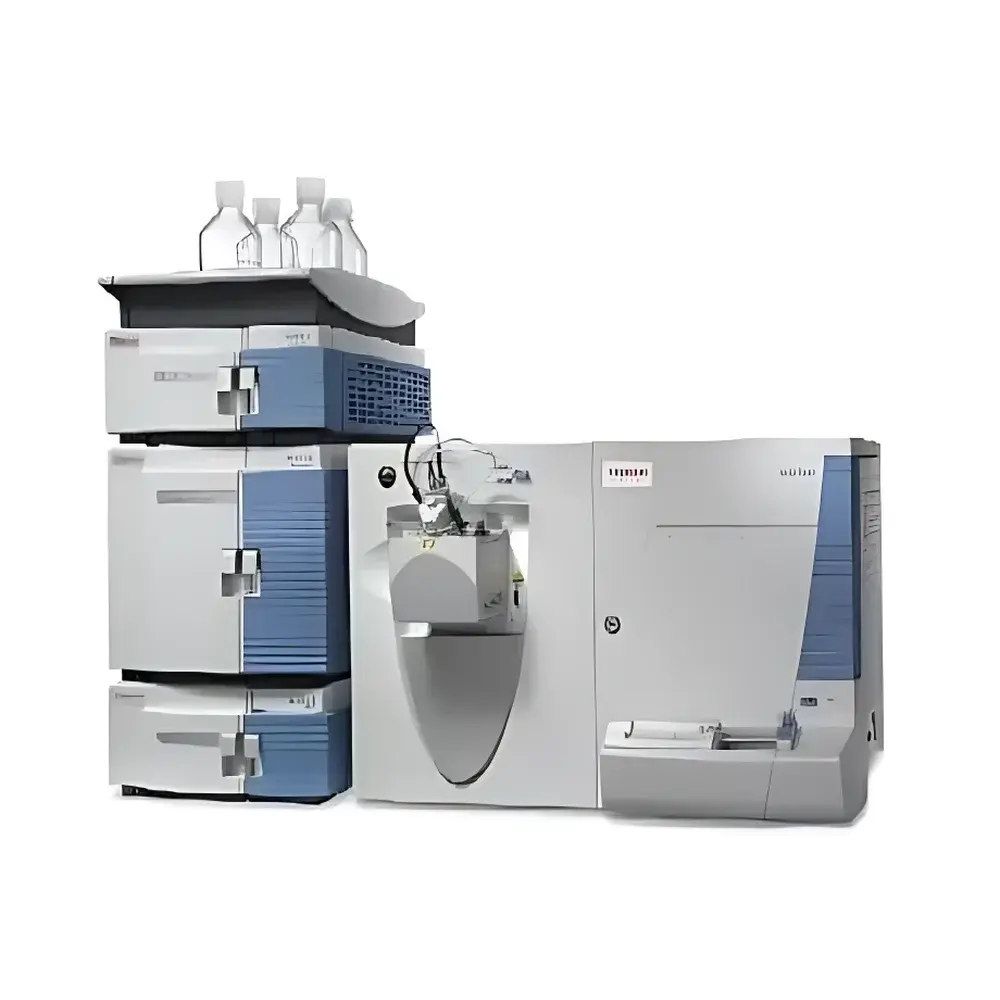
Thermo Fisher LCQ Advantage Used Liquid Chromatography–Mass Spectrometry (LC-MS) System
| Brand | Thermo Fisher |
|---|---|
| Origin | USA |
| Instrument Type | Ion Trap LC-MS System |
| Model | LCQ Advantage |
| Mass Range | 50–2000 m/z |
| Ionization Sources | ESI and APCI |
| Resolution | Up to 30,000 (FWHM) |
| Scan Speed | 66,000 Da/s |
| MSn Capability | Up to MS³ |
| Detection Sensitivity | 5 pg/μL (for standard compounds) |
| Operational Age | 6–8 years |
| Warranty | 6 months |
| Compliance | Designed for GLP/GMP environments with audit-ready data handling capabilities |
| Software | Xcalibur v2.x compatible, supports method validation, spectral library search, and quantitative workflows |
Overview
The Thermo Fisher LCQ Advantage is a robust, second-generation ion trap liquid chromatography–mass spectrometry (LC-MS) system engineered for high-sensitivity qualitative and quantitative analysis of thermally labile, polar, and high-molecular-weight compounds. Based on atmospheric pressure ionization (API) technology—specifically electrospray ionization (ESI) and atmospheric pressure chemical ionization (APCI)—the LCQ Advantage enables soft ionization of intact molecular ions with minimal fragmentation, making it especially suitable for pharmaceutical metabolite identification, peptide mapping, natural product characterization, and environmental contaminant screening. Its quadrupole–ion trap hybrid architecture supports full-scan, selected ion monitoring (SIM), and data-dependent MSn acquisition up to the third generation (MS³), facilitating structural elucidation through sequential fragmentation without requiring external collision cells. The instrument’s mass range (50–2000 m/z), resolution (up to 30,000 at unit mass), and scan speed (66,000 Da/s) reflect its design heritage for mid-throughput research laboratories where reproducibility, spectral fidelity, and operational flexibility are prioritized over ultra-high-speed acquisition.
Key Features
- API dual-source configuration: Independently adjustable ESI and APCI probes with X/Y-axis positioning for optimal droplet desolvation and ion transmission efficiency
- Ion trap mass analyzer with automatic gain control (AGC) and normalized collision energy (NCE) calibration for consistent MSn performance across runs
- Intelligent data-dependent acquisition (DDA): Real-time selection of precursor ions based on intensity thresholds, enabling automated MS² and MS³ experiments during LC gradients
- Comprehensive scan modes: Full-scan MS, SIM, neutral loss scans, precursor ion scans, and multiple reaction monitoring (MRM)-like targeted analysis via extracted ion chromatograms (XIC)
- Dedicated hardware support for GLP-compliant operation: Internal clock logging, user-accessible audit trails, and secure method storage in Xcalibur software
Sample Compatibility & Compliance
The LCQ Advantage accommodates a broad spectrum of analytes—including peptides, oligonucleotides, glycoconjugates, small-molecule metabolites, and synthetic polymers—without derivatization or excessive sample cleanup. Its low-flow ESI interface integrates seamlessly with nano-LC and microbore HPLC systems, while the APCI source extends utility to moderately polar, semi-volatile organics (e.g., steroids, lipids, and certain pesticides). From a regulatory standpoint, the system was originally validated per ASTM E1947 and ISO/IEC 17025 guidelines for analytical instrumentation qualification. When operated with Xcalibur v2.05 or later and configured with appropriate user access controls, it supports 21 CFR Part 11–compliant workflows—including electronic signatures, audit trail review, and data integrity safeguards—as required for pharmaceutical QC and contract research organizations (CROs).
Software & Data Management
Data acquisition and processing rely on Thermo Scientific Xcalibur software (v2.x series), which provides integrated control of LC pumps, autosamplers, and MS parameters. Key modules include QualBrowser for spectral interpretation, QuanBrowser for calibration curve construction and peak integration, and MetQuest for retrospective metabolite detection. All raw data files (.RAW) are stored in a proprietary but well-documented binary format compatible with open-source parsers (e.g., msConvert from ProteoWizard). The system includes built-in spectral library search capability against NIST/EPA/NIH and Thermo Mass Spectral Libraries. For long-term archival, raw files may be exported as mzML—a vendor-neutral, XML-based standard endorsed by the HUPO-PSI consortium—ensuring future accessibility independent of proprietary platform dependencies.
Applications
- Pharmaceutical R&D: Structural confirmation of synthetic intermediates, impurity profiling, and forced degradation studies under ICH Q5A/Q5B guidelines
- Clinical & translational research: Quantitative bioanalysis of endogenous biomarkers (e.g., acylcarnitines, bile acids) in plasma and urine matrices
- Proteomics: Bottom-up peptide sequencing, post-translational modification (PTM) mapping, and label-free differential expression analysis
- Environmental analysis: Detection and identification of emerging contaminants (e.g., PFAS, pharmaceutical residues) in wastewater and soil extracts
- Food safety: Screening for veterinary drug residues, mycotoxins, and adulterants using multi-residue methods validated per EU SANTE/11312/2021 criteria
FAQ
Is this LCQ Advantage unit fully refurbished and performance-verified?
Yes. Each unit undergoes comprehensive functional testing—including mass calibration, sensitivity verification using caffeine and reserpine standards, vacuum integrity checks, and ion optic alignment—prior to resale. Full test reports are provided upon request.
Does the system include original Thermo documentation and software licenses?
Hardware documentation (service manuals, schematics, and safety guides) is included. Xcalibur software is supplied with a valid node-locked license; however, maintenance contracts and cloud-based updates require separate activation through Thermo Fisher Scientific.
Can the LCQ Advantage be upgraded to support modern data systems?
While the LCQ platform does not support direct integration with current Thermo Cloud or Chromeleon CDS, raw data export to mzML and compatibility with open-source tools (Skyline, OpenMS, MZmine) ensures continued analytical utility within contemporary informatics pipelines.
What consumables and spare parts are available for ongoing operation?
ESI and APCI source components (capillaries, skimmer cones, transfer tubes), ion trap replacement kits, and vacuum pump oils remain commercially available through authorized Thermo distributors and third-party OEM suppliers.
Is on-site installation and operator training available?
Yes. Installation qualification (IQ) and operational qualification (OQ) services—including LC-MS system alignment, gradient optimization, and hands-on Xcalibur training—are offered globally by certified field application specialists.
Related Products