
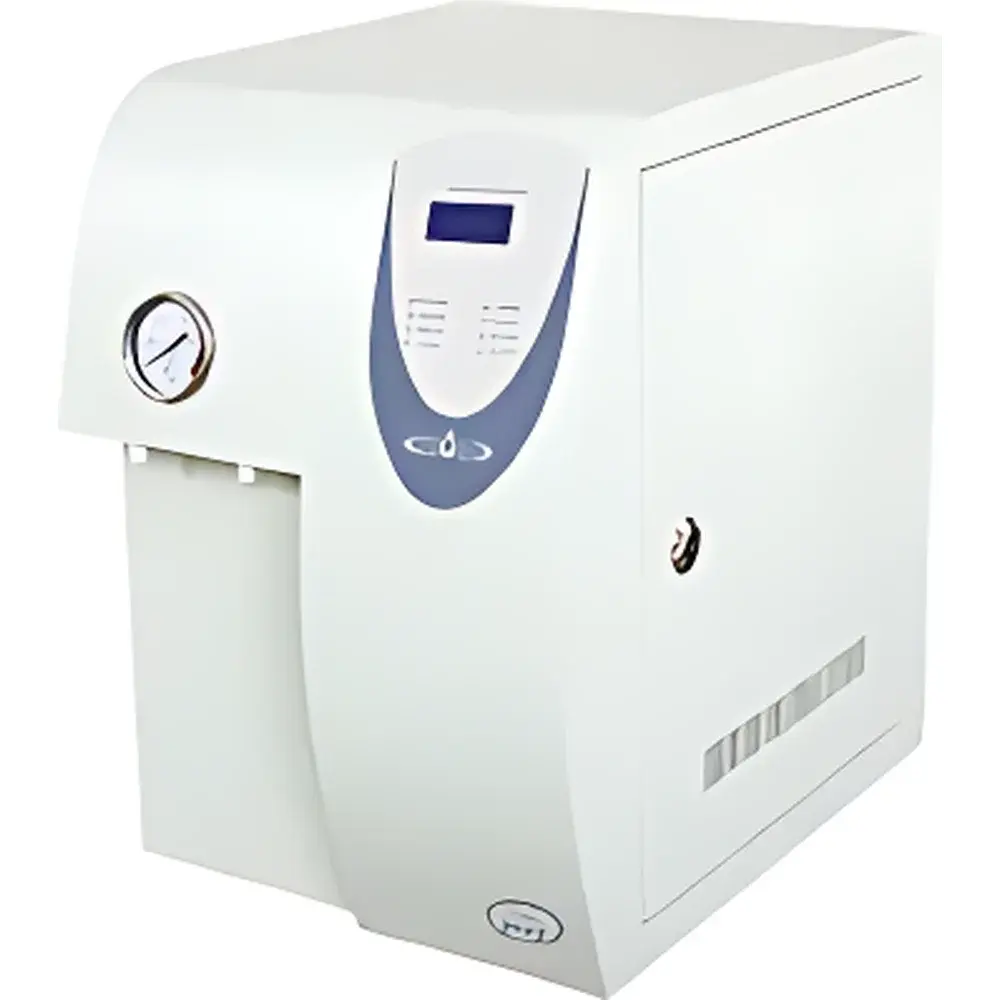
JUPT-IV Series Ultra Pure Water System by Kyocera
| Brand | Kyocera |
|---|---|
| Origin | Beijing, China |
| Manufacturer Type | Authorized Distributor |
| Product Category | Domestic |
| Model | JUPT-IV Series |
| Quotation | Available Upon Request |
| Control Interface | Touch-key with LCD display |
| Safety Features | Low-water alarm, power-failure protection |
| RO System | Integrated anti-scaling program + manual RO membrane flush button |
| Control Core | IC-based microcomputer controller |
| Monitoring | Real-time online water quality monitoring |
| Dual-Outlet Design | Grade III purified water + Grade I ultrapure water |
| Auto-Stop | Full-tank shutdown |
| Auto-Start | Activated by inlet supply or user demand |
| UV Sterilization | Dual-wavelength (185 nm + 254 nm) UV lamp with TOC reduction capability |
| Final Filtration | 0.45 µm / 0.22 µm pre-filtered high-flux terminal filter |
| Pre-desalination | Two-stage pre-desalting system (optional for high-TDS feedwater) |
| Scalability | Upgradable for enhanced water quality and flow capacity |
| Feed Water | Municipal tap water, pressure 0.1–0.5 MPa |
| RO Production Rate | 5–20 L/h |
| Continuous Dispensing Flow | 1.5 L/min |
| Grade III Water Conductivity | 2–10 µS/cm (meets GB/T 6682–1992 Class III & ASTM CAP/NCCLS standards) |
| Grade I Ultrапure Water Resistivity | ≥18.20 MΩ·cm @ 25 °C (meets GB/T 6682–1992 Class I & ASTM CAP/NCCLS standards) |
| Silica Rejection Rate | >99.9% |
| Absorbance (254 nm, 1 cm path) | ≤0.01 |
| Soluble Silica [as SiO₂] | <0.01 ppm |
| Particles (>0.22 µm) | <1/mL |
| Power Supply | 220 V AC, 50 Hz |
| Operating Environment | 5–40 °C |
| Optional Accessories | Sediment pre-filter, water softener (for hardness >200 mg/L as CaCO₃), desalinator (for TDS >400 ppm) |
Overview
The JUPT-IV Series Ultra Pure Water System is an integrated, dual-grade laboratory water purification platform engineered for consistent delivery of both Type III purified water and Type I ultrapure water—meeting stringent national and international analytical requirements. Built upon a multi-stage purification architecture, the system combines pretreatment, reverse osmosis (RO), dual-wavelength ultraviolet photooxidation (185 nm + 254 nm), electrodeionization (EDI)-compatible polishing, and submicron terminal filtration to achieve reproducible water quality suitable for HPLC, LC-MS, ICP-MS, cell culture, molecular biology, and trace elemental analysis. Its core design adheres to the thermodynamic and kinetic principles governing membrane separation, photolytic TOC degradation, and ion exchange equilibrium—ensuring stable resistivity, low particle counts, and minimal organic and ionic contaminants across extended operational cycles.
Key Features
- Intelligent IC microcomputer control with intuitive touch-key interface and real-time LCD display of critical parameters including conductivity, resistivity, flow rate, and system status.
- Comprehensive safety protocol: automatic low-water alarm, power-loss memory retention, full-tank auto-shutdown, and demand-activated startup (triggered by inlet pressure or dispensing valve actuation).
- Dual-output architecture enabling simultaneous production of Type III water (2–10 µS/cm) and Type I ultrapure water (≥18.20 MΩ·cm @ 25 °C), eliminating cross-contamination via physically isolated distribution paths.
- Integrated RO anti-scaling algorithm with manual membrane flush function—extending membrane service life and maintaining flux stability under variable feedwater hardness and TDS conditions.
- Dual-band UV chamber: 254 nm for microbial inactivation and 185 nm for advanced oxidation of organic compounds, reducing total organic carbon (TOC) to <5 ppb in final ultrapure output.
- High-flux terminal filtration using a pre-filtered 0.22 µm hydrophilic membrane certified for bacterial retention (Bacterial Retention ≥10⁷ CFU/cm²) and low extractables.
- Modular two-stage pre-desalination option for feedwaters with TDS >400 ppm or hardness >200 mg/L as CaCO₃—supporting reliable operation in geographically diverse municipal supply environments.
Sample Compatibility & Compliance
The JUPT-IV Series delivers water compliant with GB/T 6682–1992 (China National Standard for Analytical Laboratory Water), ASTM D1193–2020 (Standard Specification for Reagent Water), CLSI EP28-A3c (Clinical and Laboratory Standards Institute), and NCCLS guidelines for clinical laboratory reagent water. Its ultrapure output satisfies ISO 3696:1987 Class 1 specifications and supports GLP/GMP-aligned workflows requiring documented traceability. All wetted materials—including RO housings, UV quartz sleeves, and final filters—are USP Class VI-certified and non-leaching. The system’s architecture enables integration into audit-ready environments through optional event-log export and time-stamped parameter archiving.
Software & Data Management
While the base configuration operates via embedded firmware without external PC dependency, the JUPT-IV supports optional RS232/USB data logging modules for continuous recording of resistivity, temperature, cumulative volume, and alarm events. Exported logs are CSV-compatible and structured for import into LIMS or electronic lab notebooks (ELN). Firmware updates maintain alignment with evolving regulatory expectations—including support for FDA 21 CFR Part 11-compliant audit trails when deployed with validated third-party data acquisition software and role-based access controls.
Applications
This system serves as a primary water source in analytical chemistry laboratories performing trace metal analysis (ICP-OES/ICP-MS), where silica and chloride interference must be minimized. It supports sensitive biological applications including PCR master mix preparation, monoclonal antibody formulation, and stem cell expansion—where endotoxin levels (<0.03 EU/mL) and nucleases are controlled via UV/UF integration. In pharmaceutical QC labs, it supplies water for dissolution testing, buffer preparation, and cleaning validation per USP . Its dual-grade output also streamlines daily operations: Type III water for glassware rinsing and media preparation; Type I water for instrument feed and calibration standards.
FAQ
What feedwater quality is required for optimal RO performance?
Municipal tap water with TDS ≤400 ppm and hardness ≤200 mg/L as CaCO₃ is recommended. For higher values, optional softeners or desalinators must be installed upstream.
Can the system be validated per IQ/OQ/PQ protocols?
Yes—documentation packages including FAT/SAT reports, material certifications (EPDM, PTFE, 316L SS), and calibration templates for conductivity/resistivity sensors are available upon request.
Is remote monitoring supported?
Standard configuration includes local LCD and audible alarms. Ethernet or Wi-Fi connectivity requires optional communication module installation and custom network configuration.
How often should the RO membrane be replaced?
Typical service life is 2–3 years under proper pretreatment and scheduled manual flushing; actual interval depends on feedwater composition and daily usage volume.
Does the system meet ISO 14644-1 Class 5 cleanroom requirements for water dispensing?
When equipped with sterile-grade 0.22 µm final filters and installed in ISO Class 7+ environments with laminar airflow hoods, the dispensing point complies with particle count limits for critical aseptic processes.



