
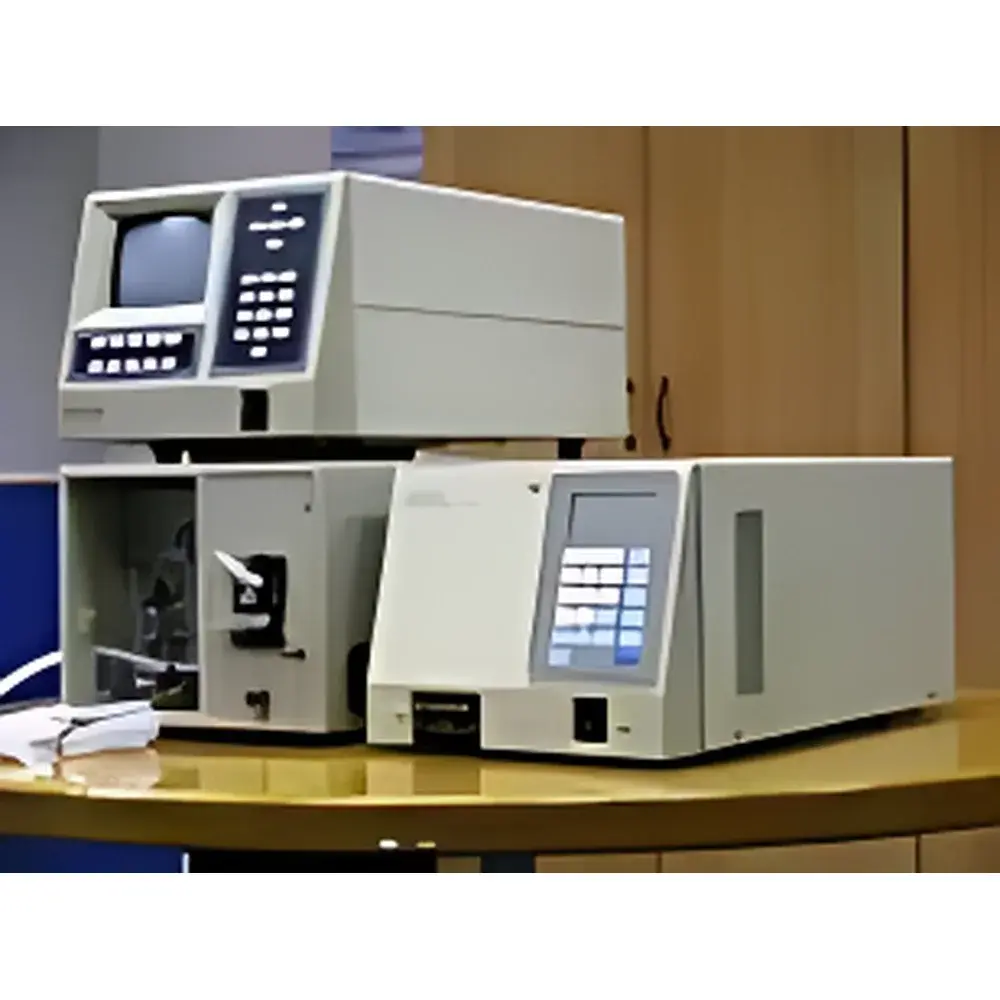
Waters 600E-2487 High-Performance Liquid Chromatograph
| Origin | USA |
|---|---|
| Manufacturer Type | Authorized Distributor |
| Origin Category | Imported |
| Model | 600E-2487 |
| Quotation | Available Upon Request |
| Pump Flow Rate Range | 0.01–20 mL/min (standard), up to 45 mL/min (high-flow configuration) |
| Flow Accuracy | ±0.1% RSD |
| Maximum Operating Pressure | 6000 psi |
| Gradient Accuracy | ±0.5% |
| UV/Vis Detector Noise | < ±3.5 × 10⁻⁶ AU |
| Baseline Drift | ≤ 1 × 10⁻⁴ AU/h |
| Linearity | < 5% deviation at 2.5 AU |
| Spectral Bandwidth | 5 nm |
| Wavelength Range | 190–700 nm |
| Absorbance Range | 0.0001–4.0 AUFS |
| System Lag Volume | Fixed via RPS (Resident Pump System) technology |
Overview
The Waters 600E-2487 is a modular, high-precision high-performance liquid chromatography (HPLC) system engineered for robust analytical performance in regulated and research laboratories. Comprising the Waters 600E dual-piston reciprocating solvent delivery module and the Waters 2487 dual-wavelength UV/Vis absorbance detector, this system implements classical reversed-phase, normal-phase, ion-exchange, and size-exclusion chromatographic separations with exceptional pressure stability, gradient fidelity, and photometric reproducibility. The 600E pump employs non-circular gear drive mechanics to minimize pulsation—critical for baseline stability in low-volume or microbore applications—while its resident pump system (RPS) architecture fixes system dwell volume, ensuring consistent gradient delay and inter-run retention time reproducibility. The 2487 detector utilizes a high-stability deuterium/tungsten lamp source, precision monochromator optics, and low-noise analog signal processing to deliver photometric performance compliant with USP , EP 2.2.25, and ICH Q2(R2) requirements for method validation.
Key Features
- Single-point Powerline control interface with large-format LCD display for intuitive system monitoring and real-time parameter adjustment
- Non-circular gear-driven pump mechanism reducing flow pulsation to <0.1% RSD across full flow range (0.01–45 mL/min)
- RPS (Resident Pump System) design maintaining fixed gradient lag volume (< 1.2 mL typical), enabling precise method transfer between instruments
- 6000 psi maximum operating pressure supports UHPLC-compatible columns (e.g., sub-2 µm particles) when used with appropriate tubing and fittings
- 2487 detector featuring dual-wavelength simultaneous acquisition, 5 nm spectral bandwidth, and wavelength accuracy ±1 nm (190–700 nm)
- On-board erasable programmable memory retains method parameters during power interruption—no data loss or reconfiguration required
- Modular fluidic architecture supporting stainless steel, PEEK, titanium, and Hastelloy wetted paths for compatibility with aggressive solvents (e.g., TFA, HFIP) and high-salt mobile phases
- Configurable for analytical, semi-preparative (up to 21.2 mm ID), microbore (0.3–1.0 mm ID), and narrow-bore (2.1 mm ID) column formats
Sample Compatibility & Compliance
The 600E-2487 accommodates a broad spectrum of sample matrices—including pharmaceutical actives, biologics digests, environmental extracts, food additives, and polymer oligomers—without requiring hardware modification. Its chemically inert flow path options enable direct analysis of corrosive samples (e.g., strong acids/bases, halogenated solvents). The system meets mechanical and electrical safety standards per UL 61010-1 and IEC 61010-1. When operated with Waters Empower™ CDS (Chromatography Data System) under validated configurations, it supports 21 CFR Part 11 compliance through electronic signatures, audit trail generation, and user-access controls. Routine operation aligns with ISO/IEC 17025:2017 clause 5.9 (method validation), ASTM E2686-19 (HPLC system suitability), and USP system suitability test criteria.
Software & Data Management
While the 600E-2487 operates autonomously via front-panel controls, full integration is achieved using Waters Empower Software (versions 3.x and later). Empower provides instrument control, sequence management, peak integration, calibration curve generation, and report templating with customizable PDF export. Audit trails record all method edits, injection events, and detector parameter changes with timestamp, operator ID, and reason-for-change fields—fully traceable for GLP/GMP audits. Raw data (.raw files) are stored in vendor-neutral format and support third-party reprocessing via open-standard chromatographic libraries (e.g., mzML-compatible parsers). Optional Waters MassLynx™ interface enables hybrid LC-MS method synchronization where the 600E serves as front-end separation module.
Applications
- Pharmaceutical QC release testing of small-molecule APIs per ICH Q5A–Q5E guidelines
- Stability-indicating assays for forced degradation studies (acid/base/oxidative/thermal stress)
- Peptide mapping of monoclonal antibodies using TFA-based mobile phases and C18 columns
- Residual solvent quantification in drug substances per ICH Q3C
- Impurity profiling of synthetic intermediates with dual-wavelength ratio tracking
- Environmental analysis of PAHs and PCB congeners in soil/water extracts using gradient elution
- Food safety testing for mycotoxins (aflatoxin B1, ochratoxin A) at sub-ppb levels
FAQ
Is the 600E-2487 compatible with modern data integrity requirements?
Yes—the system supports full 21 CFR Part 11 compliance when deployed with validated Empower CDS, including role-based access, electronic signatures, and immutable audit trails.
Can the 600E pump operate reliably at sub-ml/min flow rates for capillary or nano-LC applications?
No—the 600E is optimized for analytical to semi-preparative scales; for flows below 0.1 mL/min, Waters recommends the nanoAcquity UPLC system.
Does the 2487 detector support post-run wavelength scanning or spectral library matching?
No—it performs fixed-wavelength or dual-wavelength absorbance detection only; spectral scanning requires a photodiode array (PDA) detector such as the 2998.
What maintenance intervals are recommended for the 600E pump seals and 2487 lamp?
Pump seal replacement every 6–12 months depending on solvent aggressiveness; deuterium lamp life is typically 1000–2000 hours, monitored via built-in intensity diagnostics.
Is method transfer from legacy Waters 600 systems straightforward?
Yes—RPS-fixed dwell volume and identical fluidic geometry ensure near-identical gradient timing and retention behavior across 600-series platforms.





