
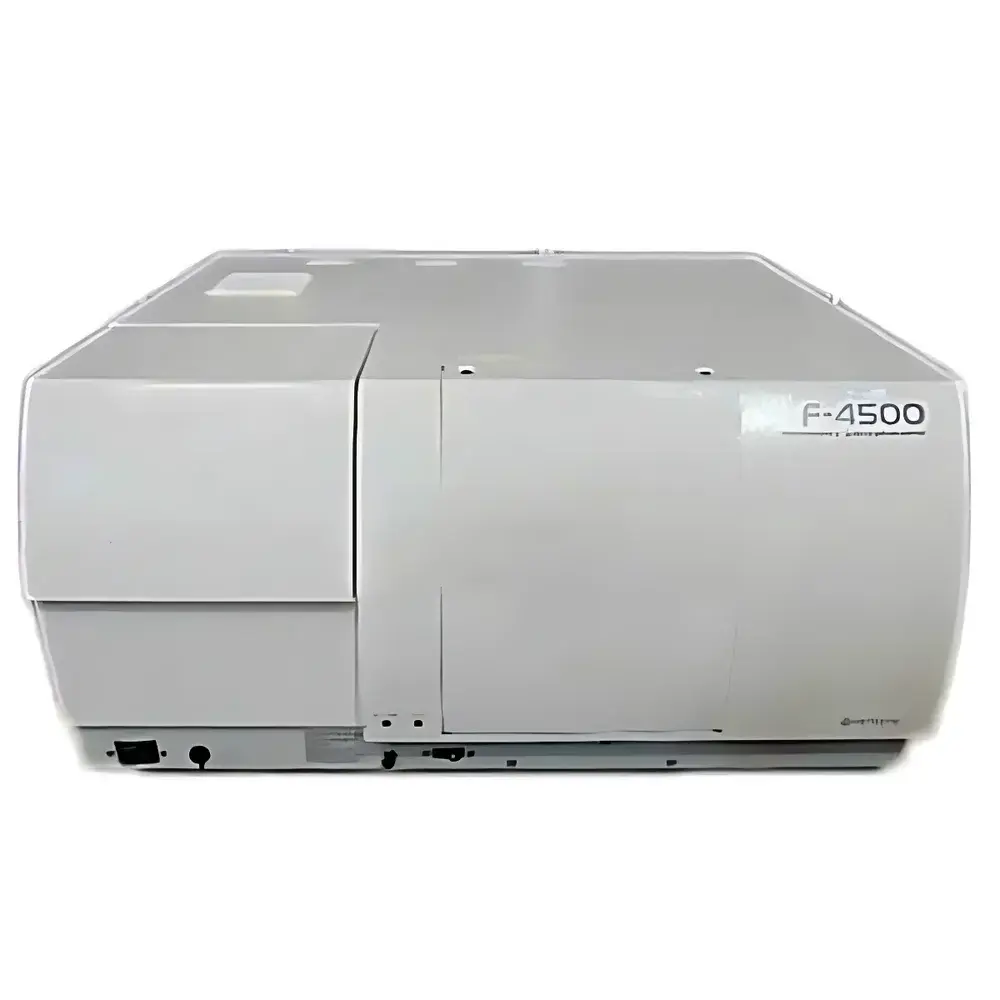
Hitachi F4500 Used Molecular Fluorescence Spectrometer
| Brand | Hitachi |
|---|---|
| Origin | Japan |
| Model | F4500 |
| Instrument Type | Molecular Fluorescence Spectrometer |
| Import Status | Imported |
| Distributor Type | Authorized Reseller |
| Price | USD 4,200 (FOB China port, ex-works condition) |
Overview
The Hitachi F4500 is a high-performance, scanning-type molecular fluorescence spectrometer originally engineered for precision quantitative and qualitative analysis of fluorescent compounds in research and quality control laboratories. Based on the principle of photoluminescence spectroscopy—where samples are excited by monochromatic light and the resulting emission intensity and wavelength distribution are measured—the F4500 delivers high-sensitivity detection across broad excitation (200–900 nm) and emission (200–900 nm) ranges. Its double-monochromator optical design minimizes stray light, enabling reliable measurement of weakly fluorescent samples and complex matrices with high signal-to-noise ratio. The instrument features a xenon lamp light source, thermoelectrically cooled R928 photomultiplier tube (PMT) detector, and motorized slit control for optimized resolution and sensitivity trade-offs. Designed for stability and reproducibility, the F4500 supports both steady-state fluorescence, synchronous scanning, and 3D excitation-emission matrix (EEM) mapping—making it suitable for structural characterization of organic molecules, protein conformation studies, and trace-level contaminant identification.
Key Features
- Double-grating monochromators for excitation and emission paths, ensuring low stray light (<0.0001% at 360 nm) and high spectral purity
- Xenon arc lamp (150 W) with stable output over extended operation cycles; lamp life typically exceeds 1,000 hours under standard usage
- Thermoelectrically cooled PMT detector (R928 type), offering enhanced sensitivity down to sub-picomolar concentrations for many fluorophores
- Motorized slits (1–20 nm adjustable in 0.1 nm increments) for dynamic optimization of resolution vs. intensity
- Standard sample compartment accommodates 10 mm quartz cuvettes; optional accessories include solid-sample holders, temperature-controlled cells (±0.1 °C), and fiber-optic probes
- Robust mechanical architecture with vibration-damped optical bench and sealed optics housing for long-term calibration stability
Sample Compatibility & Compliance
The F4500 accepts liquid, solid, and powder samples in standard 10 mm pathlength cuvettes or specialized holders. It is routinely employed in applications requiring compliance with pharmacopeial methods (e.g., USP , , for fluorescence assay validation), environmental monitoring protocols (EPA Method 445.1 for PAH quantification), and food safety testing (AOAC Official Method 2007.01 for vitamin B2). While the instrument itself does not carry CE or FDA 510(k) certification as a used unit, its original design conforms to IEC 61010-1 safety standards and electromagnetic compatibility requirements (EN 61326-1). Data integrity practices—including manual audit trails, raw data export in ASCII/CSV format, and user-accessible calibration logs—support alignment with GLP and GMP documentation expectations when integrated into validated laboratory workflows.
Software & Data Management
The F4500 operates with Hitachi’s FL Solutions v3.x software (Windows-compatible, English-language interface), providing full instrument control, spectral acquisition, kinetic time-scan functionality, and post-acquisition processing (baseline correction, peak integration, spectral subtraction, EEM contour plotting). All spectra are stored with metadata including date/time stamp, operator ID, instrument configuration, and calibration status. Raw data files (.fcd) are non-proprietary and convertible to universal formats (e.g., .txt, .csv) without vendor lock-in. Software supports user-defined method templates and report generation compliant with internal SOPs. Though the system does not natively implement FDA 21 CFR Part 11 electronic signature or audit trail modules, it permits integration with third-party LIMS platforms via ODBC or file-based data exchange for centralized record retention.
Applications
- Pharmaceutical R&D: Quantification of active pharmaceutical ingredients (APIs), degradation product profiling, and excipient interaction studies via fluorescence quenching or energy transfer assays
- Environmental analysis: Detection and speciation of polycyclic aromatic hydrocarbons (PAHs), humic substances, and dissolved organic matter in water and soil extracts
- Food & beverage quality control: Vitamin B2 (riboflavin), vitamin K, and aflatoxin B1 determination; authenticity assessment of honey and olive oil
- Life sciences: Protein folding/unfolding kinetics monitored by intrinsic tryptophan fluorescence; ligand-binding affinity measurements using labeled biomolecules
- Materials science: Characterization of quantum dots, conjugated polymers, and luminescent nanomaterials through lifetime-independent steady-state analysis
FAQ
Is the F4500 supplied with calibration verification data?
Yes—each unit undergoes pre-shipment performance verification using NIST-traceable fluorescein and quinine sulfate standards. A Certificate of Verification (CoV) documenting excitation/emission wavelength accuracy (±1.0 nm), photometric linearity (R² > 0.999), and signal-to-noise ratio (≥1,000:1 at water Raman peak) is provided.
Can the instrument be upgraded with modern connectivity options?
While the native RS-232 interface remains functional, USB-to-serial adapters are widely deployed for compatibility with current Windows OS versions. Ethernet or Wi-Fi connectivity is not supported natively but may be enabled via external hardware bridges for remote monitoring in networked lab environments.
What maintenance is required prior to installation?
All units undergo optical alignment verification, lamp replacement if remaining life is <200 hours, PMT gain recalibration, and full functional test per Hitachi’s factory service checklist. No additional commissioning is needed beyond standard lab power and environmental conditioning (20–25 °C, <60% RH, non-condensing).




