
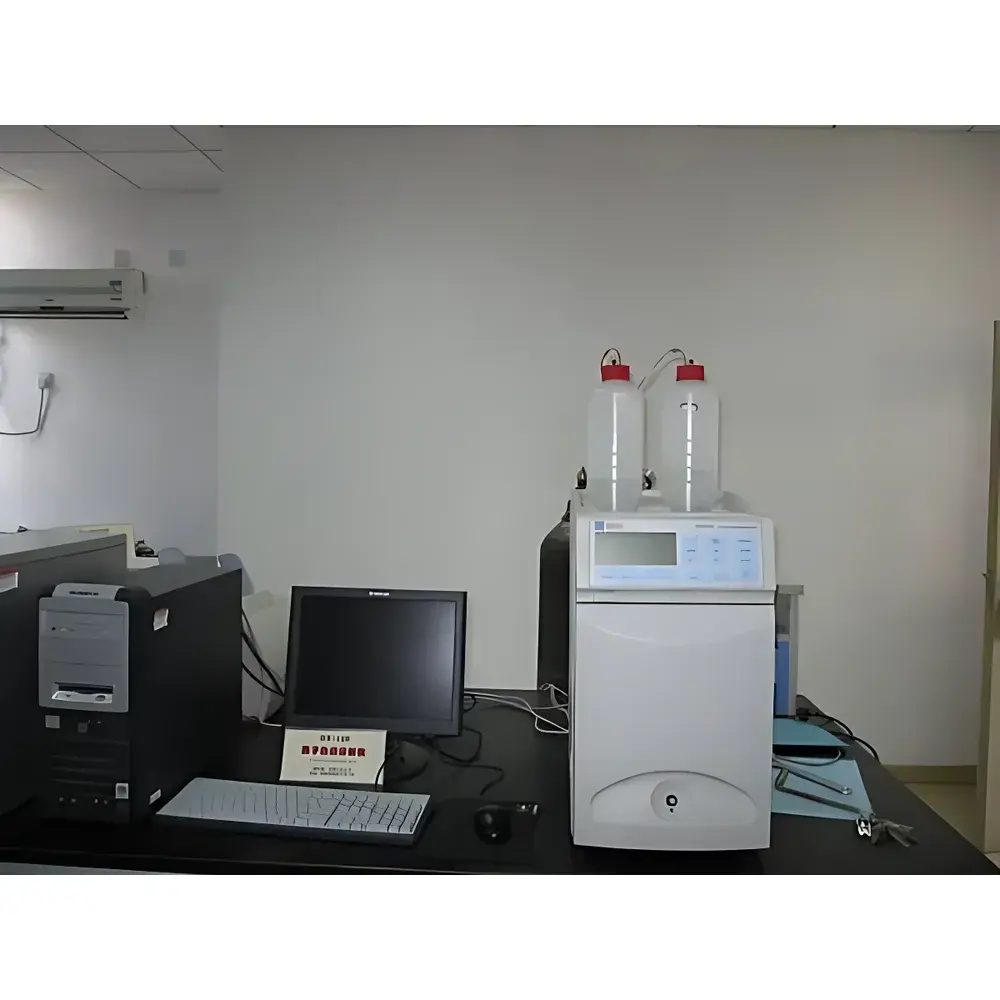
Thermo Fisher Dionex DX-120 Used Ion Chromatograph
| Brand | Thermo Fisher |
|---|---|
| Origin | USA |
| Manufacturer Type | Authorized Distributor |
| Origin Category | Imported |
| Model | DX-120 |
| Instrument Type | Laboratory |
| Pump Pressure Rating | 27.5 MPa (4000 psi) |
| Flow Rate Range | 0.00–5.00 mL/min |
| Eluent Flow Rate | 0.1–3.0 mL/min |
| Max Operating Pressure | 17 MPa (3500 psi) |
| Operating Temperature Range | 10–40 °C |
| Temperature Reproducibility | ±0.2 °C |
| Eluent Concentration Range | 0.1–100 mM |
Overview
The Thermo Fisher Dionex DX-120 is a robust, benchtop ion chromatograph engineered for high-reproducibility anion and cation analysis in regulated and research laboratory environments. Based on suppressed conductivity detection and eluent generation principles, the DX-120 employs a dual-piston reciprocating pump with pulse-dampening design to deliver stable, low-noise flow across its full operational range (0.00–5.00 mL/min). Its core analytical architecture integrates a chemically inert PEEK fluidic path — including pump heads, tubing, and detector cell — ensuring long-term compatibility with aggressive eluents such as potassium hydroxide, methanesulfonic acid, and carbonate/bicarbonate buffers. The system utilizes Dionex’s proprietary membrane-based suppressor technology, which achieves high suppression efficiency (>99%) and low background conductivity, enabling reliable quantification down to sub-ppb levels for common inorganic ions (e.g., F⁻, Cl⁻, NO₂⁻, NO₃⁻, SO₄²⁻, PO₄³⁻, Na⁺, NH₄⁺, K⁺, Mg²⁺, Ca²⁺).
Key Features
- PEEK-based fully inert fluidic path — resistant to corrosion from acidic, basic, and high-salt eluents
- Integrated digital conductivity detector with 1.25 µL cell volume, temperature-compensated signal processing (1.5–1.9% per °C), and auto-ranging output (0–1000 µS)
- Membrane-type electrochemical suppressor enabling low baseline noise and high sensitivity without chemical regeneration
- Single-column or dual-column configuration support — manual or automated column switching for simultaneous anion/cation analysis
- Thermostatically controlled column compartment (30–60 °C, ±0.2 °C reproducibility) for retention time stability
- Compliant with U.S. EPA Method 300.0/300.1, ASTM D4327, ISO 10304-1, and USP for water quality and pharmaceutical excipient testing
Sample Compatibility & Compliance
The DX-120 accommodates aqueous samples with total dissolved solids (TDS) ≤ 100 ppm and particulate-free filtration (≤0.45 µm). It supports direct injection of drinking water, wastewater, boiler feedwater, food extracts, and pharmaceutical formulations after appropriate dilution or pre-treatment. Its hardware and method protocols align with regulatory requirements specified in China’s Hygienic Standard for Drinking Water (GB 5749–2006), referencing the original 2001 Hygienic Specifications for Drinking Water that mandated ion chromatographic determination of inorganic anions. For GLP/GMP environments, the system can be validated per ICH Q2(R2) guidelines; when operated with compliant software (e.g., Chromeleon CDS v7.2+), it supports 21 CFR Part 11-compliant audit trails, electronic signatures, and data integrity controls.
Software & Data Management
While the base DX-120 operates via front-panel controls and analog/digital I/O, full method development, sequence control, peak integration, and report generation require integration with Thermo Fisher Chromeleon Chromatography Data System (CDS). Chromeleon provides validated workflows for calibration curve fitting (linear, quadratic, or weighted), system suitability assessment (retention time RSD ≤ 0.5%, peak area RSD ≤ 1.5%), and compliance-ready reporting. Raw data files (.cdl) are stored in a structured, non-proprietary binary format compatible with third-party reprocessing tools. Audit trail logs record all user actions, parameter changes, and acquisition events with timestamps and operator IDs — essential for FDA inspection readiness.
Applications
- Regulatory testing of inorganic anions and cations in potable water per EPA 300.1 and ISO 10304-1
- Quality control of chloride, sulfate, and nitrate impurities in active pharmaceutical ingredients (APIs) and excipients
- Monitoring of ionic contaminants in semiconductor process chemicals (e.g., HF, HNO₃, NH₄OH solutions)
- Analysis of organic acids (acetate, formate, oxalate) and amines in fermentation broths and bioprocess streams
- Environmental monitoring of atmospheric deposition (rainwater, snowmelt) and soil leachates
- Food safety testing for preservatives (benzoate, sorbate), phosphate additives, and iodide in dairy products
FAQ
Is the DX-120 compatible with modern Chromeleon CDS versions?
Yes — when equipped with a USB or Ethernet interface module (e.g., Dionex ICS-3000-compatible communication board), the DX-120 can be fully integrated into Chromeleon CDS v7.2 or later for method automation and compliance reporting.
What maintenance intervals are recommended for the membrane suppressor?
Under typical use (≤20 injections/day, KOH eluent), the ASRS™-ULTRA or CSRS™-ULTRA suppressor requires replacement every 6–12 months; performance should be verified weekly via baseline noise (<0.5 nS) and peak shape symmetry (asymmetry factor 0.9–1.2).
Can the DX-120 perform gradient elution?
No — the DX-120 is a single-pump, isocratic system. Gradient capability requires upgrade to the ICS-1000, ICS-1100, or newer RFIC-enabled platforms.
Does the instrument meet 21 CFR Part 11 requirements out-of-the-box?
Not inherently — Part 11 compliance depends on validated software configuration, access controls, and audit trail activation within Chromeleon CDS; standalone DX-120 operation does not satisfy electronic record requirements.
What is the typical detection limit for chloride using this system?
With standard 25 µL injection, ASRS™-ULTRA suppression, and optimized KOH gradient (if externally generated), the practical LOD for Cl⁻ is ~0.1 µg/L (sub-pptr) under ideal lab conditions.





