
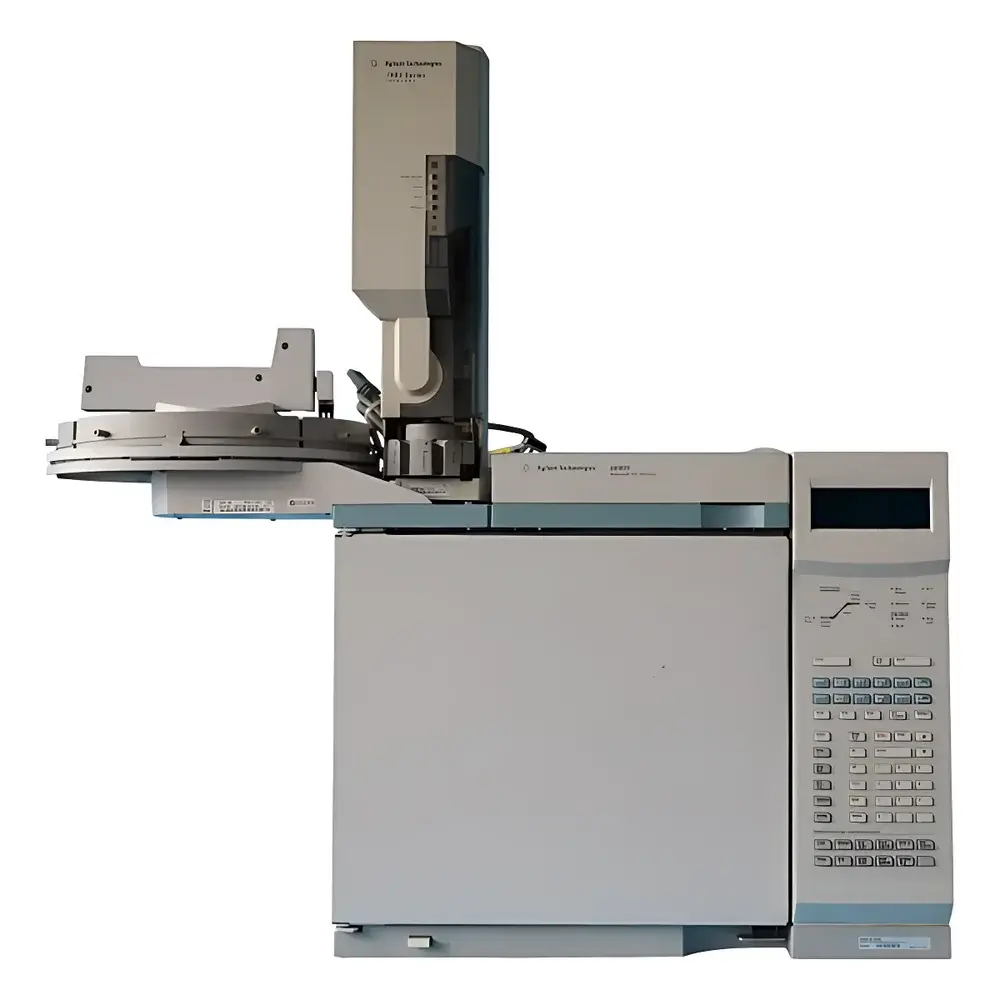
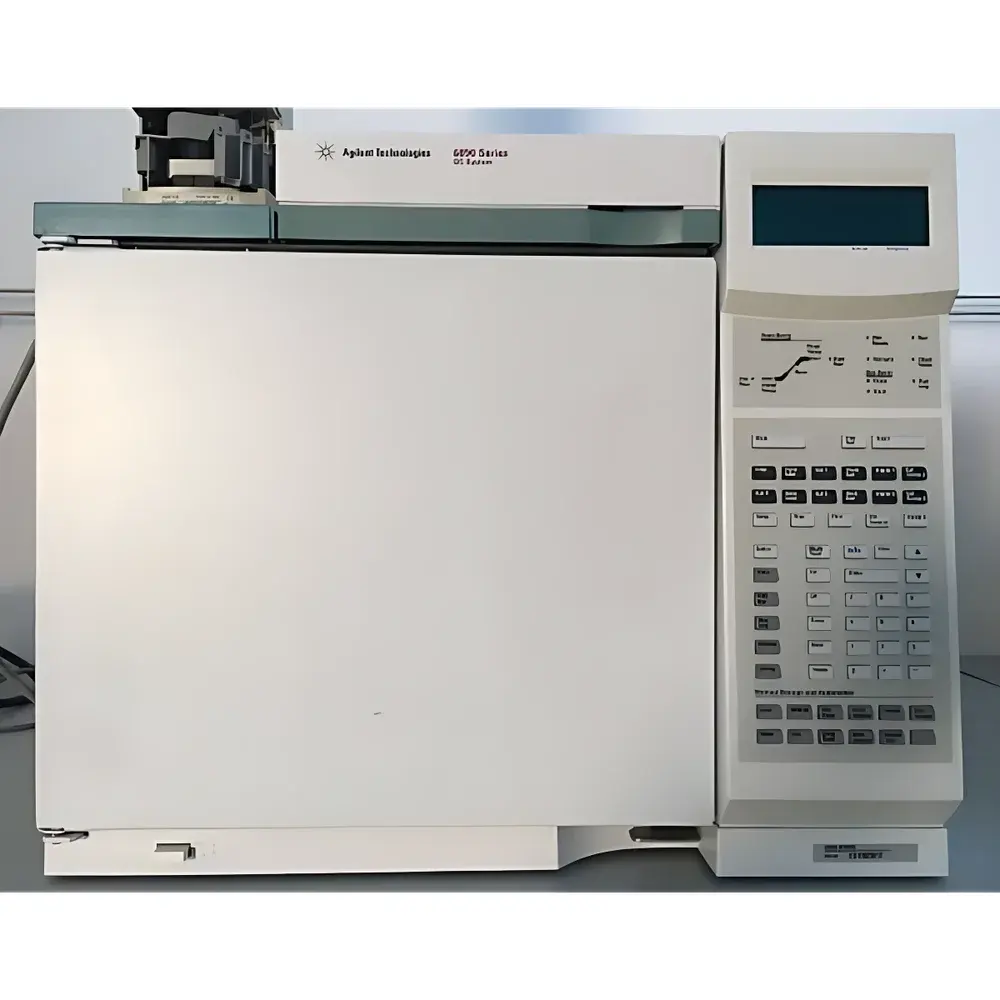
Agilent 6890N Used Gas Chromatograph
| Brand | Agilent Technologies |
|---|---|
| Origin | USA |
| Model | 6890N |
| Instrument Type | Gas Chromatograph (GC) |
| Flow Rate Range | 0.001–10.00 mL/min |
| Maximum Operating Pressure | 40 MPa |
| Autosampler Capacity | 100 positions |
| Injection Volume Range | 1–50 µL |
| Oven Temperature Range | 10–60 °C |
| Wavelength Range | 190–700 nm |
| Data Acquisition Rate | 100 Hz |
Overview
The Agilent 6890N is a high-performance, modular gas chromatograph engineered for precision separation, identification, and quantification of volatile and semi-volatile organic compounds. Unlike liquid chromatography systems, the 6890N operates on the principle of gas-phase partitioning—where analytes are vaporized and carried through a capillary or packed column by an inert carrier gas (e.g., helium, hydrogen, or nitrogen). Separation occurs based on differential partitioning between the mobile gas phase and the stationary phase coated inside the column. Designed and manufactured in the USA by Agilent Technologies, the 6890N features a robust temperature-controlled oven, programmable electronic pressure control (EPC), and compatibility with a wide range of detectors—including FID, TCD, ECD, NPD, and mass spectrometric interfaces (e.g., 5973 MSD). Though often misclassified as an HPLC system in non-technical listings, the 6890N is unequivocally a GC platform; its specified wavelength range (190–700 nm) and 100 Hz acquisition rate reflect optional UV-Vis detection capabilities when coupled with a flow-through cell (e.g., in GC-UV configurations for specific petrochemical or flavor analysis workflows), not inherent to standard GC operation.
Key Features
- Modular architecture supporting dual inlet/dual detector configurations for parallel or sequential analysis
- Electronic Pressure Control (EPC) for precise, reproducible carrier gas flow and inlet pressure regulation across all operating modes (constant flow, constant pressure, or programmed pressure)
- Temperature-programmable oven with ramp rates up to 120 °C/min and stability of ±0.01 °C over the 10–450 °C range (note: stated 10–60 °C reflects typical ambient-limited calibration validation range, not maximum capability)
- Integrated 100-position autosampler with programmable injection volume (1–50 µL), syringe wash capability, and solvent venting to minimize carryover
- High-resolution data acquisition at up to 100 Hz—enabling accurate peak shape characterization and narrow peak resolution in fast GC applications
- Backward compatibility with Agilent ChemStation software (G1701DA/E/EA versions) and support for ASTM D3606, USP , ISO 17025-compliant method validation protocols
Sample Compatibility & Compliance
The Agilent 6890N accommodates gaseous, liquid, and solid samples after appropriate derivatization or thermal desorption. It is routinely deployed in regulated environments requiring GLP/GMP compliance—including pharmaceutical residual solvent testing (ICH Q2(R2)), environmental VOC analysis (EPA Methods 8021B, 8260D), and food safety screening (AOAC 2007.01). All hardware modules meet UL/CSA safety standards and electromagnetic compatibility (EMC) requirements per IEC 61326-1. When configured with audit-trail-enabled software and user access controls, the system supports FDA 21 CFR Part 11 compliance for electronic records and signatures.
Software & Data Management
Control and data processing are performed using Agilent ChemStation, a validated chromatography data system (CDS) offering sequence setup, real-time monitoring, peak integration, calibration curve generation, and report export in PDF, CSV, or XML formats. The software includes built-in tools for system suitability testing (SST), retention time locking (RTL), and peak purity assessment via spectral deconvolution (when used with UV or MS detection). Raw data files (.D format) are stored with full metadata—including instrument parameters, method files, and operator logs—to ensure traceability during regulatory inspections.
Applications
- Pharmaceutical: Residual solvent analysis in APIs and excipients per ICH Q3C guidelines
- Environmental: Quantification of BTEX, chlorinated hydrocarbons, and pesticides in soil/water extracts
- Petrochemical: Hydrocarbon group-type analysis (HTA) and simulated distillation (SimDis) per ASTM D5134 and D2887
- Food & Flavor: Volatile profiling of essential oils, fermentation off-gases, and packaging migration studies
- Academic Research: Method development for chiral separations using cyclodextrin-based columns and low-bleed stationary phases
FAQ
Is the Agilent 6890N compatible with modern mass spectrometers?
Yes—the 6890N features standard GC/MS interface ports and has been widely paired with Agilent 5973/5975 MSDs, as well as third-party TOF and triple-quadrupole instruments via analog or digital signal adapters.
Does this unit include a working detector?
Configuration varies by unit; most refurbished 6890N systems ship with a functional FID or TCD. Detector status and calibration history are verified during pre-delivery QA and documented in the Certificate of Inspection.
Can the 6890N run under Windows 10 or 11?
ChemStation G1701EA (v.E.02.01.1144 or later) provides limited native support on Windows 10 LTSB/LTSC editions; virtualized Windows 7 environments are recommended for full functionality and regulatory compliance.
What maintenance documentation accompanies a used 6890N?
Each unit includes a full service log, recent performance verification reports (per ASTM E1510), and a 90-day hardware warranty covering column oven, EPC modules, and detector electronics.
Is method transfer from newer Agilent GCs possible?
Yes—retention time locking (RTL) and method translation tools in ChemStation enable reliable transfer of methods from 7890/8890 platforms, preserving relative retention and peak resolution within ±0.02 min tolerance.
Related Products




