
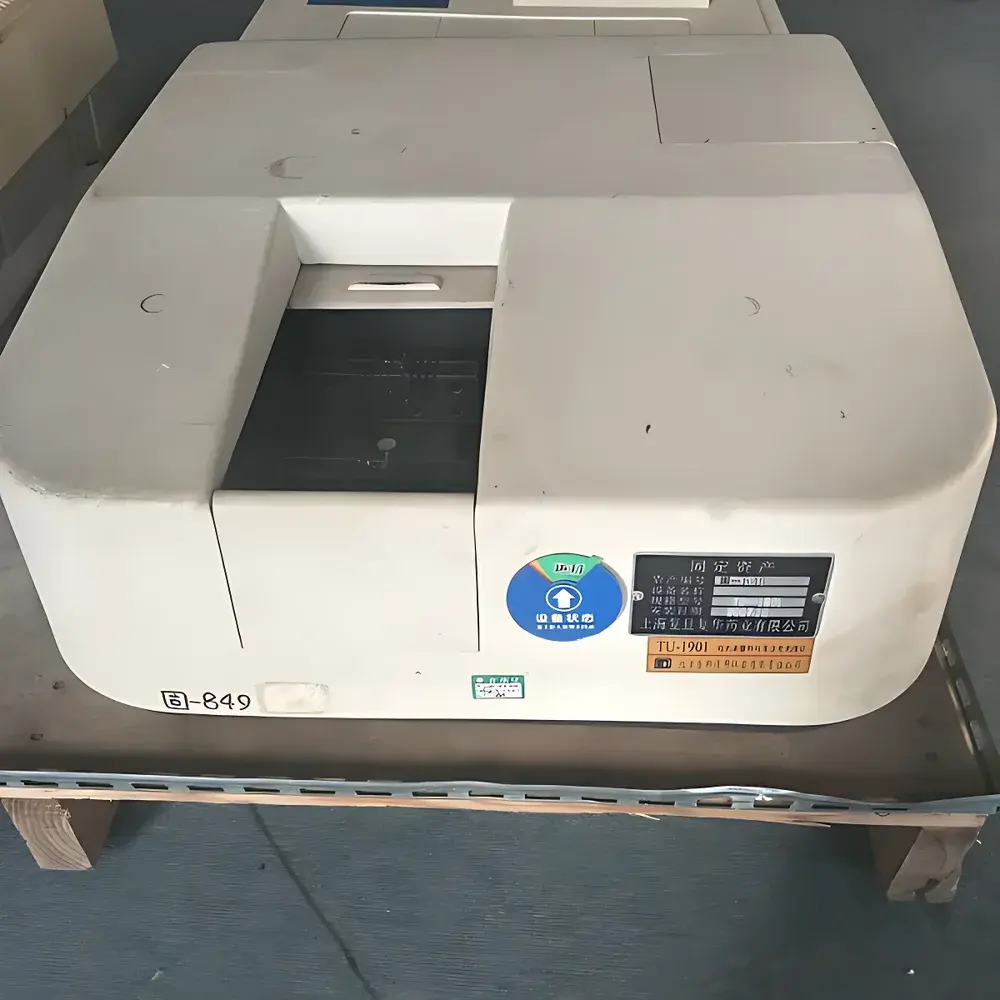
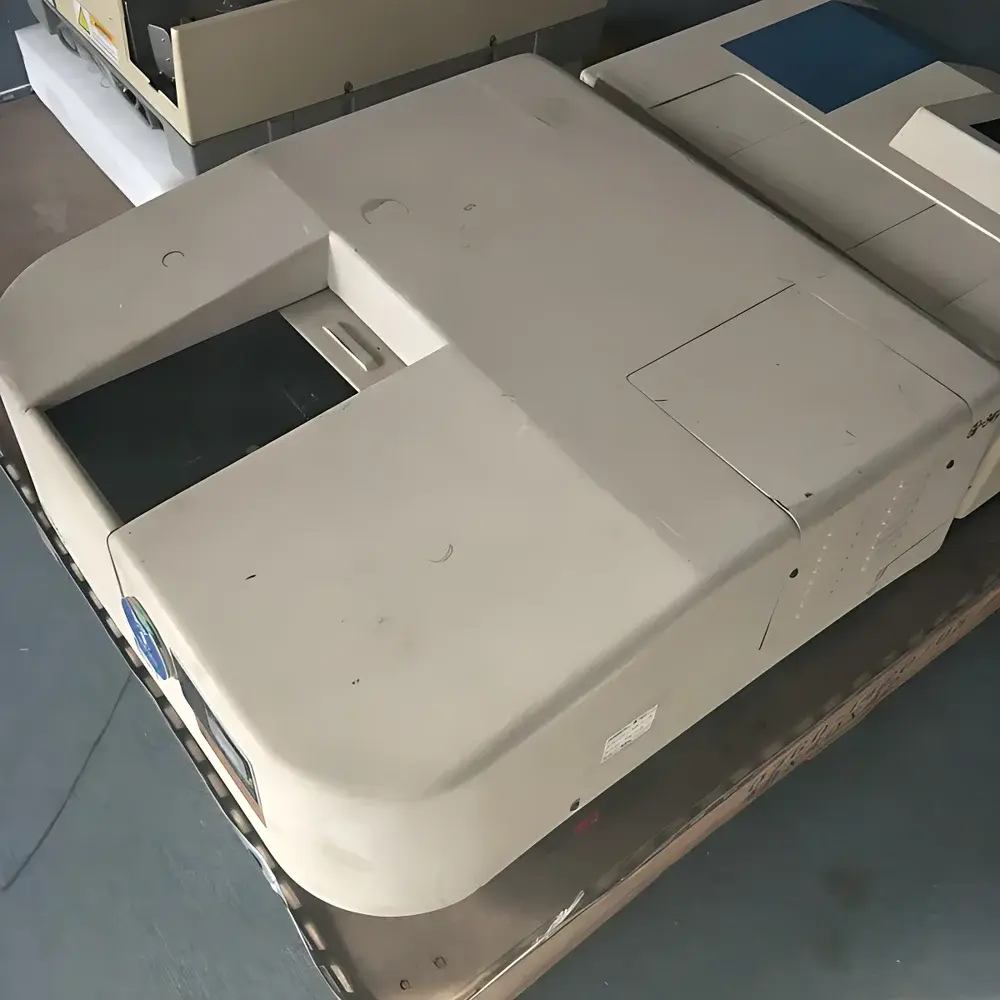
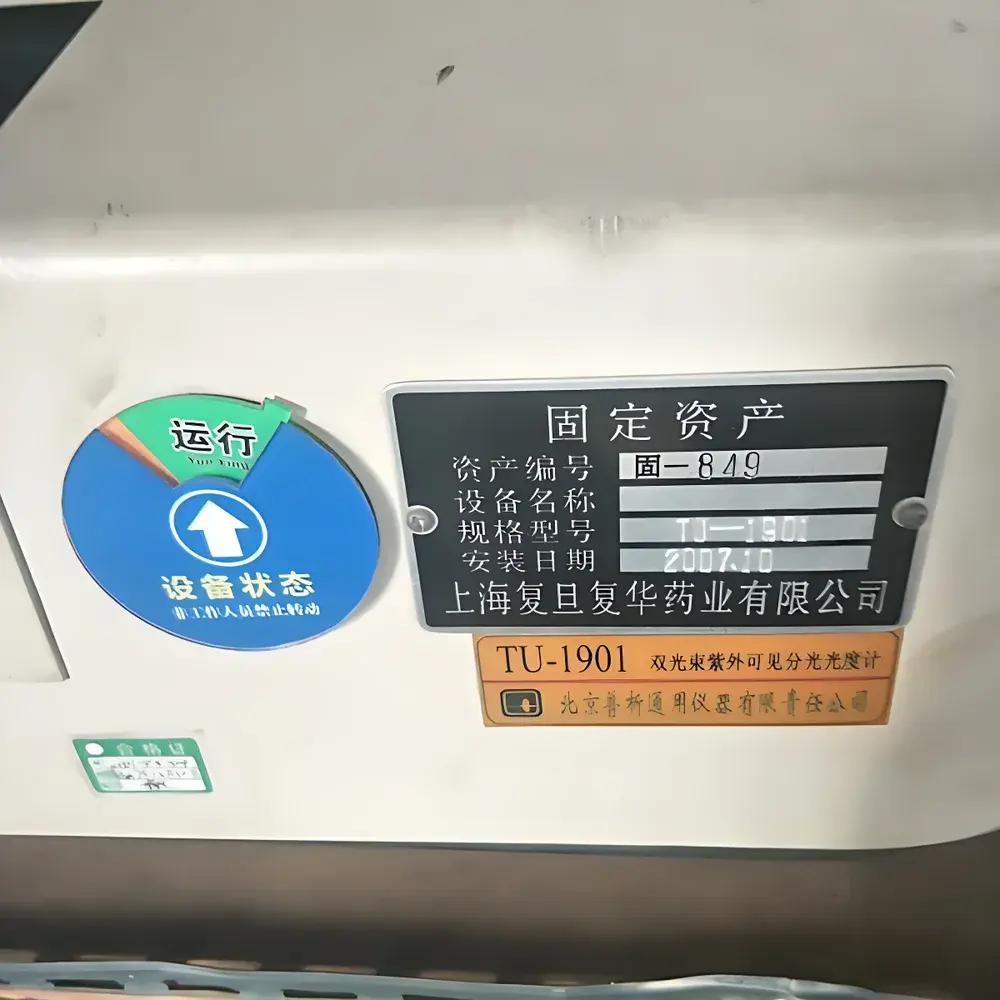
Persee TU-1901 Used Double-Beam UV-Vis Spectrophotometer
| Origin | Beijing, China |
|---|---|
| Manufacturer Type | Authorized Distributor |
| Product Origin | Domestic (China) |
| Model | TU-1901 |
| Price | USD 27,500 (FOB Beijing) |
| Optical Design | Double-Beam |
| Detector | Photodiode Array (PDA) |
| Wavelength Range | 190–900 nm |
| Wavelength Scanning | Motorized Auto-Scanning |
| Spectral Bandwidth | 5.0 nm (selectable: 0.1/0.2/0.5/1.0/2.0/5.0 nm) |
| Wavelength Accuracy | ±0.3 nm (auto-calibrated at startup) |
| Stray Light | ≤0.015% T (at 220 nm, NaI |
Overview
The Persee TU-1901 is a high-performance, used double-beam ultraviolet-visible spectrophotometer engineered for precision quantitative and qualitative analysis across academic, pharmaceutical, environmental, and industrial quality control laboratories. Operating on the principle of Beer–Lambert law-based absorbance measurement, the instrument employs a dynamic feedback ratio recording system that continuously compares sample and reference beam intensities in real time—minimizing drift and enhancing baseline stability over extended acquisition periods. Its optical architecture integrates a high-efficiency holographic grating (imported), precision stepper-motor-driven wavelength scanning, and a thermally stabilized photodiode array detector, enabling reproducible spectral acquisition from 190 nm to 900 nm with sub-nanometer positional fidelity. Designed for regulatory-compliant workflows, the TU-1901 supports traceable calibration protocols and meets foundational performance criteria aligned with ISO 9001–certified manufacturing practices and ASTM E275–22 (Standard Practices for Describing and Measuring Performance of UV–Vis Spectrophotometers).
Key Features
- Double-beam dynamic feedback optical system ensures exceptional baseline flatness (±0.001 Abs) and low long-term drift (≤0.0004 Abs/h at 500 nm after 2 h warm-up)
- High-resolution photodiode array detector enables rapid full-spectrum acquisition (190–900 nm) without mechanical slit adjustment
- Selectably variable spectral bandwidths (0.1–5.0 nm) accommodate diverse analytical requirements—from high-resolution peak deconvolution to broad-band quantitation
- Plug-in tungsten and deuterium lamps simplify source replacement without realignment or optical recalibration
- Integrated auto-wavelength calibration routine executed at power-on, ensuring continuous traceability to internal reference standards
- Low stray light performance (≤0.015% T) validated per ASTM E387 at critical wavelengths (220 nm, NaI; 340 nm, NaNO₂), essential for high-dynamic-range measurements
Sample Compatibility & Compliance
The TU-1901 accommodates standard 10 mm pathlength cuvettes as well as specialized accessories—including Peltier-controlled temperature-regulated cell holders (±0.1 °C stability), integrating spheres for diffuse reflectance analysis, fiber-optic probes for remote sampling, and microvolume adapters supporting down to 2 µL volumes. All optical components comply with RoHS Directive 2011/65/EU. While the instrument itself does not carry CE marking as a used unit, its original design conforms to IEC 61010-1:2010 safety standards for laboratory electrical equipment. Data integrity features—including user-access logs, timestamped method storage, and audit-ready parameter history—support alignment with GLP and GMP documentation expectations when deployed in regulated environments.
Software & Data Management
The instrument operates with Persee’s proprietary UVWin software (v5.x), delivered pre-installed on an embedded Windows-based controller. The interface supports multi-mode operation: photometric scanning, kinetics, quantitative analysis (single/multi-point calibration, standard addition), and spectral derivative processing. Raw absorbance, transmittance, and reflectance data are exportable in ASCII, CSV, and JCAMP-DX formats for integration with LIMS or third-party chemometric platforms (e.g., MATLAB, Unscrambler). Software includes built-in validation tools for wavelength and photometric accuracy verification per USP and EP 2.2.25 guidelines. Audit trail functionality records all method modifications, calibration events, and user actions—enabling compliance with FDA 21 CFR Part 11 requirements when configured with electronic signatures and role-based access control.
Applications
- Pharmaceutical assay development and QC release testing (e.g., dissolution profiling, excipient interference screening)
- Environmental water quality monitoring (nitrate, phosphate, COD estimation via colorimetric methods)
- Protein and nucleic acid quantification (A260/A280 ratios, extinction coefficient-based concentration calculation)
- Chemical kinetics studies requiring high temporal resolution and photometric repeatability
- Thin-film and nanomaterial characterization via transmission/reflectance spectroscopy
- Educational laboratory instruction in analytical chemistry and instrumental methods
FAQ
Is this unit supplied with valid calibration certificates?
Yes—each TU-1901 undergoes post-reconditioning verification against NIST-traceable standards. A full calibration report documenting wavelength accuracy, photometric linearity, stray light, and baseline stability is provided.
Can the instrument be integrated into a networked lab environment?
The TU-1901 supports Ethernet and USB 2.0 connectivity. Remote control and data transfer are enabled via TCP/IP protocol; optional OPC UA server add-on available for SCADA/LIMS interfacing.
What is the expected operational lifetime of the deuterium and tungsten lamps?
Typical lamp service life exceeds 1,000 hours under standard usage conditions. Replacement lamps are stocked globally and retain full compatibility with original optical alignment specifications.
Does the system support 21 CFR Part 11 compliance out-of-the-box?
The base configuration includes audit trail and user authentication. Full Part 11 compliance requires installation of validated electronic signature modules and documented SOPs—available through Persee’s Regulatory Support Package.
Are original spare parts and service manuals included?
Yes—each unit ships with a complete set of consumables (cuvettes, desiccant, cleaning tools), printed English-language operation manual, and digital archive of firmware updates and service bulletins.






