
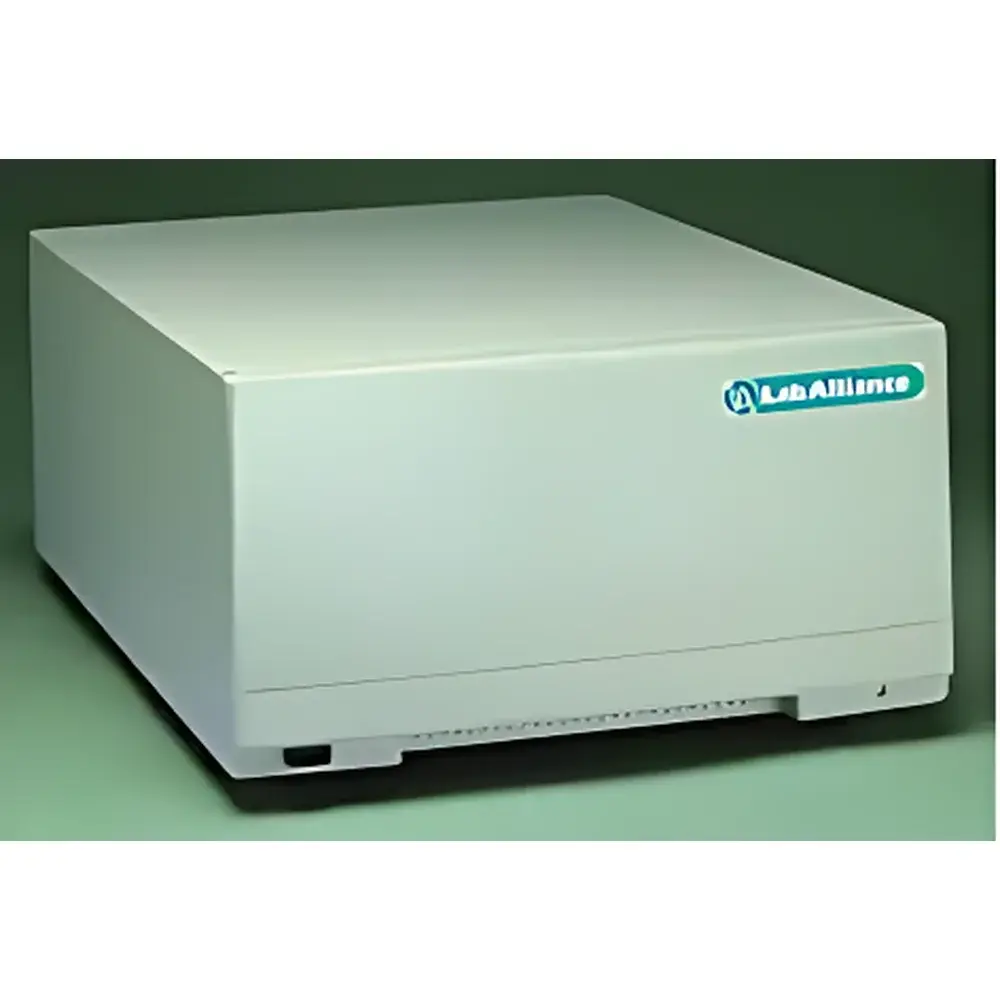
SSI Model 6000 Diode Array Detector
| Brand | SSI |
|---|---|
| Origin | USA |
| Manufacturer Type | Authorized Distributor |
| Import Status | Imported |
| Model | Model 6000 Diode Array Detector |
| Pricing | Available Upon Request |
| Wavelength Range | 190–800 nm |
| Optical Path Length / Flow Cell Volume | 5 cm / 12 µL |
| Noise | ±3 × 10⁻⁶ AU/cm |
| Drift | 1 × 10⁻³ AU/hr |
| Linearity | >2.0 AU |
| Scan Rate | ≤20 Hz |
| Spectral Resolution | 1.2 nm |
| Wavelength Accuracy | ±1 nm |
| Light Source | Deuterium Lamp + Tungsten-Halogen Lamp |
| A/D Converter | 20-bit |
| Photodiode Array | 512 elements |
| Beam Conditioning | Stacked Optical Fiber Assembly |
| Calibration Reference | Holmium Oxide (Ho₂O₃) Solution Cell |
Overview
The SSI Model 6000 Diode Array Detector (DAD) is a high-performance UV-Vis spectral detection system engineered for integration with analytical liquid chromatography platforms. It operates on the principle of simultaneous multi-wavelength absorbance measurement using a fixed 512-element photodiode array, enabling full-spectrum acquisition across 190–800 nm in a single scan. Unlike conventional single-wavelength detectors, the Model 6000 captures complete spectral profiles for every eluting peak—supporting peak purity assessment, spectral library matching, method development, and post-run wavelength optimization. Its optical architecture centers on a 5 cm pathlength flow cell with a 12 µL internal volume, optimized to maximize signal-to-noise ratio while preserving chromatographic resolution. The detector employs a proprietary stacked optical fiber beam-forming assembly that replaces mechanical slits, ensuring near-unity light throughput and eliminating slit-related intensity loss—a key factor contributing to its industry-leading sensitivity (5× higher than standard 10 mm pathlength cells).
Key Features
- High-sensitivity 5 cm optical path flow cell with 12 µL volume, delivering sharper, taller peaks and improved detection limits
- Dual-light-source configuration: deuterium lamp (190–400 nm) and tungsten-halogen lamp (350–800 nm), providing continuous, stable output across the full UV-Vis range
- 512-element diode array with 1.2 nm digital spectral resolution and ±1 nm wavelength accuracy, verified via integrated holmium oxide (Ho₂O₃) solution reference cell
- 20-bit analog-to-digital converter enabling superior baseline noise resolution and reduced quantitation error
- Real-time self-diagnostic system monitoring lamp intensity, usage hours, and spectral stability
- Automated wavelength calibration, linearity verification, noise assessment, and drift evaluation—generating audit-ready performance reports compliant with GLP and 21 CFR Part 11 requirements
- Adjustable scan rate up to 20 Hz, supporting high-speed LC and UHPLC applications with narrow peak capture fidelity
Sample Compatibility & Compliance
The Model 6000 is compatible with standard HPLC and UHPLC systems operating at pressures up to 600 bar, and interfaces seamlessly with common data systems via RS-232 or Ethernet. Its flow cell design accommodates aqueous, organic, and mixed mobile phases—including aggressive solvents such as THF and DMSO—without degradation of optical surfaces. All calibration and verification procedures adhere to internationally recognized standards, including ASTM E275 (UV-Vis spectrophotometer performance testing), ISO/IEC 17025 (general competence of testing laboratories), and USP (spectrophotometric absorption measurements). The Ho₂O₃ solution reference cell provides traceable wavelength validation at 241 nm and multiple visible-region peaks, satisfying regulatory expectations for instrument qualification under GMP and pharmaceutical QC workflows.
Software & Data Management
The detector is controlled through SSI’s ChromaVision™ software suite, which supports method-driven acquisition, real-time spectral overlay, peak tracking, and spectral deconvolution. Raw spectral data are stored in vendor-neutral .spc and .csv formats, facilitating third-party processing in tools such as MATLAB, Python (SciPy), or commercial chemometrics platforms. Audit trails record all user actions, parameter changes, calibration events, and report generation timestamps—fully compliant with FDA 21 CFR Part 11 electronic records and signature requirements. Software includes built-in tools for generating IQ/OQ documentation packages, supporting laboratory validation protocols required in regulated environments.
Applications
- Pharmaceutical impurity profiling and forced degradation studies
- Identification and quantification of polycyclic aromatic hydrocarbons (PAHs), phenols, and nitroaromatics in environmental water analysis
- Quality control of natural product extracts and botanical formulations
- Stability-indicating assay development per ICH Q2(R2)
- Reaction monitoring in preparative and process analytical technology (PAT) workflows
- Method transfer between labs using spectral fingerprinting and peak purity algorithms
FAQ
What is the purpose of the holmium oxide solution cell?
It serves as a primary wavelength calibration standard, providing certified absorption maxima at 241 nm and multiple visible wavelengths (e.g., 361, 419, 536 nm) for traceable verification of spectral accuracy.
Can the Model 6000 be used with UHPLC systems?
Yes—the detector supports scan rates up to 20 Hz and features low dispersion optics, making it suitable for sub-2-second peak widths typical of UHPLC separations.
Is the flow cell replaceable by the end user?
The 12 µL fused-silica flow cell is field-replaceable using standard Torx tools; replacement kits include pre-aligned optical coupling components to maintain alignment integrity.
How does the stacked optical fiber beam conditioner improve performance?
It eliminates mechanical slit losses by collecting and reconditioning the entire exit beam from the flow cell into a narrow vertical profile prior to diffraction grating dispersion—maximizing photon utilization and reducing shot noise.
Does the system support remote diagnostics and firmware updates?
Yes—via secure Ethernet connection, technicians can perform health checks, initiate calibration routines, and deploy validated firmware patches without onsite service visits.
Related Products





