
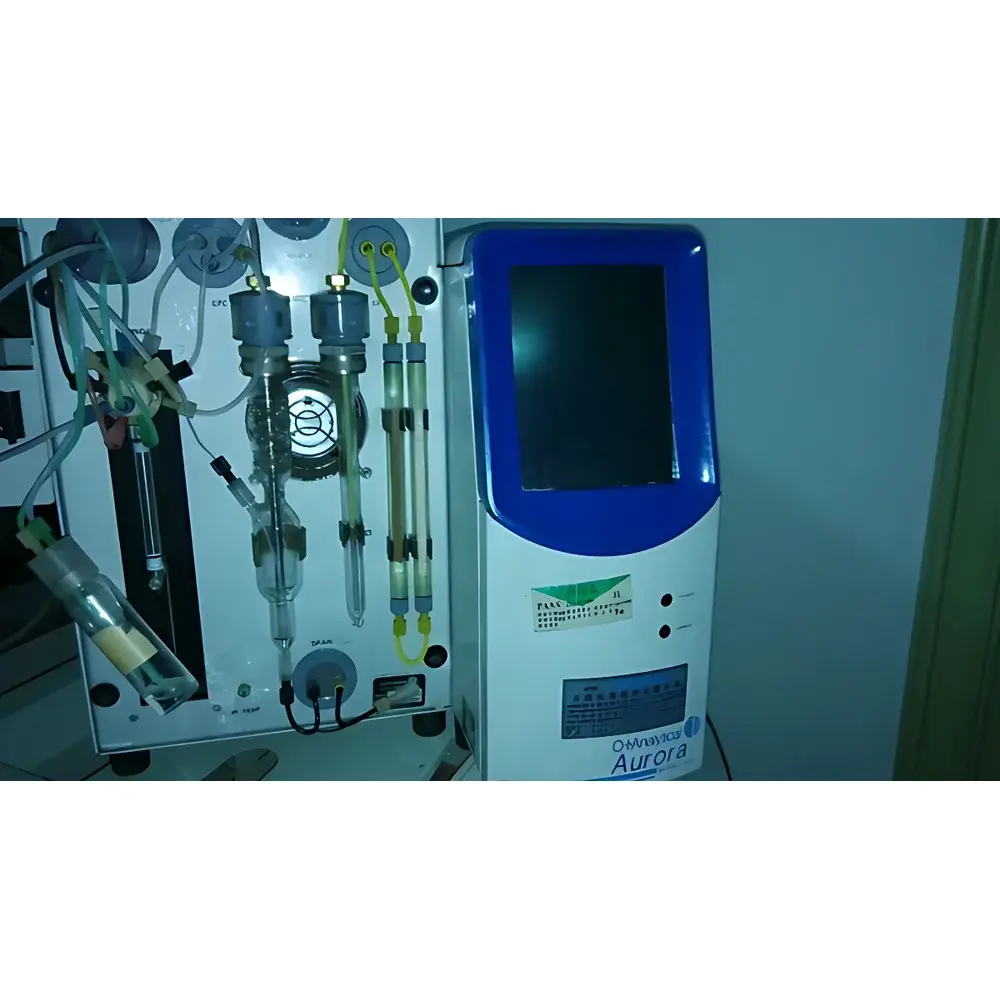
OI 1030 Series Total Organic Carbon (TOC) Analyzer
| Origin | Beijing, China |
|---|---|
| Manufacturer Type | Authorized Distributor |
| Origin Category | Domestic (China) |
| Model | 1030 |
| Price Range | USD 1,400 – 7,200 |
| Detection Range | 2 ppb C to 30,000 ppm C |
| Oxidation Methods | Acid-Persulfate Oxidation (Heated) & High-Temperature Catalytic Combustion (680–950 °C) |
| Detection Technology | Solid-State Non-Dispersive Infrared (SS-NDIR) |
| Compliance | EPA Method 415.3, ASTM D5905, D7573, USP <643>, ISO 8245 |
| Sample Types | Liquid aqueous matrices only (ultrapure water, PW, WFI, wastewater, seawater, process streams) |
| Optional Modules | POC, TNb, Solid TOC, Autosampler, Online Sampling Interface |
Overview
The OI 1030 Series Total Organic Carbon (TOC) Analyzer is a laboratory-grade, dual-oxidation platform engineered for high-fidelity quantification of carbon species in aqueous samples. It operates on two complementary oxidation principles: (1) acid-persulfate oxidation under controlled heating (for low-to-mid concentration ranges), and (2) high-temperature catalytic combustion (680–950 °C) in a quartz furnace (for demanding, high-salinity, or high-TOC applications). The instrument simultaneously measures Total Carbon (TC), Total Inorganic Carbon (TIC), Total Organic Carbon (TOC), Non-Purgeable Organic Carbon (NPOC), and Purgeable Organic Carbon (POC)—with TOC derived either directly via NPOC mode or by difference (TC − TIC). Its solid-state non-dispersive infrared (SS-NDIR) detector delivers stable, drift-free CO₂ quantification across a dynamic range spanning 2 ppb C to 30,000 ppm C—enabling trace-level monitoring in ultrapure water systems and robust analysis of industrial effluents without dilution.
Key Features
- Dual-oxidation architecture: Selectable heated persulfate (wet chemistry) or high-temperature catalytic combustion—optimized for matrix-specific performance and regulatory compliance.
- ACT II dual-stage combustion technology: Enhanced furnace geometry and thermal profiling improve oxidation efficiency and reduce carryover, especially for saline or viscous samples.
- Solid-state NDIR detector (SS-NDIR): No moving parts, no optical alignment drift; calibrated against NIST-traceable CO₂ standards for long-term baseline stability.
- Electronic pressure-controlled carrier gas system: Ensures consistent purge flow and minimizes baseline fluctuations during sequential injections.
- Adjustable combustion temperature (680–950 °C): Catalyst-free operation at ≥900 °C; optional low-temperature catalytic mode (680 °C) for chloride-rich samples to prevent catalyst poisoning.
- Full-color LCD touchscreen with Windows CE OS: Intuitive method navigation, real-time diagnostics, and embedded audit trail logging compliant with ALCOA+ data integrity principles.
Sample Compatibility & Compliance
The OI 1030 accommodates a broad spectrum of aqueous sample types—including pharmaceutical water (PW, WFI, purified water), clean-in-place (CIP) rinse waters, groundwater, seawater, cooling tower water, and municipal/industrial wastewater—without pre-treatment in most cases. It meets the instrumental requirements of U.S. EPA Method 415.3, ASTM D5905 (for drinking water), ASTM D7573 (for high-TOC waters), USP (for pharmaceutical water quality control), and ISO 8245. All data acquisition, method storage, and report generation support 21 CFR Part 11-compliant electronic signatures when integrated with WinTOC™ software and networked LIMS environments. System suitability testing (SST), calibration verification, and blank tracking are fully automated and documented per GLP/GMP expectations.
Software & Data Management
WinTOC™ software provides full remote instrument control via Ethernet or USB, enabling centralized method deployment, sequence scheduling, and result archiving. It supports user-defined calculation templates (e.g., TOC = TC − TIC, % recovery for standard addition), customizable report formats (PDF, CSV, XML), and secure database storage with role-based access control. Audit trails record all critical events—including method edits, calibration updates, and result overrides—with timestamps, operator IDs, and reason-for-change fields. Raw detector signals, peak integration parameters, and system pressure logs are retained alongside final results to satisfy FDA and EMA inspection requirements.
Applications
- Pharmaceutical manufacturing: Routine TOC monitoring of Water for Injection (WFI), Purified Water (PW), and cleaning validation rinse samples per USP and EU Annex 1.
- Microelectronics: Ultrapure water (UPW) quality assurance in semiconductor fab facilities where sub-ppb TOC detection limits are mandated.
- Environmental laboratories: Regulatory compliance testing of surface water, groundwater, and wastewater per EPA and ASTM protocols.
- Power generation: Boiler feedwater and condensate TOC surveillance to prevent organic fouling and corrosion.
- Academic and R&D labs: Kinetic studies of organic degradation, oxidation efficiency benchmarking, and method development for complex matrices (e.g., brines, humic-rich waters).
FAQ
What oxidation methods does the OI 1030 support?
It supports both acid-persulfate oxidation (heated, for 2 ppb–100 ppm C) and high-temperature catalytic combustion (680–950 °C, for up to 30,000 ppm C).
Can it analyze solid samples?
Yes—when equipped with the optional Solid TOC module, which includes acid digestion and sparging accessories for soil, sludge, or filter-collected particulates.
Is the instrument compliant with 21 CFR Part 11?
Yes—when operated with WinTOC™ software, network authentication, and enabled electronic signature workflows.
Does it require catalyst replacement during routine use?
Not in high-temperature mode (≥900 °C); catalyst is only used in low-temperature (680 °C) mode for high-chloride samples—and has a typical service life exceeding 12 months under normal operation.
How is data integrity ensured during unattended operation?
All analyses generate immutable audit trails; raw detector output, calibration history, and environmental logs (temperature, pressure, gas flow) are time-stamped and stored with each result.
Related Products




