
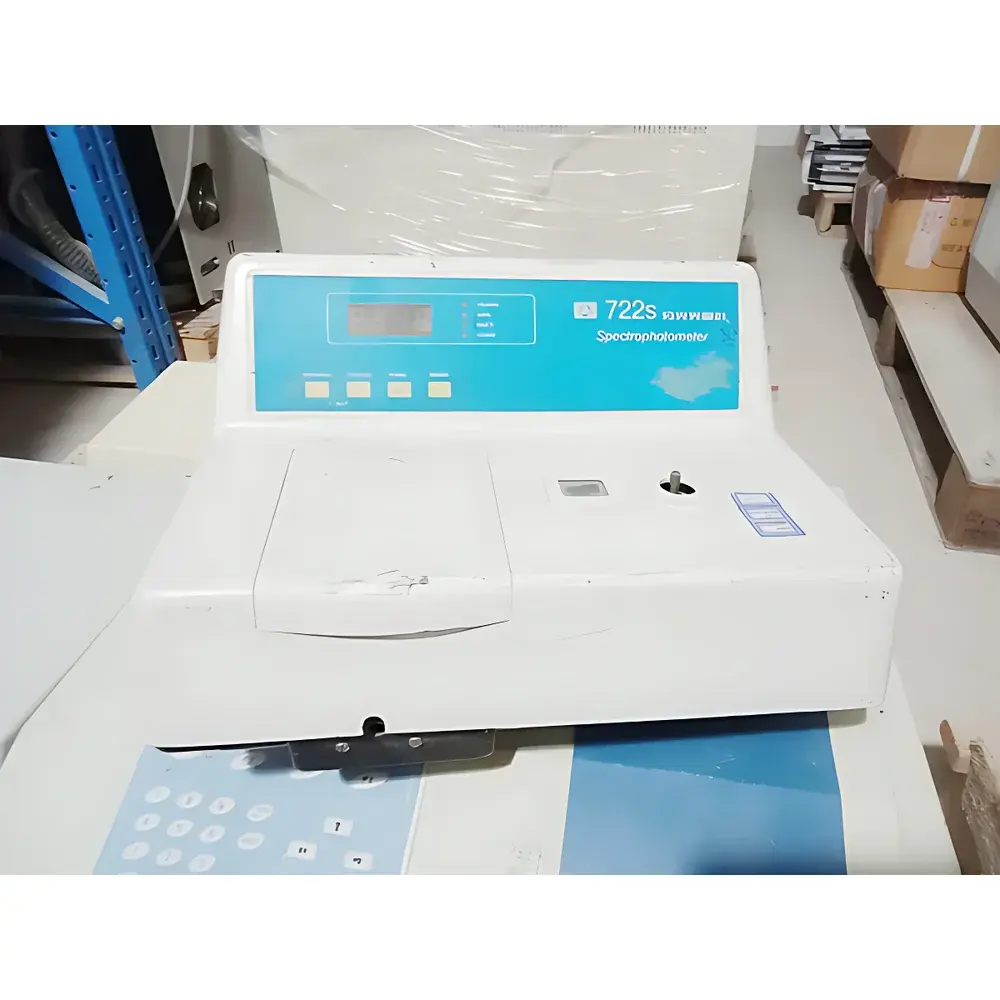
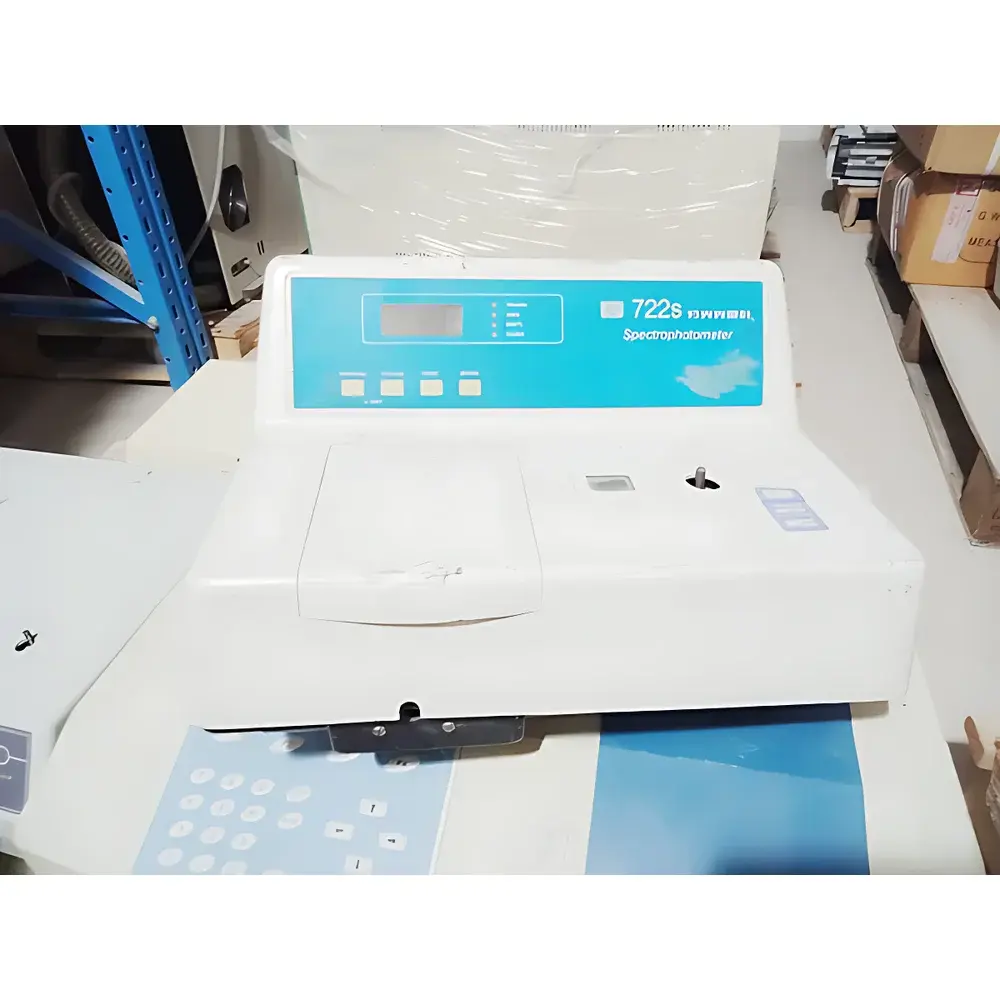
Shanghai Instrument 722S Visible Spectrophotometer
| Origin | Shanghai, China |
|---|---|
| Manufacturer Type | Authorized Distributor |
| Origin Category | Domestic (PRC) |
| Model | 722S |
| Price | USD 70 (FOB Shanghai) |
| Optical Design | Pseudo-Double-Beam |
| Detector | Photomultiplier Tube (PMT) |
| Wavelength Range | 325 nm – 1000 nm |
| Wavelength Scanning | Motorized Auto-Scanning |
| Spectral Bandwidth | 4 nm |
| Wavelength Accuracy | ±2 nm |
| Stray Light | ≤0.2% T at 360 nm |
| Absorbance Range | −0.301 A to 3.000 A |
| Absorbance Accuracy | ±0.004 A (at 1.0 A, using NIST-traceable filters) |
| Transmittance Accuracy | ±0.5% T |
| Transmittance Repeatability | ±0.2% T |
| Transmittance Range | 0.0–125.0% T |
| Concentration Display Range | 0–9999 units |
| Baseline Stability | ≤±0.003 A/h (at 500 nm, 2 h warm-up) |
| Data Interface | RS-232C serial port (ASCII protocol, 9600 bps) |
Overview
The Shanghai Instrument 722S Visible Spectrophotometer is a benchtop, pseudo-double-beam UV-Vis spectrophotometer engineered for routine quantitative and qualitative analysis in educational laboratories, quality control environments, and industrial R&D settings where visible-range absorbance measurements are required. Operating on the principle of Beer–Lambert law-based absorption spectroscopy, the instrument employs a fixed-grating monochromator with motorized wavelength drive to deliver precise, reproducible spectral data across the 325–1000 nm range. Its pseudo-double-beam architecture—achieved via time-shared single-beam optics with reference and sample beam alternation—compensates for source drift and detector instability without requiring dual optical paths, thereby balancing cost-efficiency with improved photometric stability over conventional single-beam systems. The high-gain photomultiplier tube (PMT) detector ensures excellent signal-to-noise ratio, particularly critical for low-absorbance measurements and trace-level concentration determinations.
Key Features
- Pseudo-double-beam optical design with automatic reference-sample alternation for real-time baseline correction and enhanced photometric stability
- Motorized auto-wavelength scanning system enabling programmable spectral acquisition and peak search functionality
- Fixed 4 nm spectral bandwidth optimized for resolution–sensitivity trade-off in routine visible spectroscopy applications
- NIST-traceable wavelength calibration verified at multiple points (e.g., holmium oxide, didymium filters) supporting ISO/IEC 17025-compliant verification protocols
- High-stability tungsten-halogen lamp with ≥2000-hour operational lifetime and integrated thermal management
- RS-232C serial interface compliant with ASTM E131-22 standard for digital data exchange; supports direct connection to LIMS or custom LabVIEW-based acquisition software
- Onboard memory for up to 100 method parameters including calibration curves, wavelength sets, and measurement modes (A, %T, C)
Sample Compatibility & Compliance
The 722S accommodates standard 10 mm square cuvettes (glass or quartz), as well as optional 5 mm and 20 mm pathlength cells for specialized applications such as high-concentration or turbid sample analysis. It meets key regulatory expectations for non-GMP environments, including alignment with USP guidelines for spectrophotometric system suitability testing. While not certified for 21 CFR Part 11 compliance out-of-the-box, its RS-232 output enables integration into validated workflows when paired with audit-trail-enabled host software. The instrument conforms to IEC 61010-1:2010 safety standards for laboratory electrical equipment and carries CE marking for EMC and low-voltage directive compliance.
Software & Data Management
The 722S operates autonomously via front-panel keypad navigation but is fully compatible with PC-based control via ASCII command protocol over RS-232. Standard communication commands support wavelength setting, absorbance reading, kinetic scan initiation, and calibration curve upload. Raw data export is formatted as tab-delimited ASCII files suitable for import into Excel, OriginLab, or MATLAB. Optional Windows-compatible utility software (v3.2+) provides graphical spectrum visualization, multi-point calibration (linear, polynomial), and GLP-style report generation—including operator ID, timestamp, instrument ID, and environmental conditions (ambient temperature logged externally). All exported datasets include metadata headers compliant with MIAME-like minimal information descriptors.
Applications
- Quantitative analysis of transition metal ions (e.g., Fe²⁺/Fe³⁺, Cu²⁺, Co²⁺) using d–d electronic transitions in the visible region
- Enzyme kinetics monitoring (e.g., NADH/NADPH oxidation at 340 nm) under controlled temperature conditions
- Pharmaceutical excipient identification and purity screening per EP 2.2.25 recommendations
- Water quality assessment: nitrate (302 nm), phosphate (880 nm after molybdenum blue reaction), and COD estimation
- Food industry applications including color index determination (e.g., AOAC 992.15 for tomato paste), antioxidant capacity assays (DPPH at 517 nm), and pigment quantification (chlorophyll a/b, β-carotene)
- Academic teaching labs for fundamental spectroscopy experiments, including Lambert–Beer law validation and interference studies
FAQ
Is the 722S suitable for UV-range measurements below 325 nm?
No. The optical train and PMT sensitivity profile are optimized for 325–1000 nm. For true UV capability (190–325 nm), a deuterium lamp-equipped spectrophotometer with quartz optics is required.
Can the 722S perform kinetic or time-scan measurements?
Yes—via RS-232 command triggering at user-defined intervals (minimum 1 s between readings); onboard storage does not support internal time-scan mode.
What is the recommended calibration frequency for routine QC use?
Daily verification using neutral density filters at 440 nm and 635 nm is advised; full wavelength and photometric calibration every 3 months or after lamp replacement.
Does the instrument support GLP audit trails?
Not natively—but when connected to validated third-party software with electronic signature and change-log capabilities, it satisfies core GLP data integrity requirements per OECD Principles.
Is quartz cuvette compatibility confirmed?
Yes. The 722S accepts standard 10 mm quartz cuvettes for measurements down to 325 nm; fused silica cuvettes are unnecessary given the lower wavelength limit.





