
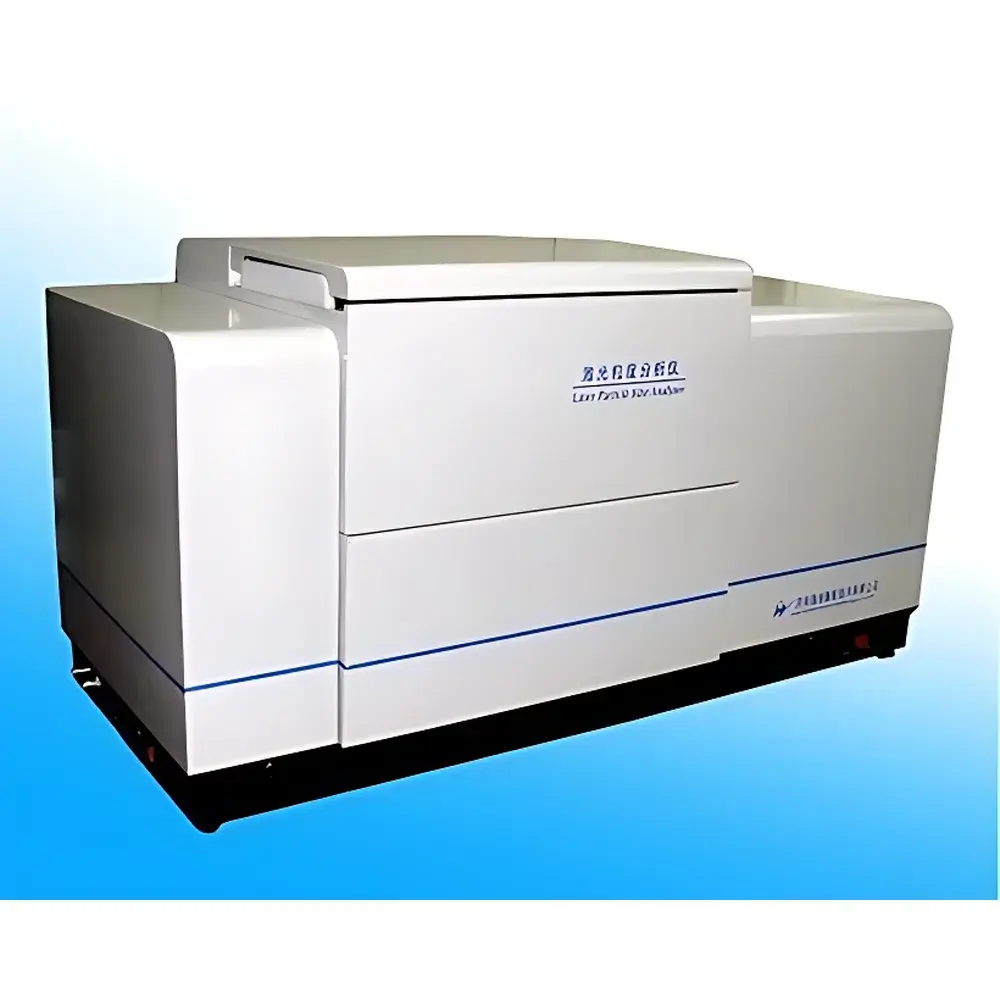
JK-JG7000 Laser Particle Size Analyzer (Refurbished)
| Brand | Jingke Ruida (Kyocera-associated distribution channel) |
|---|---|
| Origin | Beijing, China |
| Model | JK-JG7000 |
| Dispersion Method | Wet Dispersion |
| Measurement Range | 0.01–780 µm |
| Repeatability | <0.5% (D50 of NIST-traceable standard reference materials) |
| Laser Source | He-Ne laser (632.8 nm, >2 mW) + auxiliary diode laser (650 nm, >2 mW) |
| Detector Channels | 77 |
| Compliance | ISO 13320:2020, GB/T 19077–2016, Q/0100JWN001–2013 |
| Ultrasonic Dispersion | 40 kHz, 35 W |
| Stirring Speed | 0–3000 rpm (adjustable) |
| Circulation Flow Rate | 8 L/min |
| Sample Cell Volume | 350 mL |
| Auto-alignment | Four-phase hybrid stepper motor system |
| Analysis Modes | Free distribution, Rosin-Rammler, log-normal, and sieve-based grading |
| Output Formats | BMP, TXT, DOCX, XLSX |
| Software Interface | English & Chinese (localization-ready) |
Overview
The JK-JG7000 Laser Particle Size Analyzer (refurbished unit) is a fully automated wet-dispersion instrument engineered for high-fidelity particle size distribution (PSD) analysis across broad dynamic ranges—from sub-100 nm colloidal suspensions to coarse powders up to 780 µm. It operates on the principle of Mie scattering theory, supported by convergent-beam Fourier transform optical architecture. This design eliminates angular limitations imposed by conventional lens apertures and enables full-scattering-angle detection via an integrated array of 77 photodetectors—including forward, side, and backward angular sectors—thereby enhancing sensitivity to fine and ultrafine particles while preserving resolution across multimodal distributions. The system employs dual-laser illumination (He-Ne at 632.8 nm and auxiliary red diode at 650 nm), ensuring stable coherence and minimized noise in low-intensity scattering regimes typical of dilute or weakly scattering samples.
Key Features
- Convergent-beam Fourier transform optical path with extended angular coverage (0.01°–140°), optimized for accurate submicron quantification and wide-range PSD reconstruction.
- Automated alignment system driven by a four-phase hybrid stepper motor, performing real-time optical centering without manual intervention—critical for long-term measurement stability and inter-laboratory reproducibility.
- Integrated wet dispersion module combining programmable ultrasonication (40 kHz, 35 W, ≥1 s pulse control), variable-speed mechanical stirring (0–3000 rpm), and electromagnetic circulation pump (8 L/min flow rate), ensuring homogeneous suspension of polydisperse samples prior to measurement.
- Advanced inverse algorithm based on unconstrained non-negative least-squares fitting, enabling robust resolution of arbitrary particle size distributions without preset assumptions about shape or symmetry.
- Comprehensive software suite supporting volume-weighted, number-weighted, and surface-area-weighted distribution outputs; compliant with ISO 13320:2020 requirements for reporting uncertainty and repeatability metrics.
- Full audit trail capability with timestamped parameter logging, user-access-level controls, and exportable raw scattering data—facilitating GLP/GMP-aligned validation protocols and FDA 21 CFR Part 11 readiness when deployed with appropriate IT infrastructure.
Sample Compatibility & Compliance
The JK-JG7000 accommodates aqueous and organic suspensions across diverse industrial and research domains—including pharmaceutical excipients, ceramic slurries, catalyst powders, mineral fillers, pigment dispersions, food-grade starches, and biological particulates (e.g., cell aggregates, spores). Its wet-cell configuration (350 mL capacity) supports both batch and recirculating measurement modes. Calibration is traceable to NIST-certified silica and polystyrene latex standards spanning 0.05 µm to 100 µm, validated per ISO 13320:2020 Annex B. Instrument performance verification includes repeatability testing (<0.5% RSD on D50 of SRM 1963) and linearity assessment across its full 0.01–780 µm range. Regulatory documentation aligns with GB/T 19077–2016 (equivalent to ISO 13320) and internal quality standard Q/0100JWN001–2013.
Software & Data Management
The embedded Windows-based analytical software provides dual-language UI (English/Chinese), customizable report templates, and granular control over measurement parameters—including sonication duration, stir speed ramp profiles, and refractive index inputs for Mie modeling. Raw intensity data (77-channel detector array) are stored in binary format with metadata tagging (operator ID, date/time stamp, sample ID, dispersion settings). Export options include vectorized histograms (BMP), tabular summaries (TXT), editable reports (DOCX), and spreadsheet-ready datasets (XLSX). Statistical comparison tools allow overlay and quantitative delta analysis between up to eight independent runs—essential for QC trending, batch release evaluation, or process change impact assessment. All software modules undergo version-controlled revision management, with firmware and application updates delivered via secure authenticated channels.
Applications
This analyzer serves as a primary PSD characterization tool in quality control laboratories for cementitious materials (e.g., fineness of Portland cement per ASTM C114), pharmaceutical dry powder inhalers (DPIs) requiring aerodynamic particle size assessment, pigment manufacturing (TiO₂, carbon black), battery electrode slurry development (anode/cathode active material sizing), and environmental monitoring (sediment grain-size classification per USGS protocols). Its ability to resolve bimodal or trimodal distributions makes it particularly suitable for evaluating milling efficiency, classifying spray-dried microspheres, or characterizing agglomerate breakage behavior under shear.
FAQ
Is this a factory-refurbished unit or a used instrument with third-party service history?
This JK-JG7000 unit has undergone full OEM-level refurbishment including optical recalibration, fluidic system replacement, laser power verification, and software reinstallation—documented in a certified refurbishment certificate.
Does the system include valid calibration certificates traceable to national standards?
Yes—each unit ships with a full calibration report referencing NIST-traceable SRMs (1963, 1979, and 2800 series), performed immediately prior to shipment.
Can the instrument be validated for GMP-regulated environments?
The hardware and software architecture support IQ/OQ/PQ execution; however, final validation must be conducted by the end-user’s qualified personnel using site-specific protocols aligned with Annex 11 and 21 CFR Part 11 expectations.
What maintenance intervals are recommended for sustained accuracy?
Optical alignment verification every 6 months; fluidic component inspection (pump seals, tubing, cell gasket) every 12 months; annual full metrological recalibration recommended.
Is remote technical support available for international users?
Yes—diagnostic assistance, software troubleshooting, and method optimization guidance are provided via secure remote desktop sessions and encrypted file transfer, with response SLA defined per support contract tier.



