
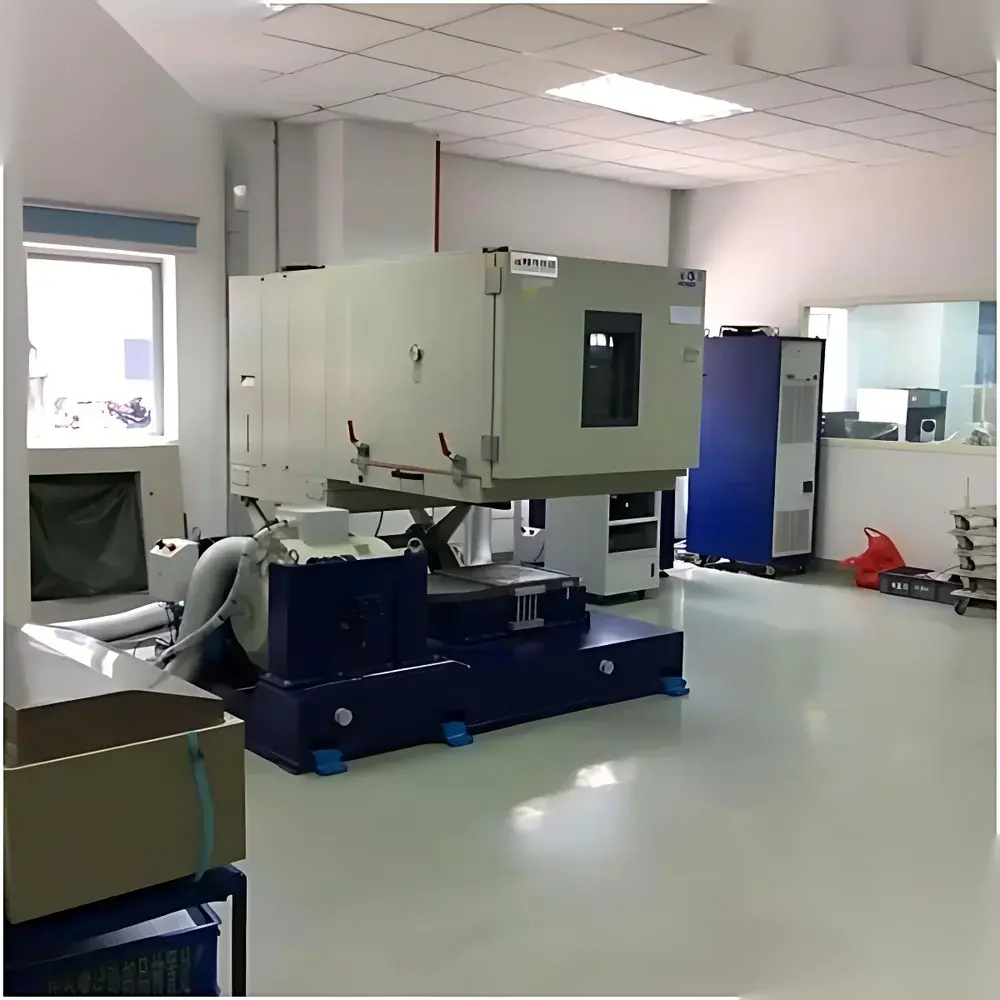
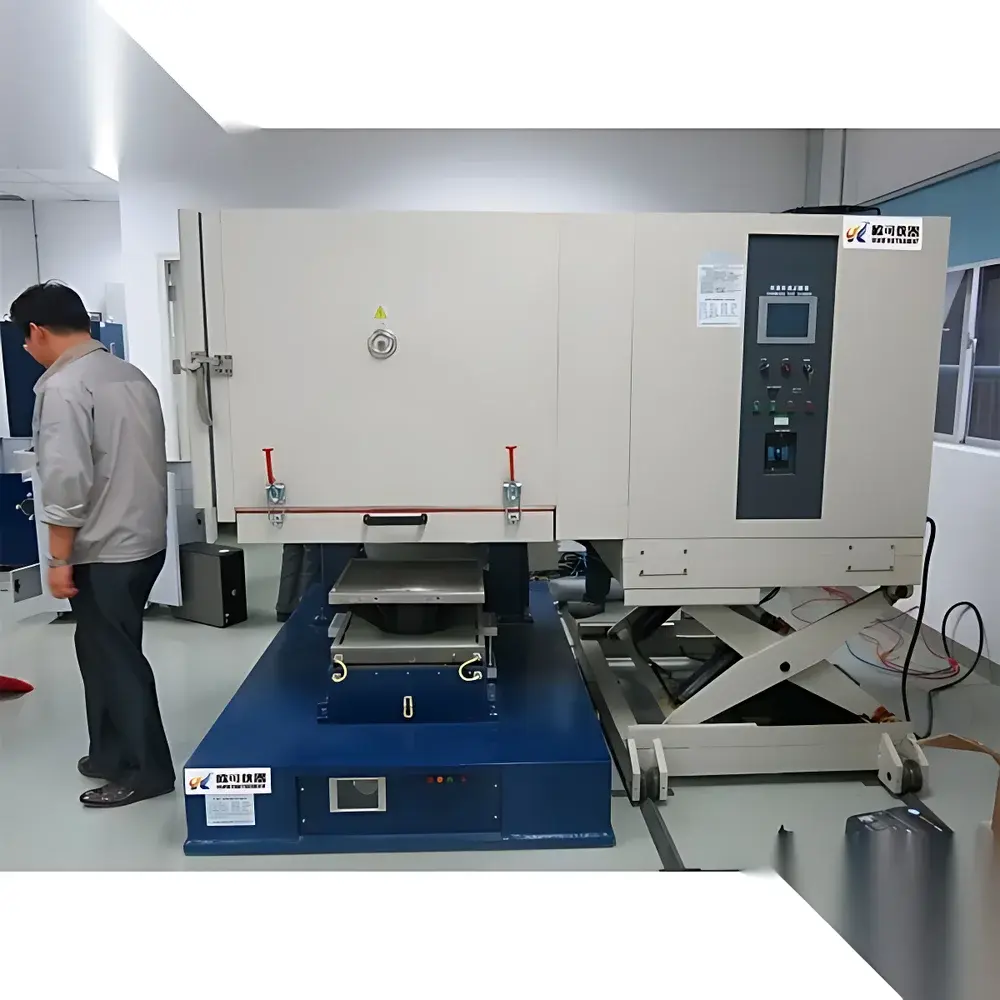
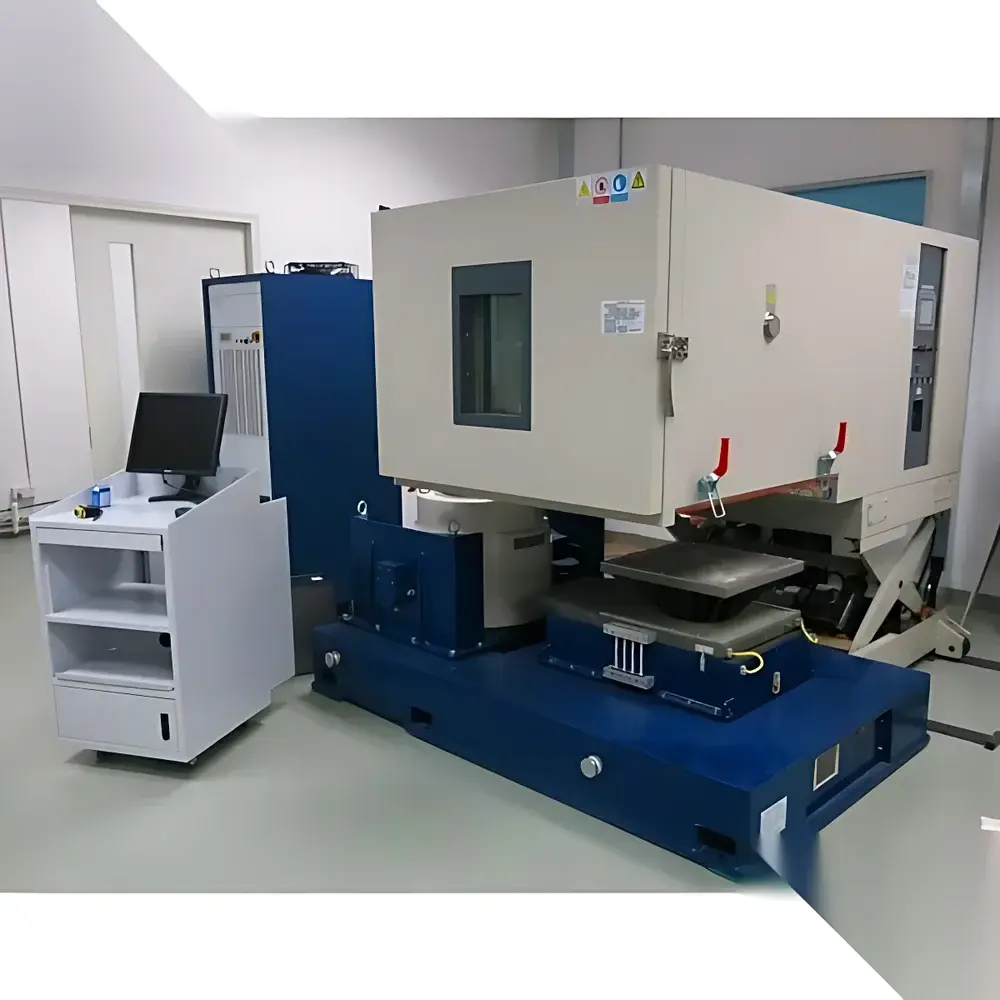
Combined Environmental Test System for Temperature, Humidity and Vibration
| Key | Temperature Range: −70 °C to +150 °C |
|---|---|
| Humidity Range | 20–98% RH |
| Temp. Uniformity | ≤ ±2.0 °C |
| Temp. Stability | ≤ ±0.5 °C |
| Humidity Stability | +2/−3% RH |
| Cooling Rate (unloaded) | 0.7–1.0 °C/min |
| Heating Rate (unloaded) | 1.0–3.0 °C/min |
| Vibration Type | Electromagnetic Shaker |
| Frequency Range | 2–500 Hz |
| Displacement Amplitude | 0–5 mm |
| Acceleration Range | 0–20 g |
| Compliance | GB/T 2423.1, GB/T 2423.2, GB/T 2423.3, GB/T 2423.10, GB/T 2423.48, GB/T 2423.49, GB 10586, GB 10589, GB 10592, GB 11158, GB/T 5170.2, GB/T 5170.5 |
Overview
The Combined Environmental Test System for Temperature, Humidity and Vibration is an integrated tri-axial environmental simulation platform engineered for concurrent or sequential exposure of test specimens to controlled thermal, hygric, and mechanical stress conditions. It operates on the principle of synchronized chamber conditioning and electromagnetic vibration excitation—enabling precise replication of real-world service environments where temperature cycling, humidity loading, and dynamic mechanical loads co-occur. This system is designed to meet the stringent requirements of reliability engineering, accelerated life testing, and qualification validation across aerospace, automotive, defense, electronics, and energy sectors. Unlike standalone chambers or shakers, this configuration ensures traceable phase alignment between thermal transients and vibratory inputs—critical for evaluating solder joint fatigue, material delamination, seal integrity, and PCB-level resonance under combined stress.
Key Features
- Triple-stress integration: Simultaneous control of temperature (−70 °C to +150 °C), relative humidity (20–98% RH), and broadband electromagnetic vibration (2–500 Hz).
- High-fidelity thermal performance: Temperature uniformity ≤ ±2.0 °C and stability ≤ ±0.5 °C across working volume; humidity stability maintained within +2/−3% RH tolerance.
- Dynamic vibration capability: Programmable displacement amplitude (0–5 mm peak-to-peak) and acceleration range (0–20 g RMS), supporting sine, random, and shock profile execution.
- Modular architecture: Interlocked chamber and shaker subsystems with ISO 13374-compliant mechanical interface, enabling rapid reconfiguration for vertical or horizontal vibration orientation.
- Robust insulation and condensation management: Multi-layer vacuum-insulated walls, stainless-steel interior, and integrated dehumidification bypass to prevent frost accumulation during low-temperature/humidity transitions.
- Real-time synchronization: Hardware-triggered data acquisition interface compliant with IEEE 1588 PTP for sub-millisecond temporal alignment between environmental setpoints and vibration waveform generation.
Sample Compatibility & Compliance
The system accommodates test articles up to 150 kg mass and 600 × 600 × 600 mm³ dimensions (customizable). It supports standard mounting configurations including threaded inserts, inertia blocks, and isolation plates compatible with MIL-STD-810H, RTCA DO-160G, and IEC 60068-2 test sequences. All operational parameters adhere to national and international standards including GB/T 2423 series (China), ISO 16750-4 (road vehicles), ASTM D471 (rubber resistance), and IEC 60068-2-64 (random vibration). Calibration protocols follow GB/T 5170.2 (temperature) and GB/T 5170.5 (humidity), with optional NIST-traceable certification available per customer request.
Software & Data Management
Control and monitoring are performed via a Windows-based HMI with deterministic real-time kernel (RTOS-integrated), supporting multi-channel logging at ≥100 Hz sampling rate. The software enables script-driven test sequencing (e.g., MIL-STD-810H Method 514.7, Annex C), automatic pass/fail evaluation against user-defined thresholds, and export of time-synchronized datasets in CSV, HDF5, and UFF58 formats. Audit trail functionality complies with GLP and GMP principles—including electronic signatures, change history, and 21 CFR Part 11–ready user access controls. Remote diagnostics and firmware updates are supported over TLS-secured Ethernet or optional cellular gateway.
Applications
- Qualification of avionics modules under thermal-vibrational stress per DO-160G Section 20.
- Validation of battery pack structural integrity during charge/discharge cycles under variable humidity and road-spectrum vibration.
- Evaluation of MEMS sensor drift under combined thermal gradient and resonant frequency sweep.
- Accelerated corrosion testing of coated metallic components using cyclic damp heat + vibration per ISO 9227 and ASTM B117.
- Reliability screening of automotive ECUs subjected to temperature ramping while exposed to random vibration profiles mimicking chassis dynamics.
- Material compatibility assessment for seals, gaskets, and potting compounds under simultaneous thermal cycling and mechanical strain.
FAQ
What standards does this system support for automotive qualification?
It fully implements ISO 16750-4 (mechanical loads), ISO 16750-2 (climatic loads), and SAE J2380 for combined environment testing—enabling direct correlation with OEM-specific validation plans.
Can the system perform HALT or HASS protocols?
Yes—when configured with optional high-gradient thermal modules and extended vibration bandwidth (up to 2 kHz), it supports step-stress and limit testing per EIA-470B and JEDEC JESD22-A104 guidelines.
Is remote operation and data export supported?
The system includes secure remote access via HTTPS-enabled web interface, real-time telemetry streaming over MQTT, and automated report generation with configurable templates in PDF or Excel format.
How is calibration traceability maintained?
All sensors are calibrated annually against NIST-traceable references; certificate documentation includes uncertainty budgets per ISO/IEC 17025 and is archived within the system’s audit log module.
What safety interlocks are implemented?
Dual-channel hardware safety circuitry monitors chamber door status, over-temperature, over-humidity, vibration over-acceleration, and emergency stop activation—complying with EN 60204-1 and GB 5226.1.



